



PPAR gamma Antibody (YA5149)
(Synonyms: PPARG; NR1C3; Peroxisome proliferator-activated receptor gamma; PPAR-gamma; Nuclear receptor subfamily 1 group C member 3)
Based on 1 Customer Validation
PPAR gamma Antibody (YA5149) is a Mouse-derived and non-conjugated monoclonal antibody, targeting to PPAR gamma.
-
Host:
Mouse
-
Application:
WB, ICC/IF
-
Reactivity :
Human, Mouse, Rat, Bovine, Dog, Goat, Pig, Rabbit, Sheep
-
Formulation:
Supplied in PBS containing 50% glycerol, 0.5% BSA and 0.02% sodium azide.
-
Conjugation:
Non-conjugated


To place orders, for customer services and technical support, please contact: MedChemExpress USA
Tel: 609-228-6898 E-mail: [email protected] [email protected]





Applications
| Application |
WB

WB: Western Blot
|
ICC/IF
ICC/IF: Immunocytochemistry/
Immunofluorescence |
|---|---|---|
| Dilution Ratio | 1:1000-1:2000 | 1:100-1:500 |


Product Details
PPAR gamma Antibody (YA5149) is a Mouse-derived and non-conjugated monoclonal antibody, targeting to PPAR gamma.
-
Host Mouse

-
Clonality Monoclonal

-
Species ReactivityHuman, Mouse, Rat, Bovine, Dog, Goat, Pig, Rabbit, Sheep
-
Calculated Molecular Weight Predicted band size: 58 kDa;

Purified recombinant human PPAR-γ (C-terminus) protein fragments expressed in E.coli.
affinity purified.
Non-conjugated
Unmodified


Product Properties
-
Appearance
Liquid
-
Formulation
Supplied in PBS containing 50% glycerol, 0.5% BSA and 0.02% sodium azide.
-
Concentration
Batch-dependent, Please check the COA for the concentration of each lot. Check Lot Concentration
-
Storage & Stability
Stored at -20°C for 1 year. Avoid repeated freeze / thaw cycles.
-
Shipping
Shipping with blue ice.


Verification Images
-
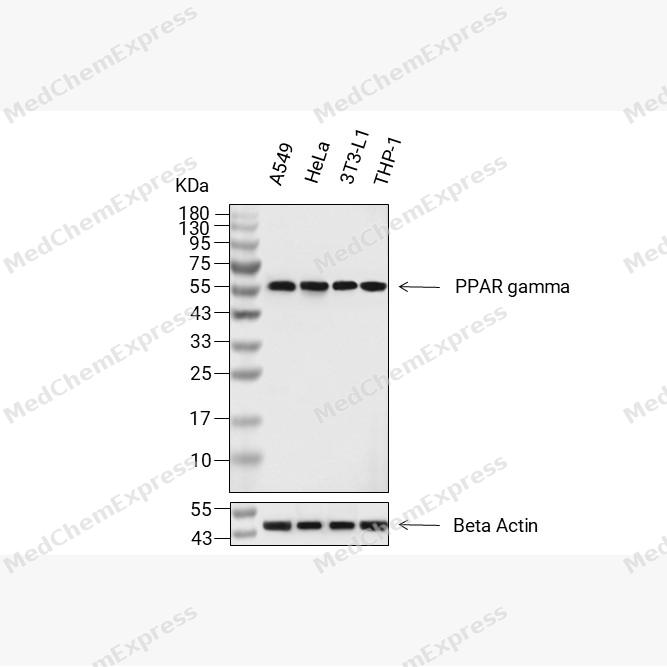 Western blot analysis of extracts from A549(lane 2(20μg), HeLa(lane 3(20μg), 3T3-L1(lane 4(20μg), THP-1(lane 5(20μg) using PPAR gamma Antibody (HY-P85457). Proteins were transferred to a PVDF membrane and blocked with 5% non-fat milk in TBST for 2 hours at room temperature. The primary antibody (1/1000) and Loading control antibody (Beta Actin, HY-P80993, 1/10,000) was used in 5% non-fat milk in TBST at 4°C overnight. Goat Anti-Mouse IgG-HRP Secondary Antibody (HY-P8004, 1/10,000) was used for 1 hour at room temperature.
 -
 Immunocytochemistry analysis of Hela cells labeling PPAR gamma with PPAR gamma Antibody (HY-P85457) at 1/200 dilution. Cells were fixed in 4% paraformaldehyde for 15 minutes at room temperature, permeabilized with 0.1% Triton X-100 in PBS for 15 minutes at room temperature, then blocked with quick block buffer for 10 minutes at room temperature. Cells were then incubated with PPAR gamma Antibody (HY-P85457) at 1/200 dilution in quick block buffer overnight at 4 ℃.AF488-conjugated Goat Anti-Mouse IgG H&L (HY-P8005, Green) was used as the secondary antibody at 1/1,000 dilution. PBS instead of the primary antibody was used as the secondary antibody only control. The Nuclear counterstain was DAPI (Blue).
 -
 Immunocytochemistry analysis of NIH-3T3 cells labeling PPAR gamma with PPAR gamma Antibody (HY-P85457) at 1/200 dilution. Cells were fixed in 4% paraformaldehyde for 15 minutes at room temperature, permeabilized with 0.1% Triton X-100 in PBS for 15 minutes at room temperature, then blocked with quick block buffer for 10 minutes at room temperature. Cells were then incubated with PPAR gamma Antibody (HY-P85457) at 1/200 dilution in quick block buffer overnight at 4 ℃.AF488-conjugated Goat Anti-Mouse IgG H&L (HY-P8005, Green) was used as the secondary antibody at 1/1,000 dilution. PBS instead of the primary antibody was used as the secondary antibody only control. The Nuclear counterstain was DAPI (Blue).


Background
-
Function
PPAR gamma is a Nuclear receptor that binds peroxisome proliferators such as hypolipidemic drugs and fatty acids. Once activated by a ligand, the nuclear receptor binds to DNA specific PPAR response elements (PPRE) and modulates the transcription of its target genes, such as acyl-CoA oxidase. It therefore controls the peroxisomal beta-oxidation pathway of fatty acids. Key regulator of adipocyte differentiation and glucose homeostasis. ARF6 acts as a key regulator of the tissue-specific adipocyte P2 (aP2) enhancer. Acts as a critical regulator of gut homeostasis by suppressing NF-kappa-B-mediated pro-inflammatory responses. Plays a role in the regulation of cardiovascular circadian rhythms by regulating the transcription of BMAL1 in the blood vessels; (Microbial infection) Upon treatment with M.tuberculosis or its lipoprotein LpqH, phosphorylation of MAPK p38 and IL-6 production are modulated, probably via this protein
-
Subcellular Localization
Nucleus; Cytoplasm
-
Expression
Tissue_specificity:It is expressed most highly in adipose tissue. It is expressed at lower levels in skeletal muscle, spleen, heart, and liver. It can also be detected in the placenta, lungs, and ovaries.
Induction: (Microbial infection) Expression increases when incubated with M.tuberculosis or its lipoprotein LpqH; induction is TLR2-dependent (at protein level) -
Isoforms & Post-Translational Modification
P37231 has 3 isomers: P37231-1: 57620 Da (predicted); P37231-2: 54681 Da (predicted); P37231-3: 21580 Da (predicted).
O-GlcNAcylation at Thr-84 reduces transcriptional activity in adipocytes;Phosphorylated in basal conditions and dephosphorylated when treated with the ligand. May be dephosphorylated by PPP5C. The phosphorylated form may be inactive and dephosphorylation at Ser-112 induces adipogenic activity (By similarity);Ubiquitinated by E3 ubiquitin-protein ligase complex containing FBXO9; leading to proteasomal degradation (By similarity). Ubiquitinated at Lys-252 by TRIM55 leading to proteasomal degradation (PubMed:36737649). Ubiquitinated by E3 ubiquitin-protein ligase STUB1/CHIP; leading to proteasomal degradation (By similarity) -
Subunit
Interacts with FOXO1 (acetylated form) (By similarity). Heterodimer with other nuclear receptors, such as RXRA. The heterodimer with the retinoic acid receptor RXRA is called adipocyte-specific transcription factor ARF6. Interacts with NCOA6 coactivator, leading to a strong increase in transcription of target genes. Interacts with coactivator PPARBP, leading to a mild increase in transcription of target genes. Interacts with NOCA7 in a ligand-inducible manner. Interacts with NCOA1 and NCOA2 LXXLL motifs. Interacts with ASXL1, ASXL2, DNTTIP2, FAM120B, MAP2K1/MEK1, NR0B2, PDPK1, PRDM16, PRMT2 and TGFB1I1. Interacts (when activated by agonist) with PPP5C. Interacts with HELZ2 and THRAP3; the interaction stimulates the transcriptional activity of PPARG. Interacts with PER2, the interaction is ligand dependent and blocks PPARG recruitment to target promoters. Interacts with NOCT. Interacts with ACTN4. Interacts (when in the liganded conformation) with GPS2 (By similarity). Interacts with CRY1 and CRY2 in a ligand-dependent manner (By similarity). In the absence of hormonal ligand, interacts with TACC1 (PubMed:20078863). In macrophages, interacts with PAQR3 and STUB1; the interactions promote PPARG poylubiquitination and STUB1-mediated degradation (By similarity)
-
SwissProt ID
-
Synonyms
PPARG; NR1C3; Peroxisome proliferator-activated receptor gamma; PPAR-gamma; Nuclear receptor subfamily 1 group C member 3


Documentation
-
Data Sheet (234 KB)
-
SDS (252 KB)
- English - EN (252 KB)
- Français - FR (252 KB)
- Deutsch - DE (252 KB)
- Norwegian - NO (252 KB)
- Español - ES (252 KB)
- Swedish - SV (252 KB)
- Italian - IT (252 KB)
- Korean - KR (252 KB)
- Portuguese - PT (252 KB)
-
User Guide for Antibodies (1077 KB)

 Powered by Bioz
