



PYK2 Antibody (YA682)
(Synonyms: PTK2B; FAK2; PYK2; RAFTK; Protein-tyrosine kinase 2-beta; Calcium-dependent tyrosine kinase; CADTK; Calcium-regulated non-receptor proline-rich tyrosine kinase; Cell adhesion kinase beta; CAK-beta; CAKB; Focal adhesion kinase 2; FADK 2; Pro)Based on 1 Customer Validation
PYK2 Antibody (YA682) is a Mouse-derived and non-conjugated IgG2a monoclonal antibody, targeting to PYK2.
-
Host:
Mouse
-
Isotype:
IgG
-
Application:
WB, IHC-P
-
Reactivity :
Human
-
Formulation:
Supplied in 1*PBS (pH 7.3), 50% glycerol and 0.5% BSA. Preservative: 0.02% sodium azide.
-
Conjugation:
Non-conjugated


To place orders, for customer services and technical support, please contact: MedChemExpress USA
Tel: 609-228-6898 E-mail: [email protected] [email protected]





Applications
| Application |
WB

WB: Western Blot
|
IHC-P
IHC-P: Immunohistochemistry-Paraffin
|
|---|---|---|
| Dilution Ratio | 1:500-1:1000 | 1:50-1:100 |


Product Details
PYK2 Antibody (YA682) is a Mouse-derived and non-conjugated IgG2a monoclonal antibody, targeting to PYK2.
-
Host Mouse

-
Clonality Monoclonal

-
Species ReactivityHuman
-
Observed Molecular WeightObserved band size: 116 kDa
Note: Due to possible protein modifications or aggregation, the molecular weight should be confirmed by actual measurement, and the predicted value is for reference only.

-
Calculated Molecular Weight Predicted band size: 116 kDa

Synthetic peptide corresponding to PYK2.AA range:815-997.
Endogenous
affinity purified
Non-conjugated
Unmodified
IgG


Product Properties
-
Appearance
Solution
-
Formulation
Supplied in 1*PBS (pH 7.3), 50% glycerol and 0.5% BSA. Preservative: 0.02% sodium azide.
-
Concentration
Batch-dependent, Please check the COA for the concentration of each lot. Check Lot Concentration
-
Storage & Stability
Stored at -20°C for 1 year. Avoid repeated freeze / thaw cycles.
-
Shipping
Shipping with blue ice.


Verification Images
-
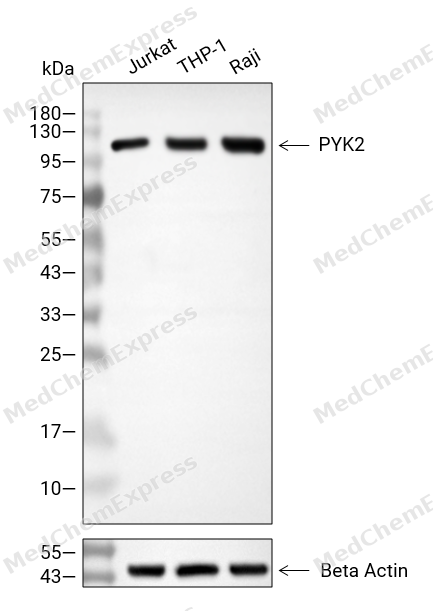 Western blot analysis of extracts from Jurkat (lane 2(20μg), THP-1 (lane 3(20μg), Raji (lane 4(20μg), using PYK2 Antibody. Proteins were transferred to a PVDF membrane and blocked with 5% BSA in TBST for 2 hour at room temperature. The primary antibody and Loading control antibody (Beta Actin, HY-P80438, 1/3000) was used in 5% BSA in TBST at 4°C overnight. Goat Anti-Mouse/Rabbit IgG-HRP Secondary Antibody (HY-P8004/HY-P8001, 1/10,000) was used for 1 hour at room temperature.


Background
-
Function
Proline-rich tyrosine kinase 2 (Pyk2) is a cytoplasmic, non-receptor tyrosine kinase implicated in multiple signaling pathways. It is a negative regulator of osteogenesis and considered a viable drug target for osteoporosis treatment.
Pyk2 and focal adhesion kinase (FAK) comprise the focal adhesion kinase subfamily of non-receptor tyrosine kinases. PYK2 and FAK are large multidomain proteins containing an N-terminal FERM domain, a central catalytic domain, and a C-terminal segment containing dual proline rich (PR) subdomains and a focal adhesion targeting (FAT) region.
Pyk2, a non-receptor tyrosine kinase of the FAK family, is up-regulated in more than 60% of the tumors of hepatocellular carcinoma (HCC) patients.
-
Subcellular Localization
Cytoplasm; Cytoplasm, perinuclear region; Cell membrane; Peripheral membrane protein; Cytoplasmic side; Cell junction, focal adhesion; Cell projection, lamellipodium; Cytoplasm, cell cortex; Nucleus
-
Expression
Tissue_specificity:It is most abundant in the brain, with the highest concentrations found in the amygdala and hippocampus. Lower concentrations (at protein levels) are found in the kidneys. It is also expressed in the spleen and lymphocytes. -
Isoforms & Post-Translational Modification
Q14289 has 2 isomers: Q14289-1: 115875 Da (predicted); Q14289-2: 111183 Da (predicted).
Phosphorylated on tyrosine residues in response to various stimuli that elevate the intracellular calcium concentration; this activation is indirect and may be mediated by production of reactive oxygen species (ROS). Tyr-402 is the major autophosphorylation site, but other kinases can also phosphorylate Tyr-402. Autophosphorylation occurs in trans, i.e. one subunit of the dimeric receptor phosphorylates tyrosine residues on the other subunit. Phosphorylation at Tyr-402 promotes interaction with SRC and SRC family members, leading to phosphorylation at Tyr-579; Tyr-580 and Tyr-881. Phosphorylation at Tyr-881 is important for interaction with GRB2. Phosphorylated on tyrosine residues upon activation of FGR and PKC. Recruitment by NPHP1 to cell matrix adhesions initiates Tyr-402 phosphorylation. In monocytes, adherence to substrata is required for tyrosine phosphorylation and kinase activation. Angiotensin II, thapsigargin and L-alpha-lysophosphatidic acid (LPA) also induce autophosphorylation and increase kinase activity. Phosphorylation by MYLK promotes ITGB2 activation and is thus essential to trigger neutrophil transmigration during lung injury. Dephosphorylated by PTPN12 -
Subunit
Homodimer, or homooligomer. Interacts with SIRPA and SH2D3C. Interacts with ARHGAP10. Interacts with DLG4 (By similarity). Interacts with KCNA2 (By similarity). Interacts with NPHP1, ASAP1, ASAP2, ARHGAP26, SKAP2 and TGFB1I1. The Tyr-402 phosphorylated form interacts with SRC (via SH2 domain) and SRC family members. Forms a signaling complex with EPHA1, LCK and phosphatidylinositol 3-kinase; upon activation by EFNA1. Interacts with GRB2 (via SH2 domain). Interacts with P53/TP53 and MDM2. Interacts with MYLK. Interacts with BCAR1. Interacts with PDPK1. Interacts (hypophosphorylated) with PXN. Interacts with RB1CC1. Interacts with RHOU. Interacts with VAV1. Interacts with LPXN and PTPN12
-
SwissProt ID
-
Synonyms
PTK2B; FAK2; PYK2; RAFTK; Protein-tyrosine kinase 2-beta; Calcium-dependent tyrosine kinase; CADTK; Calcium-regulated non-receptor proline-rich tyrosine kinase; Cell adhesion kinase beta; CAK-beta; CAKB; Focal adhesion kinase 2; FADK 2; Pro
-
Research Field
Signal Transduction


Documentation
-
Data Sheet (235 KB)
-
SDS (252 KB)
- English - EN (252 KB)
- Français - FR (252 KB)
- Deutsch - DE (252 KB)
- Norwegian - NO (252 KB)
- Español - ES (252 KB)
- Swedish - SV (252 KB)
- Italian - IT (252 KB)
- Korean - KR (252 KB)
- Portuguese - PT (252 KB)
-
User Guide for Antibodies (1077 KB)

 Powered by Bioz
