



Retinoid X Receptor alpha Antibody (YA095)
(Synonyms: NR2B1, RXRA, Retinoic acid receptor RXR-alpha, Nuclear receptor subfamily 2 group B member 1, Retinoid X receptor alpha)Based on 1 publication(s) in Google Scholar
Retinoid X Receptor alpha Antibody (YA095) is a Rabbit-derived and non-conjugated IgG monoclonal antibody, targeting to Retinoid X Receptor alpha.
-
Host:
Rabbit
-
Isotype:
IgG
-
Application:
WB, ICC/IF, IHC-P, IP
-
Reactivity :
Human, Rat
-
Formulation:
Supplied in 1*TBS (pH7.4), 0.05% BSA and 40% Glycerol. Preservative: 0.05% Sodium Azide.
-
Conjugation:
Non-conjugated


To place orders, for customer services and technical support, please contact: MedChemExpress USA
Tel: 609-228-6898 E-mail: [email protected] [email protected]



Publications Citing Use of MedChemExpress (MCE) Retinoid X Receptor alpha Antibody (YA095)
More

Applications
| Application |
WB

WB: Western Blot
|
IHC-P
IHC-P: Immunohistochemistry-Paraffin
|
ICC/IF
ICC/IF: Immunocytochemistry/
Immunofluorescence |
IP
IP: Immunoprecipitation
|
|---|---|---|---|---|
| Dilution Ratio | 1:500-1:2000 | 1:50-1:400 | 1:50 | Use at an assay dependent concentration. |


Product Details
Retinoid X Receptor alpha Antibody (YA095) is a Rabbit-derived and non-conjugated IgG monoclonal antibody, targeting to Retinoid X Receptor alpha.
-
Host Rabbit

-
Clonality Recombinant,Monoclonal

-
Species ReactivityHuman, Rat
-
Observed Molecular WeightObserved band size: 51 kDa
Note: Due to possible protein modifications or aggregation, the molecular weight should be confirmed by actual measurement, and the predicted value is for reference only.

-
Calculated Molecular Weight Predicted band size: 51 kDa

Synthetic peptide corresponding to Human Retinoid X Receptor alpha.AA range:1-50.
Endogenous
Protein A affinity purified.
Non-conjugated
Unmodified
IgG


Product Properties
-
Appearance
Solution
-
Formulation
Supplied in 1*TBS (pH7.4), 0.05% BSA and 40% Glycerol. Preservative: 0.05% Sodium Azide.
-
Concentration
Batch-dependent, Please check the COA for the concentration of each lot. Check Lot Concentration
-
Storage & Stability
Stored at -20°C for 1 year. Avoid repeated freeze / thaw cycles.
-
Shipping
Shipping with blue ice.


Publications (1)
-
Journal Impact Factor
-
Most Recent
-
Cell Rep Med
CAR-M2 immunotherapy resolves renal fibrosis via revascularization and apoptosis of profibrotic Cxcr2+ endothelial cells. [Abstract]2026 Apr 21;7(4):102698. PMID: 41887221


Verification Images
-
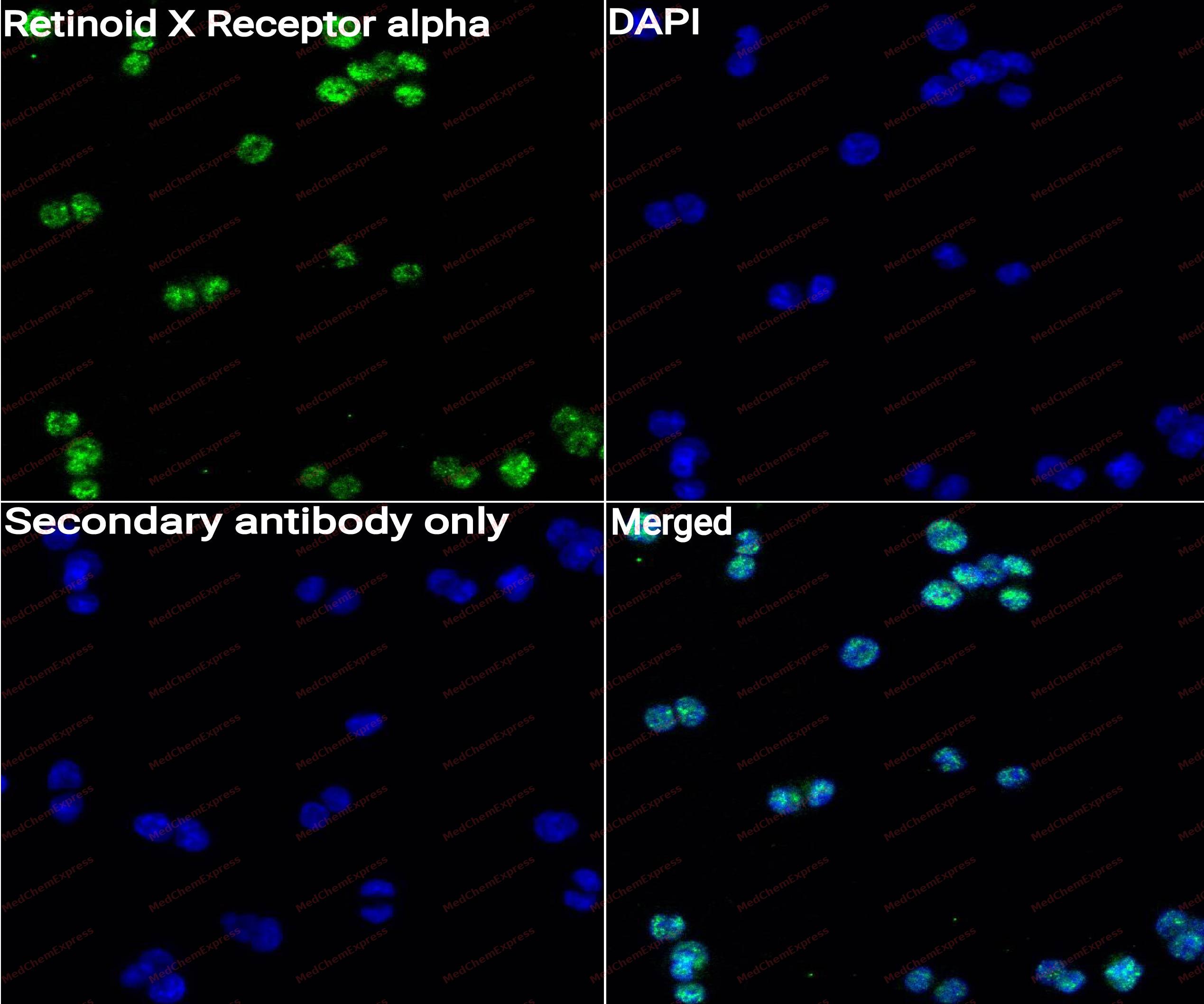 Immunocytochemistry analysis of HCT116 cells labeling Retinoid X Receptor alpha with Retinoid X Receptor alpha Antibody (HY-P80309) at 1/50 dilution. Cells were fixed in 4% paraformaldehyde for 15 minutes at room temperature, permeabilized with 0.1% Triton X-100 for 10 minutes at room temperature, then blocked with QuickBlock™ Blocking Buffer for Immunol Staining for 10 min at room temperature. Cells were then incubated with Retinoid X Receptor alpha Antibody (HY-P80309) at 1/50 dilution in QuickBlock™ Blocking Buffer for Immunol Staining at 4 ℃. Alexa Fluor® 488-conjugated AffiniPure Goat Anti-Rabbit IgG H&L(HY-P8002, Green) was used as the secondary antibody at 1/1,000 dilution. PBS instead of the primary antibody was used as the secondary antibody only control. The Nuclear counterstain was DAPI (Blue).
 -
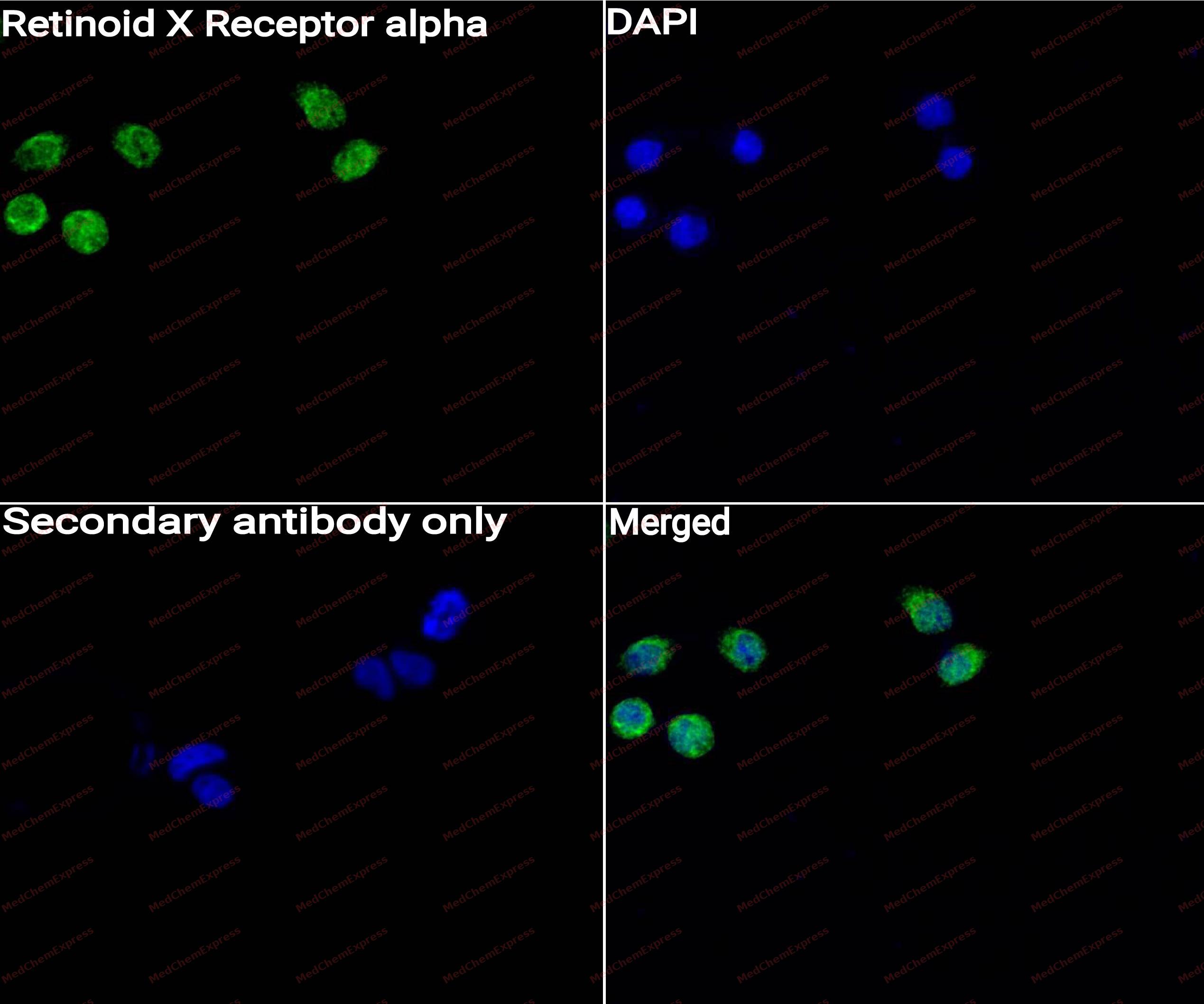 Immunocytochemistry analysis of MCF-7 cells labeling Retinoid X Receptor alpha with Retinoid X Receptor alpha Antibody (HY-P80309) at 1/50 dilution. Cells were fixed in 4% paraformaldehyde for 15 minutes at room temperature, permeabilized with 0.1% Triton X-100 for 10 minutes at room temperature, then blocked with QuickBlock™ Blocking Buffer for Immunol Staining for 10 min at room temperature. Cells were then incubated with Retinoid X Receptor alpha Antibody (HY-P80309)at 1/50 dilution in QuickBlock™ Blocking Buffer for Immunol Staining at 4 ℃. Alexa Fluor® 488-conjugated AffiniPure Goat Anti-Rabbit IgG H&L(HY-P8002,Green) was used as the secondary antibody at 1/1,000 dilution. PBS instead of the primary antibody was used as the secondary antibody only control. The Nuclear counterstain was DAPI (Blue).
 -
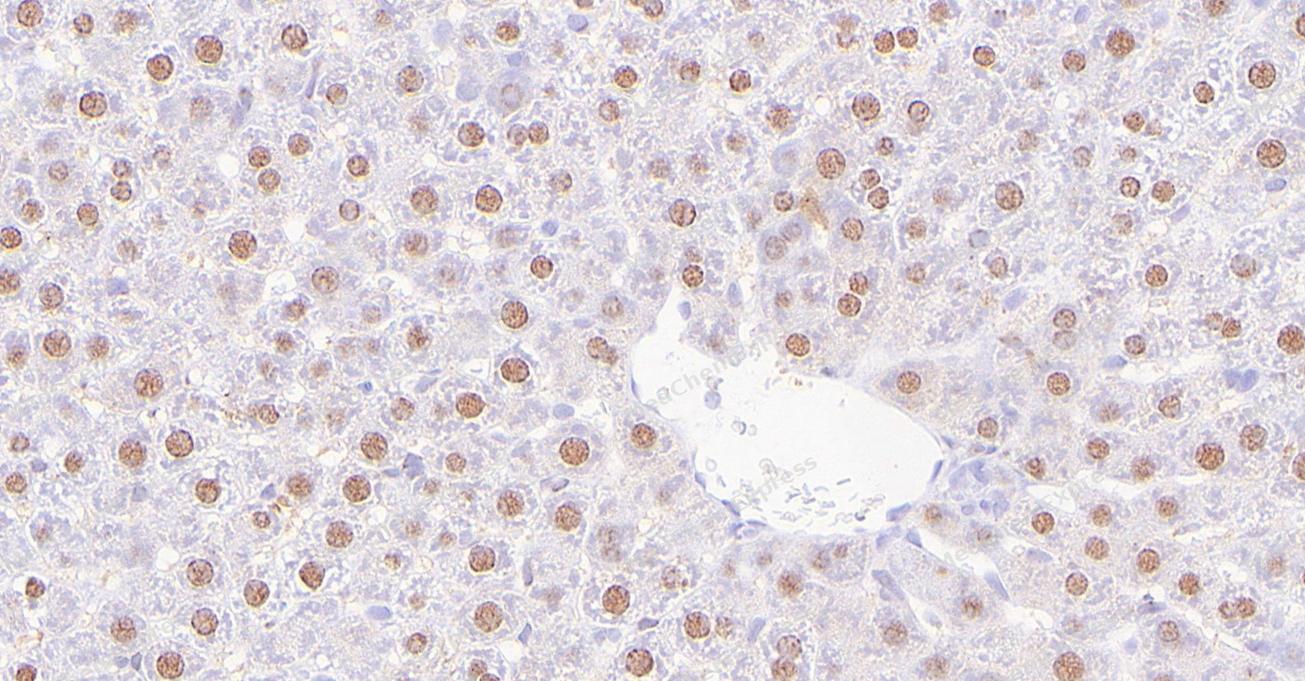 Immunohistochemical analysis of paraffin-embedded Rat liver tissue using Retinoid X Receptor alpha Antibody. The section was pre-treated using heat mediated antigen retrieval with Tris-EDTA buffer (pH 8.0) for 8 minutes. The tissues were blocked in QuickBlock for 20 minutes at room temperature, washed with ddH2O and PBS, and then probed with the primary antibody (HY-P80309, 1/200) in 4℃ overnight. The detection was performed using an HRP conjugated compact polymer system. DAB was used as the chromogen. Tissues were counterstained with hematoxylin and mounted with DPX.
 -
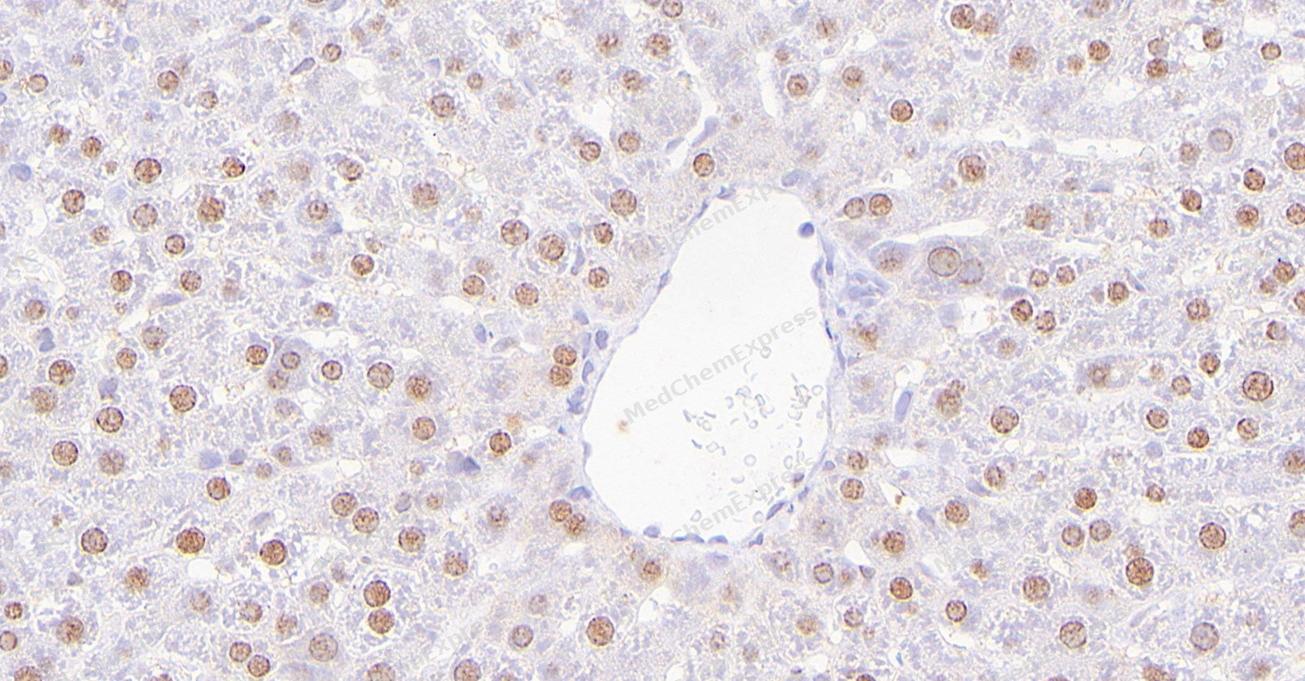 Immunohistochemical analysis of paraffin-embedded Rat liver tissue using Retinoid X Receptor alpha Antibody. The section was pre-treated using heat mediated antigen retrieval with Tris-EDTA buffer (pH 8.0) for 8 minutes. The tissues were blocked in QuickBlock for 20 minutes at room temperature, washed with ddH2O and PBS, and then probed with the primary antibody (HY-P80309, 1/200) in 4℃ overnight. The detection was performed using an HRP conjugated compact polymer system. DAB was used as the chromogen. Tissues were counterstained with hematoxylin and mounted with DPX.


Background
-
Function
The retinoid X receptor (RXR) belongs to the steroid/thyroid hormone superfamily of nuclear receptors (NRs) and includes RXRα, β, and γ (NR2B1, NR2B2 and NR2B3) . They feature a modular structure, which can be dissected in several domains with associated f
-
Subcellular Localization
Nucleus; Cytoplasm; Mitochondrion
-
Expression
Tissue_specificity:Expressed in lung fibroblasts (at protein level) (PubMed:30216632) . Expressed in monocytes (PubMed:26463675) . Highly expressed in liver, also found in kidney and brain (PubMed:14702039, PubMed:2159111, PubMed:24275569)
Induction:Down-regulated by aging (PubMed:26463675) . Induced by pulsatile shear stress (PubMed:28167758) -
Isoforms & Post-Translational Modification
P19793 has 2 isomers: P19793-1: 50811 Da (predicted); P19793-2: 41060 Da (predicted).
Acetylated by EP300; acetylation enhances DNA binding and transcriptional activity;Phosphorylated on serine and threonine residues mainly in the N-terminal modulating domain (By similarity). Constitutively phosphorylated on Ser-21 in the presence or absence of ligand (By similarity). Under stress conditions, hyperphosphorylated by activated JNK on Ser-56, Ser-70, Thr-82 and Ser-260 (By similarity). Phosphorylated on Ser-27, in vitro, by PKA (PubMed:11162439). This phosphorylation is required for repression of cAMP-mediated transcriptional activity of RARA (PubMed:11162439);Ubiquitinated by UBR5, leading to its degradation: UBR5 specifically recognizes and binds ligand-bound RXRA when it is not associated with coactivators (NCOAs) (PubMed:37478846). In presence of NCOAs, the UBR5-degron is not accessible, preventing its ubiquitination and degradation (PubMed:37478846);Sumoylation negatively regulates transcriptional activity. Desumoylated specifically by SENP6 -
Subunit
Homodimer (PubMed:10669605, PubMed:17761950). Heterodimer (via C-terminus) with RARA; required for ligand-dependent retinoic acid receptor transcriptional activity; association with RARA is enhanced by pulsatile shear stress (PubMed:10698945, PubMed:15509776, PubMed:28167758). Heterodimer with PPARA (via the leucine-like zipper in the LBD); the interaction is required for PPARA transcriptional activity (PubMed:10195690, PubMed:11698662, PubMed:11915042). Heterodimerizes with PPARG (PubMed:10882139, PubMed:11698662). Heterodimerizes (via NR LBD) with RARB (PubMed:29021580). Heterodimerizes with NR1H4; the heterodimerization enhances the binding affinity for LXXLL motifs from coactivators (PubMed:30275017). Interacts with NCOA3 and NCOA6 coactivators (PubMed:10567404, PubMed:9267036). Interacts with coactivator FAM120B (By similarity). Interacts with coactivator PELP1, SENP6, SFPQ, DNTTIP2 and RNF8 (PubMed:11259580, PubMed:14981089, PubMed:15047147, PubMed:16574651, PubMed:16912044). Interacts with PRMT2 (PubMed:12039952). Interacts with ASXL1 (By similarity). Interacts with BHLHE40/DEC1, BHLHE41/DEC2, NCOR1 and NCOR2 (PubMed:19786558). Interacts in a ligand-dependent fashion with MED1 and NCOA1 (PubMed:10882139, PubMed:11698662, PubMed:19786558). Interacts with VDR (PubMed:28698609). Interacts with EP300; the interaction is decreased by 9-cis retinoic acid (PubMed:17761950). Heterodimer (via C-terminus) with NR4A1 (via DNA-binding domain); DNA-binding of the heterodimer is enhanced by 9-cis retinoic acid (PubMed:15509776, PubMed:17761950). NR4A1 competes with EP300 for interaction with RXRA and thereby attenuates EP300 mediated acetylation of RXRA (PubMed:17761950). In the absence of hormonal ligand, interacts with TACC1 (PubMed:20078863). Interacts ith IGFBP3 (PubMed:10874028)
-
SwissProt ID
-
Synonyms
NR2B1, RXRA, Retinoic acid receptor RXR-alpha, Nuclear receptor subfamily 2 group B member 1, Retinoid X receptor alpha
-
Research Field
Epigenetics and Nuclear Signaling
Documentation
-
Data Sheet (236 KB)
-
SDS (252 KB)
- English - EN (252 KB)
- Français - FR (252 KB)
- Deutsch - DE (252 KB)
- Norwegian - NO (252 KB)
- Español - ES (252 KB)
- Swedish - SV (252 KB)
- Italian - IT (252 KB)
- Korean - KR (252 KB)
- Portuguese - PT (252 KB)
-
User Guide for Antibodies (1077 KB)

 Powered by Bioz
