



ROMO1 Antibody (YA8354)
(Synonyms: bA353C18.2; C20orf52; MTGM; MTGMP)
Based on 1 Customer Validation
ROMO1 Antibody (YA8354) is a Mouse-derived and non-conjugated IgG1 monoclonal antibody, targeting to ROMO1.
-
Host:
Mouse
-
Isotype:
IgG1
-
Application:
WB, IHC-P, ICC/IF
-
Reactivity :
Human, Mouse, Rat, Monkey, Dog
-
Formulation:
Spplied in PBS (pH 7.3) containing 1% BSA, 50% glycerol and 0.02% sodium azide.
-
Conjugation:
Non-conjugated


To place orders, for customer services and technical support, please contact: MedChemExpress USA
Tel: 609-228-6898 E-mail: [email protected] [email protected]





Applications
| Application |
WB

WB: Western Blot
|
IHC-P
IHC-P: Immunohistochemistry-Paraffin
|
ICC/IF
ICC/IF: Immunocytochemistry/
Immunofluorescence |
|---|---|---|---|
| Dilution Ratio | 1:500-2000 | 1:150-500 | 1:100-250 |


Product Details
ROMO1 Antibody (YA8354) is a Mouse-derived and non-conjugated IgG1 monoclonal antibody, targeting to ROMO1.
-
Host Mouse

-
Clonality Monoclonal

-
Species ReactivityHuman, Mouse, Rat, Monkey, Dog
-
Calculated Molecular Weight Predicted band size: 8 kDa

Full length human recombinant protein of human ROMO1 produced in HEK293T cell.
Endogenous
Affinity purified
Non-conjugated
Unmodified
IgG1


Product Properties
-
Appearance
Solution
-
Formulation
Spplied in PBS (pH 7.3) containing 1% BSA, 50% glycerol and 0.02% sodium azide.
-
Concentration
Batch-dependent, Please check the COA for the concentration of each lot. Check Lot Concentration
-
Storage & Stability
Stored at -20°C for 1 year. Avoid repeated freeze / thaw cycles.
-
Shipping
Shipping with blue ice.


Verification Images
-
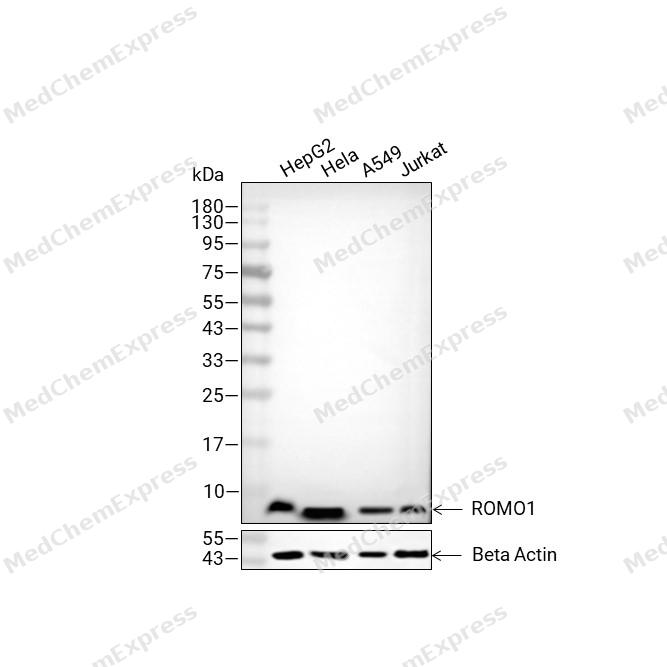 Western blot analysis of extracts from HepG2 (lane2(20μg), Hela (lane3(20μg), A549 (lane4(20μg) and Jurkat (lane5(20μg) using ROMO1 Antibody (HY-P88670). Proteins were transferred to a PVDF membrane and blocked with 5% non-fat milk in TBST for 2 hour at room temperature. The primary antibody (1/1000) and Loading control antibody (Beta Actin, HY-P80993, 1/10,000) was used in 5% non-fat milk in TBST at 4°C overnight. Goat Anti-Mouse IgG-HRP Secondary Antibody (HY-P8004 ,1/10,000) was used for 1 hour at room temperature.
 -
 Immunocytochemistry analysis of Hela cells labeling ROMO1 with ROMO1 Antibody (HY-P88670) at 1/100 dilution. Cells were fixed in 4% paraformaldehyde for 15 minutes at room temperature, permeabilized with 0.1% Triton X-100 in PBS for 15 minutes at room temperature, then blocked with quick block buffer for 10 minutes at room temperature. Cells were then incubated with ROMO1 Antibody (HY-P88670) at 1/100 dilution in quick block buffer overnight at 4 ℃.AF488-conjugated Goat Anti-Mouse IgG H&L (HY-P8005, Green) was used as the secondary antibody at 1/1,000 dilution. PBS instead of the primary antibody was used as the secondary antibody only control. The Nuclear counterstain was DAPI (Blue).
 -
 Immunocytochemistry analysis of PC-3 cells labeling ROMO1 with ROMO1 Antibody (HY-P88670) at 1/100 dilution. Cells were fixed in 4% paraformaldehyde for 15 minutes at room temperature, permeabilized with 0.1% Triton X-100 in PBS for 15 minutes at room temperature, then blocked with quick block buffer for 10 minutes at room temperature. Cells were then incubated with ROMO1 Antibody (HY-P88670) at 1/100 dilution in quick block buffer overnight at 4 ℃.AF488-conjugated Goat Anti-Mouse IgG H&L (HY-P8005, Green) was used as the secondary antibody at 1/1,000 dilution. PBS instead of the primary antibody was used as the secondary antibody only control. The Nuclear counterstain was DAPI (Blue).


Background
-
Function
ROMO1 induces production of reactive oxygen species (ROS) which are necessary for cell proliferation. May play a role in inducing oxidative DNA damage and replicative senescence. May play a role in the coordination of mitochondrial morphology and cell proliferation|Has antibacterial activity against a variety of bacteria including S.aureus, P.aeruginosa and M.tuberculosis. Acts by inducing bacterial membrane breakage
-
Subcellular Localization
Mitochondrion inner membrane
-
Expression
Tissue_Specificity: Up-regulated in a number of cancer cell lines when compared to a normal lung fibroblast cell line. Highly expressed in brain tumors
Induction: By the anticancer drug fluorouracil (5FU) -
Isoforms & Post-Translational Modification
P60602 has two isomers: P60602-1: 8183 Da (predicted); P60602-2: 5900 Da (predicted).
-
SwissProt ID
-
Synonyms
bA353C18.2; C20orf52; MTGM; MTGMP


Documentation

 Powered by Bioz
