



xCT Antibody (YA652)
(Synonyms: Cystine/glutamate transporter, Amino acid transport system xc-, Calcium channel blocker resistance protein CCBR1, Solute carrier family 7 member 11, xCT, SLC7A11)Based on 1 publication(s) in Google Scholar
xCT Antibody (YA652) is a Mouse-derived and non-conjugated IgG2b monoclonal antibody, targeting to xCT.
-
Host:
Mouse
-
Isotype:
IgG
-
Application:
WB, IHC-P, ICC/IF, FC
-
Reactivity :
Human, Mouse
-
Formulation:
Supplied in 1*PBS (pH7.4), 0.1% BSA, 40% Glycerol. Preservative: 0.05% Sodium Azide
-
Conjugation:
Non-conjugated


To place orders, for customer services and technical support, please contact: MedChemExpress USA
Tel: 609-228-6898 E-mail: [email protected] [email protected]



Publications Citing Use of MedChemExpress (MCE) xCT Antibody (YA652)
More

Applications
| Application |
WB

WB: Western Blot
|
IHC-P
IHC-P: Immunohistochemistry-Paraffin
|
ICC/IF
ICC/IF: Immunocytochemistry/
Immunofluorescence |
FC
FC: Flow Cytometry
|
|---|---|---|---|---|
| Dilution Ratio | 1:500-1:5000 | 1:600 | 1:200 | 1:500-1:1000 |


Product Details
xCT Antibody (YA652) is a Mouse-derived and non-conjugated IgG2b monoclonal antibody, targeting to xCT.
-
Host Mouse

-
Clonality Monoclonal

-
Species ReactivityHuman, Mouse
-
Observed Molecular WeightObserved band size: 55 kDa
Note: Due to possible protein modifications or aggregation, the molecular weight should be confirmed by actual measurement, and the predicted value is for reference only.

-
Calculated Molecular Weight Predicted band size: 55 kDa

Entrez Gene: 23657 Human ; 26570 Mouse ; 310392 Rat
SwissProt: Q9UPY5 Human ; Q9WTR6 Mouse ;
OMIM: 607933 Human
293 cell line overexpressing SLC7A11.
Endogenous
Protein A affinity purified.
Non-conjugated
Unmodified
IgG


Product Properties
-
Appearance
Solution
-
Formulation
Supplied in 1*PBS (pH7.4), 0.1% BSA, 40% Glycerol. Preservative: 0.05% Sodium Azide
-
Concentration
Batch-dependent, Please check the COA for the concentration of each lot. Check Lot Concentration
-
Storage & Stability
Stored at -20°C for 1 year. Avoid repeated freeze / thaw cycles.
-
Shipping
Shipping with blue ice.


Publications (1)
-
Journal Impact Factor
-
Most Recent
-
Mol Med
Lycorine ameliorates liver steatosis, oxidative stress, ferroptosis and intestinal homeostasis imbalance in MASLD mice. [Abstract]2024 Nov 27;30(1):235. PMID: 39604837


Verification Images
-
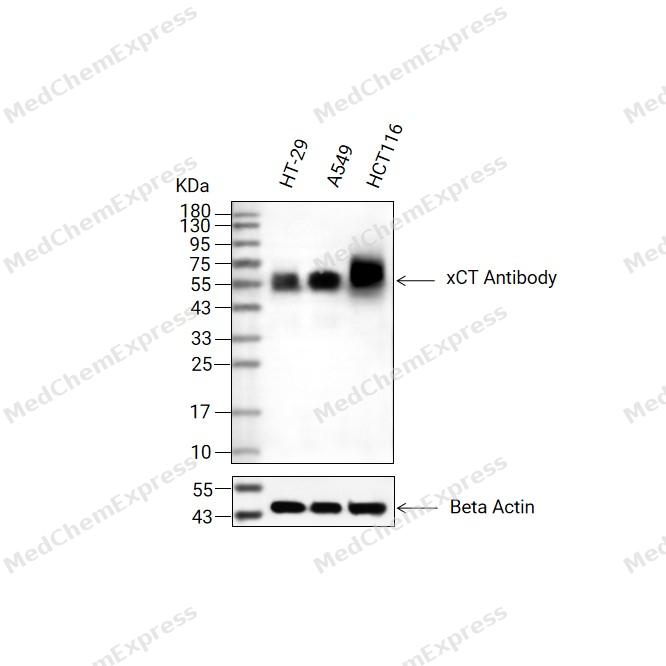 Western blot analysis of extracts from HT-29(lane 2(20ug) , A549(lane 3(20ug) and HCT116(lane 4(20ug) using xCT Antibody (HY-P80523) Mouse mAb. Proteins were transferred to a PVDF membrane and blocked with 5% non-fat milk in TBST for 2 hour at room temperature. The primary antibody (1/1000) and Loading control antibody (Beta Actin, HY-P83730, 1/10000) was used in 5% non-fat milk in TBST at 4°C overnight. Goat Anti-Mouse/Rabbit IgG-HRP Secondary Antibody (1/10000) was used for 1 hour at room temperature.
 -
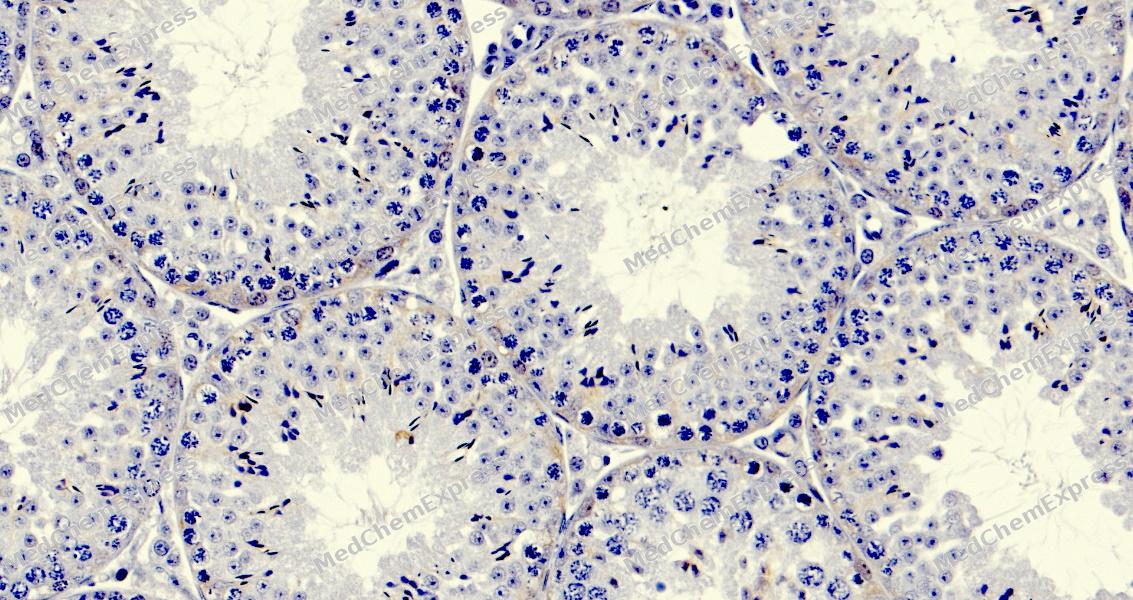 Immunohistochemical analysis of paraffin-embedded mouse testis tissue using xCT Antibody. The section was pre-treated using heat mediated antigen retrieval with sodium citrate buffer (pH 6.0) for 8 minutes. The tissues were blocked in QuickBlock for 20 minutes at room temperature, washed with ddH2O and PBS, and then probed with the primary antibody at 1/100 dilution in 4℃ overnight. The detection was performed using an HRP conjugated compact polymer system. DAB was used as the chromogen. Tissues were counterstained with hematoxylin and mounted with DPX.
 -
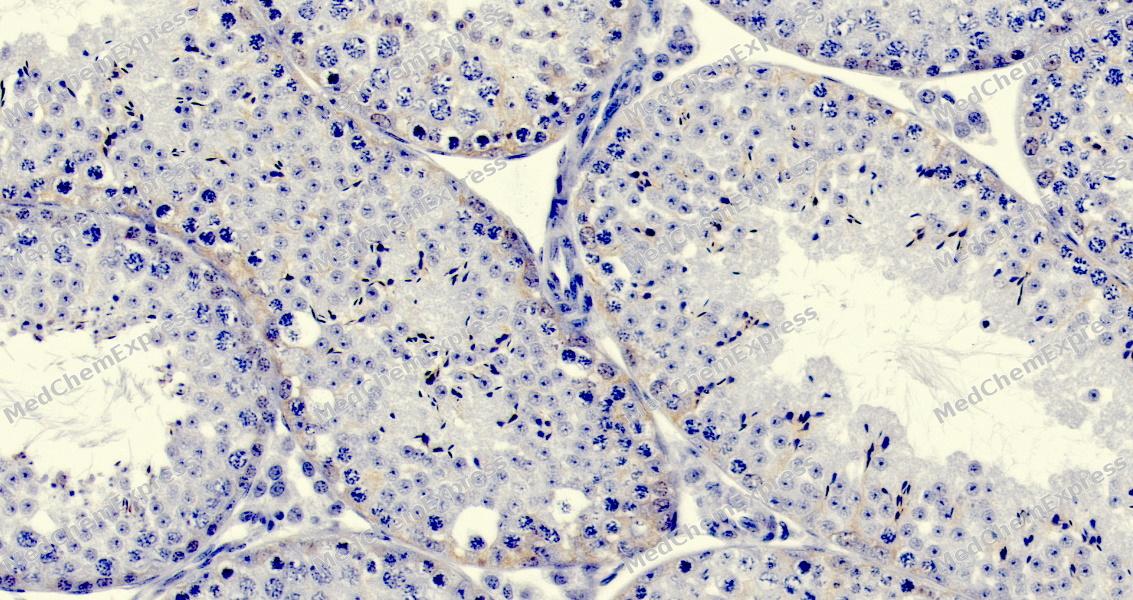 Immunohistochemical analysis of paraffin-embedded mouse testis tissue using xCT Antibody. The section was pre-treated using heat mediated antigen retrieval with sodium citrate buffer (pH 6.0) for 8 minutes. The tissues were blocked in QuickBlock for 20 minutes at room temperature, washed with ddH2O and PBS, and then probed with the primary antibody at 1/100 dilution in 4℃ overnight. The detection was performed using an HRP conjugated compact polymer system. DAB was used as the chromogen. Tissues were counterstained with hematoxylin and mounted with DPX.
 -
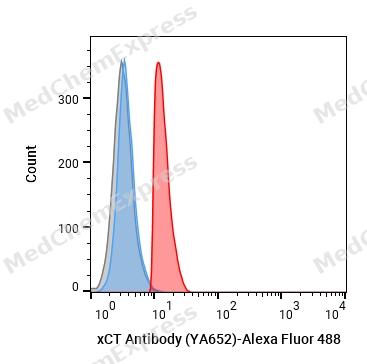 Flow cytometric analysis of 1.5X10^6 U937 cells labeling xCT Antibody (YA652) (HY-P80523, red). Cells were fixed with 4% paraformaldehyde. Then stained with the primary antibody at 1/200 dilution for an hour at 4℃. Goat Anti-Rabbit IgG H&L (AF488) (HY-P8002) was used as the secondary antibody at 1/1,000 dilution for 30 minutes at 4℃. Rabbit IgG Isotype Control (HY-P80879, blue) was used as the isotype control, cells without incubation with primary antibody were used as the unlabeled control (black).
 -
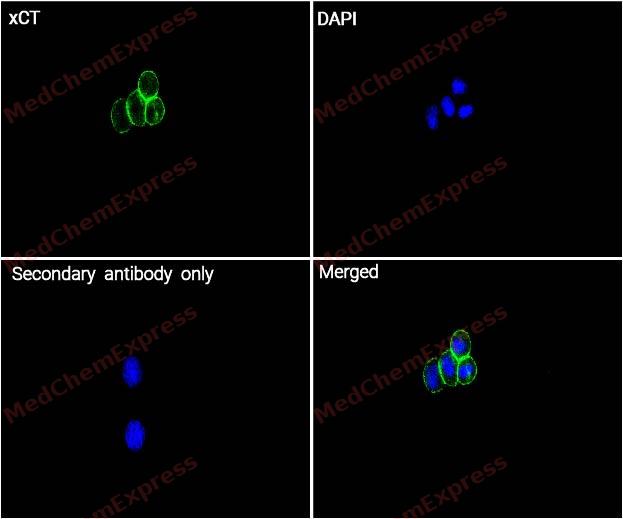 Immunocytochemistry analysis of Hela cells labeling xCT with xCT Antibody (HY-P80523) at 1/100 dilution. Cells were fixed in 4% paraformaldehyde for 15 minutes at room temperature, permeabilized with 0.1% Triton X-100 in PBS for 15 minutes at room temperature, then blocked with quick block buffer for 10 minutes at room temperature. Cells were then incubated with xCT Antibody (HY-P80523) at 1/100 dilution in quick block buffer overnight at 4 ℃. AF488-conjugated Goat Anti-Mouse IgG H&L(HY-P8005, Green) was used as the secondary antibody at 1/1,000 dilution. PBS instead of the primary antibody was used as the secondary antibody only control. The Nuclear counterstain was DAPI (Blue).
 -
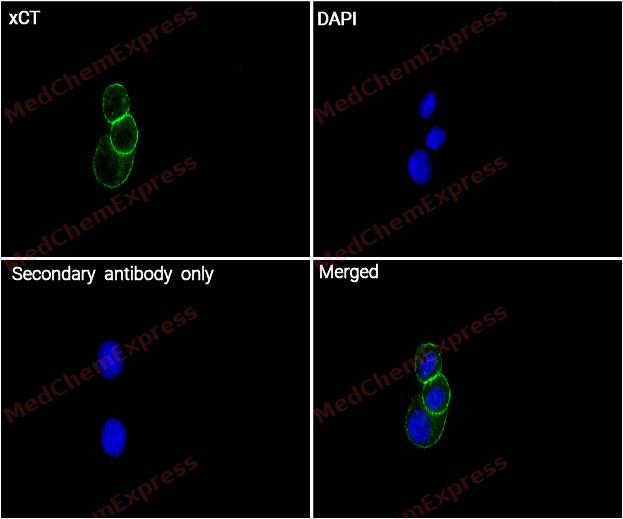 Immunocytochemistry analysis of Hela cells labeling xCT with xCT Antibody (HY-P80523) at 1/200 dilution. Cells were fixed in 4% paraformaldehyde for 15 minutes at room temperature, permeabilized with 0.1% Triton X-100 in PBS for 15 minutes at room temperature, then blocked with quick block buffer for 10 minutes at room temperature. Cells were then incubated with xCT Antibody (HY-P80523) at 1/200 dilution in quick block buffer overnight at 4 ℃. AF488-conjugated Goat Anti-Mouse IgG H&L(HY-P8005, Green) was used as the secondary antibody at 1/1,000 dilution. PBS instead of the primary antibody was used as the secondary antibody only control. The Nuclear counterstain was DAPI (Blue).


Background
-
Function
xCT is a Heterodimer with SLC3A2, that functions as an antiporter by mediating the exchange of extracellular anionic L-cystine and intracellular L-glutamate across the cellular plasma membrane. Provides L-cystine for the maintenance of the redox balance between extracellular L-cystine and L-cysteine and for the maintenance of the intracellular levels of glutathione that is essential for cells protection from oxidative stress. The transport is sodium-independent, electroneutral with a stoichiometry of 1:1, and is drove by the high intracellular concentration of L-glutamate and the intracellular reduction of L-cystine. In addition, mediates the import of L-kynurenine leading to anti-ferroptotic signaling propagation required to maintain L-cystine and glutathione homeostasis. Moreover, mediates N-acetyl-L-cysteine uptake into the placenta leading to subsequently down-regulation of pathways associated with oxidative stress, inflammation and apoptosis. In vitro can also transport L-aspartate. May participate in astrocyte and meningeal cell proliferation during development and can provide neuroprotection by promoting glutathione synthesis and delivery from non-neuronal cells such as astrocytes and meningeal cells to immature neurons. Controls the production of pheomelanin pigment directly[1][2][3][4][5][6][7][8].
-
Subcellular Localization
Cell membrane; Multi-pass membrane protein; Cell projection, microvillus membrane; Multi-pass membrane protein
-
Expression
Tissue_specificity:It is expressed in the term placenta and term primary trophoblast cells (PubMed:34120018) . It is mainly expressed in the brain, but also in the pancreas (PubMed:11417227) .
Induction:By oxygen in a concentration-dependent manner (PubMed:11213471) . Up-regulated by S-nitroso-N-acetyl-D-penicillamine (PubMed:11133847) -
Subunit
Disulfide-linked heterodimer with the amino acid transport protein SLC3A2/4F2hc; this interaction mediates cell membrane localization
-
SwissProt ID
-
Synonyms
Cystine/glutamate transporter, Amino acid transport system xc-, Calcium channel blocker resistance protein CCBR1, Solute carrier family 7 member 11, xCT, SLC7A11
-
Research Field
Signal Transduction
Documentation
-
Data Sheet (262 KB)
-
SDS (251 KB)
- English - EN (251 KB)
- Français - FR (251 KB)
- Deutsch - DE (251 KB)
- Norwegian - NO (251 KB)
- Español - ES (251 KB)
- Swedish - SV (251 KB)
- Italian - IT (251 KB)
- Korean - KR (251 KB)
- Portuguese - PT (251 KB)
-
User Guide for Antibodies (1077 KB)
References
[1]. Bridges CC, et al. Structure, function, and regulation of human cystine/glutamate transporter in retinal pigment epithelial cells. Invest Ophthalmol Vis Sci. 2001 Jan;42(1):47-54. [Content Brief]
[2]. Bassi MT, et al. Identification and characterisation of human xCT that co-expresses, with 4F2 heavy chain, the amino acid transport activity system xc-. Pflugers Arch. 2001 May;442(2):286-96. [Content Brief]
[3]. Jiménez-Vidal M, et al. Thiol modification of cysteine 327 in the eighth transmembrane domain of the light subunit xCT of the heteromeric cystine/glutamate antiporter suggests close proximity to the substrate binding site/permeation pathway. J Biol Chem. 2004 Mar 19;279(12):11214-21. [Content Brief]
[4]. Gasol E, et al. Membrane topology of system xc- light subunit reveals a re-entrant loop with substrate-restricted accessibility. J Biol Chem. 2004 Jul 23;279(30):31228-36. [Content Brief]
[5]. Parker JL, et al. Molecular basis for redox control by the human cystine/glutamate antiporter system xc(). Nat Commun. 2021 Dec 8;12(1):7147. [Content Brief]
[6]. Fiore A, et al. Kynurenine importation by SLC7A11 propagates anti-ferroptotic signaling. Mol Cell. 2022 Mar 3;82(5):920-932.e7. [Content Brief]
[7]. Yan R, et al. The structure of erastin-bound xCT-4F2hc complex reveals molecular mechanisms underlying erastin-induced ferroptosis. Cell Res. 2022 Jul;32(7):687-690. [Content Brief]
[8]. Lofthouse EM, et al. N-acetylcysteine, xCT and suppression of Maxi-chloride channel activity in human placenta. Placenta. 2021 Jul;110:46-55. [Content Brief]

 Powered by Bioz
