



Arbemnifosbuvir

Based on 1 Customer Validation
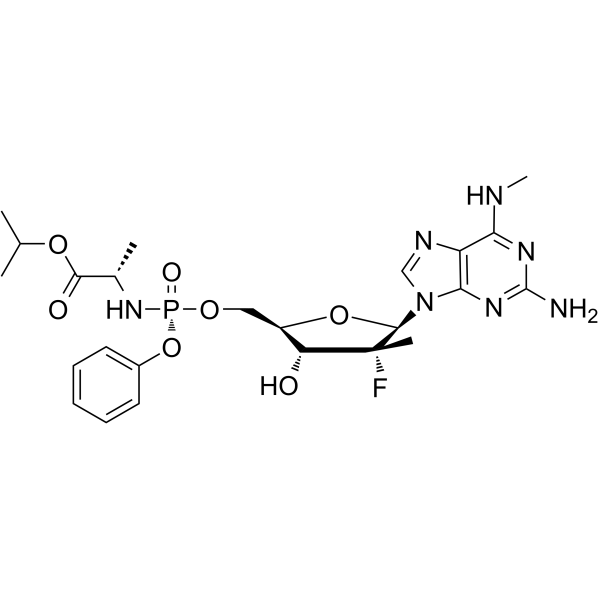
Arbemnifosbuvir (AT-752 free base) is an orally active inhibitor of DENV NS5 RdRp and MTase, and is also a guanosine nucleotide analog prodrug. Arbemnifosbuvir forms the active triphosphate metabolite AT‑9010 (HY-139165) in peripheral blood mononuclear cells, which competes with GTP to terminate RNA synthesis and binds to the GTP/RNA-cap site to inhibit 2'-O-methylation. Arbemnifosbuvir reduces viremia, improves survival, prevents weight loss, and decreases viral load in a mouse model of dengue virus. Arbemnifosbuvir can be used for research related to viral infections.
For research use only. We do not sell to patients.
- Purity : 99.40%
- CAS No.: 1998705-63-7
- Formula: C24H33FN7O7P
- Molecular Weight:581.53
-
Storage:
4°C, sealed storage, away from moisture and light
* In solvent : -80°C, 6 months; -20°C, 1 month (sealed storage, away from moisture and light)

To place orders, for customer services and technical support, please contact: MedChemExpress USA
Tel: 609-228-6898 E-mail: [email protected] [email protected]


-
 Biological Activity
-
Chemical Information
-
Solvent & Solubility
- Protocols
- Purity & Documentation
- References
-
 Help & FAQs




Biological Activity
Description
In Vitro
Arbemnifosbuvir (AT-752) was stable for up to 120 min in cynomolgus monkey and human plasma, but was highly unstable in Sprague Dawley rat plasma[1].
Arbemnifosbuvir (AT-752), corresponding to its free base AT-281, inhibits DENV1-4 reporter viruses in Huh-7 cells with an EC50 value of 0.30-0.75 µM[2].
MedChemExpress (MCE) has not independently confirmed the accuracy of these methods. They are for reference only. Further protocols information, click here.
In Vivo
MedChemExpress (MCE) has not independently confirmed the accuracy of these methods. They are for reference only.
-
Animal Model:AG129 (female; 6 to 8 weeks old; α, β, and γ interferon knockout)[1]
-
Dosage:1,000 mg/kg (4 h before challenge); 500 mg/kg (1 h postchallenge); 500 mg/kg (BID for 7 consecutive days)
-
Administration:p.o.; once 4 h before challenge, once 1 h postchallenge, BID; 7 consecutive days
-
Result:Lowered viremia on day 6 postinfection compared with vehicle group.
Cleared viremia in all AT-752 group by day 8 postinfection.
Reduced spleen viral load by day 7 postinfection compared with control.
Survived to between days 11 and 18 postinfection.
Reduced weight loss on days 5, 7, and 8 postinfection compared with vehicle group.
Improved health scores on days 4 to 9 postinfection compared with vehicle group.


Chemical Information
-
CAS No. 1998705-63-7
-
Appearance Solid
-
Molecular Weight 581.53
-
Formula C24H33FN7O7P
-
Color White to off-white
-
SMILES
C[C@@]1(F)C(O)[C@@H](CO[P@](N[C@@H](C)C(OC(C)C)=O)(OC2=CC=CC=C2)=O)O[C@H]1N3C(N=C(N)N=C4NC)=C4N=C3
-
Synonyms
AT-752 free base
-
Shipping
Room temperature in continental US; may vary elsewhere.
-
Storage
4°C, sealed storage, away from moisture and light
* In solvent : -80°C, 6 months; -20°C, 1 month (sealed storage, away from moisture and light)


Solvent & Solubility
In Vitro:
DMSO : 100 mg/mL (171.96 mM; Need ultrasonic; Hygroscopic DMSO has a significant impact on the solubility of product, please use newly opened DMSO)
Please refer to the solubility information to select the appropriate solvent. Once prepared, please aliquot and store the solution to prevent product inactivation from repeated freeze-thaw cycles.
Storage method and period of stock solution: -80°C, 6 months; -20°C, 1 month (sealed storage, away from moisture and light). When stored at -80°C, please use it within 6 months. When stored at -20°C, please use it within 1 month.
Please refer to the solubility information to select the appropriate solvent. Once prepared, please aliquot and store the solution to prevent product inactivation from repeated freeze-thaw cycles.
Storage method and period of stock solution: -80°C, 6 months; -20°C, 1 month (sealed storage, away from moisture and light). When stored at -80°C, please use it within 6 months. When stored at -20°C, please use it within 1 month.
Concentration (start) × Volume (start) = Concentration (final) × Volume (final)
In Vivo:
Select the appropriate dissolution method based on your experimental animal and administration route.
- For the following dissolution methods, please ensure to first prepare a clear stock solution using an In Vitro approach and then sequentially add co-solvents:
- To ensure reliable experimental results, the clarified stock solution can be appropriately stored based on storage conditions. As for the working solution for In Vivo experiments, it is recommended to prepare freshly and use it on the same day.
- The percentages shown for the solvents indicate their volumetric ratio in the final prepared solution. If precipitation or phase separation occurs during preparation, heat and/or sonication can be used to aid dissolution.
Add each solvent one by one: 10% DMSO 40% PEG300 5% Tween-80 45% Saline
Solubility: ≥ 2.5 mg/mL (4.30 mM); Clear solution
This protocol yields a clear solution of ≥ 2.5 mg/mL (saturation unknown).
Taking 1 mL working solution as an example, add 100 μL DMSO stock solution (25.0 mg/mL) to 400 μL PEG300, and mix evenly; then add 50 μL Tween-80 and mix evenly; then add 450 μL Saline to adjust the volume to 1 mL.
Preparation of Saline: Dissolve 0.9 g sodium chloride in ddH₂O and dilute to 100 mL to obtain a clear Saline solution.
Add each solvent one by one: 10% DMSO 90% (20% SBE-β-CD in Saline)
Solubility: ≥ 2.5 mg/mL (4.30 mM); Clear solution
This protocol yields a clear solution of ≥ 2.5 mg/mL (saturation unknown).
Taking 1 mL working solution as an example, add 100 μL DMSO stock solution (25.0 mg/mL) to 900 μL 20% SBE-β-CD in Saline, and mix evenly.
Preparation of 20% SBE-β-CD in Saline (4°C, storage for one week): 2 g SBE-β-CD powder is dissolved in 10 mL Saline, completely dissolve until clear.
In Vivo Dissolution Calculator
Please enter the basic information of animal experiments:
-
-
-
-
Recommended: Prepare an additional quantity of animals to account for potential losses during experiments.
Please enter your animal formula composition:
-
%DMSO +
Recommended: Keep the proportion of DMSO in working solution below 2% if your animal is weak.
-
%+
-
+%Tween-80 + +
-
%Saline +
The co-solvents required include: DMSO, . All of co-solvents are available by MedChemExpress (MCE). , Tween 80. All of co-solvents are available by MedChemExpress (MCE).
Working solution concentration: 0.22 mg/mL
Method for preparing stock solution: mg drug dissolved in μL DMSO. Stock solution concentration: mg/mL. * In solvent : -80°C, 6 months; -20°C, 1 month (sealed storage, away from moisture and light)
1. Take μL DMSO stock solution;
2. Add μL .
μL , mix evenly;
3. Then add μL Tween 80, mix evenly;
4. Then add μL
Please ensure that the stock solution in the first step is dissolved to a clear state, and add co-solvents in sequence. You can use ultrasonic heating (ultrasonic cleaner, recommended frequency 20-40 kHz), vortexing, etc. to assist dissolution.

Protocols
-
PBMC Thawing for Immune Assays
PBMC thawing for immune assays recovers viable cryopreserved peripheral blood mononuclear cells for downstream functional or phenotypic readouts, including ELISPOT, intracellular cytokine staining, proliferation assays, and flow-cytometric immunophenotyping. Cryopreserved PBMCs can support immune monitoring because antigen-specific T-cell function and major CD4/CD8 phenotypes may be retained after optimized freezing and thawing, although some lymphocyte subsets and activation or memory markers can be altered by cryopreservation. The technical objective is rapid warming of the frozen vial followed by controlled dilution and removal of DMSO-containing cryomedium, because thawing and wash conditions measurably affect viable PBMC recovery and downstream assay performance. Viability alone is insufficient for protocol evaluation because high viability may occur with low live-cell recovery, so both viable percentage and absolute live-cell recovery should be measured after thawing.
-
How to Choose the Right Model Animal
Choosing the right model animal is a validity-driven decision in which the species, strain, sex, age, genetic background, disease-induction method, outcome measures, and welfare burden must match the scientific question rather than laboratory tradition or convenience. A model should be selected by judging face validity, construct validity, and predictive validity: whether it resembles the human phenotype, whether it reproduces relevant mechanisms, and whether results are likely to predict human biology or treatment response. Animal studies often fail to translate because of species differences, weak disease resemblance, poor experimental design, inadequate reporting, publication bias, and underuse of randomization, blinding, and sample-size justification. Unresolved questions include how to rank competing models objectively, how much human-disease complexity must be reproduced for a given objective, and when non-animal systems such as organoids, ex vivo tissue, or computational models


Purity & Documentation
-
Data Sheet (284 KB)
-
SDS (252 KB)
- English - EN (252 KB)
- Français - FR (252 KB)
- Deutsch - DE (252 KB)
- Norwegian - NO (252 KB)
- Español - ES (252 KB)
- Swedish - SV (252 KB)
- Italian - IT (252 KB)
- Korean - KR (252 KB)
- Portuguese - PT (252 KB)
-
Handling Instructions (2659 KB)
References


Complete Stock Solution Preparation Table
Please refer to the solubility information to select the appropriate solvent. Once prepared, please aliquot and store the solution to prevent product inactivation from repeated freeze-thaw cycles.
Storage method and period of stock solution: -80°C, 6 months; -20°C, 1 month (sealed storage, away from moisture and light). When stored at -80°C, please use it within 6 months. When stored at -20°C, please use it within 1 month.
| Optional Solvent | Concentration Solvent Mass | 1 mg | 5 mg | 10 mg | 25 mg |
|---|---|---|---|---|---|
| DMSO | 1 mM | 1.7196 mL | 8.5980 mL | 17.1960 mL | 42.9900 mL |
| 5 mM | 0.3439 mL | 1.7196 mL | 3.4392 mL | 8.5980 mL | |
| 10 mM | 0.1720 mL | 0.8598 mL | 1.7196 mL | 4.2990 mL | |
| 15 mM | 0.1146 mL | 0.5732 mL | 1.1464 mL | 2.8660 mL | |
| 20 mM | 0.0860 mL | 0.4299 mL | 0.8598 mL | 2.1495 mL | |
| 25 mM | 0.0688 mL | 0.3439 mL | 0.6878 mL | 1.7196 mL | |
| 30 mM | 0.0573 mL | 0.2866 mL | 0.5732 mL | 1.4330 mL | |
| 40 mM | 0.0430 mL | 0.2150 mL | 0.4299 mL | 1.0748 mL | |
| 50 mM | 0.0344 mL | 0.1720 mL | 0.3439 mL | 0.8598 mL | |
| 60 mM | 0.0287 mL | 0.1433 mL | 0.2866 mL | 0.7165 mL | |
| 80 mM | 0.0215 mL | 0.1075 mL | 0.2150 mL | 0.5374 mL | |
| 100 mM | 0.0172 mL | 0.0860 mL | 0.1720 mL | 0.4299 mL |


Arbemnifosbuvir Related Classifications
HY-156597 Related Classifications
 Powered by Bioz