



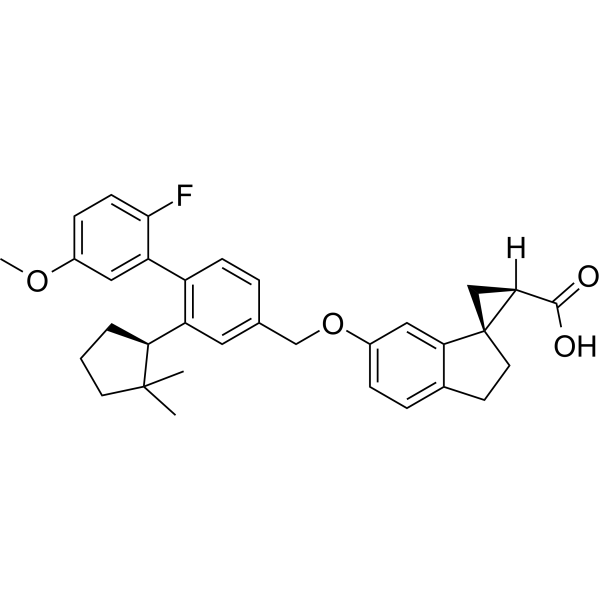
AM-5262
AM-5262 is a GPR40 full agonist with an EC50 value of 0.081 μM. AM-5262 can be used for the research of type II diabetes.
Nur für Forschungszwecke. Wir verkaufen nicht an Patienten.
- CAS. Nr.: 1222088-90-5
- Formel: C33H35FO4
- Molecular Weight:514.63
-
Speicherung:
Please store the product under the recommended conditions in the Certificate of Analysis.

To place orders, for customer services and technical support, please contact: MedChemExpress USA
Tel: 609-228-6898 E-mail: [email protected] [email protected]


-
 Biologische Aktivität
-
Chemical Information
- Protokoll
- Reinheit & Dokumentation
- Verweise
-
 Help & FAQs




Biologische Aktivität
Beschreibung
IC50 & Target
EC50: 0.081 μM (GPR40)[1]
Cellular Effect
|
Cell Line

|
Type | Value | Description | References |
|---|---|---|---|---|
| CHO | EC50 |
0.081 μM
Compound: 26, AM-5262
|
Agonist activity at human FFA1 receptor expressed in CHO cell membranes after 4 hrs by aequorin bioluminescence assay
Agonist activity at human FFA1 receptor expressed in CHO cell membranes after 4 hrs by aequorin bioluminescence assay
|
[PMID: 24900707] |
In Vitro
AM-5262 has activity for GPR40 with an EC50 value of 0.081 μM[1].
MedChemExpress (MCE) has not independently confirmed the accuracy of these methods. They are for reference only.
In Vivo
AM-5262 (0-100 μM) enhances glucose stimulated insulin secretion (mouse and human islets) and improves glucose homeostasis in vivo (OGTT in HF/STZ mice) [1].
MedChemExpress (MCE) has not independently confirmed the accuracy of these methods. They are for reference only.


Chemical Information
-
CAS. Nr. 1222088-90-5
-
Molecular Weight 514.63
-
Formel C33H35FO4
-
SMILES
COC1=CC=C(F)C(C2=C([C@@H]3CCCC3(C)C)C=C(COC4=CC=C(CC[C@]56C[C@]6(C(O)=O)[H])C5=C4)C=C2)=C1
-
Versand
Room temperature in continental US; may vary elsewhere.
-
Speicherung
Please store the product under the recommended conditions in the Certificate of Analysis.


Reinheit & Dokumentation
Verweise

Calculators
Konzentration (Stammlösung) × Volumen (Stammlösung) = Konzentration (Ziellösung) × Volumen (Ziellösung)


AM-5262 Related Classifications
HY-16619 Related Classifications
 Powered by Bioz