



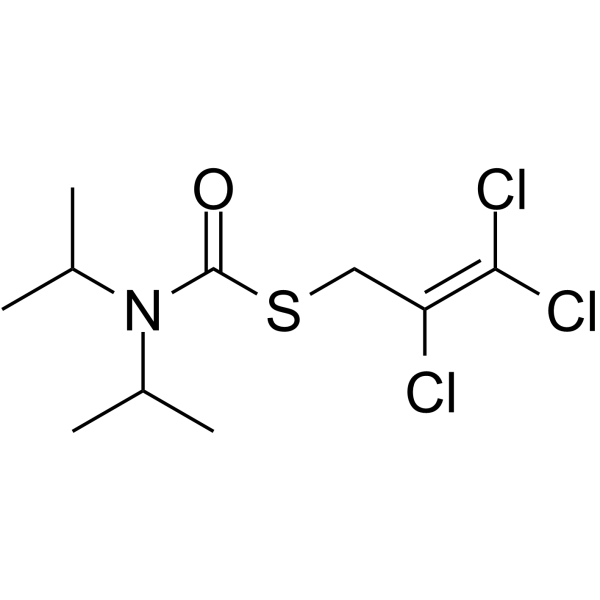
Triallate

Based on 1 Customer Validation
Triallate is a selective thiocarbamate herbicide. Triallate regulates the biosynthesis of very-long-chain fatty acids and inhibits the elongation and division of plant cells. Triallate is used to control wild oats in barley, spring wheat, durum wheat, winter wheat and sugar beets.
Nur für Forschungszwecke. Wir verkaufen nicht an Patienten.
- Reinheit : 99.02%
- CAS. Nr.: 2303-17-5
- Formel: C10H16Cl3NOS
- Molecular Weight:304.66
-
Speicherung:Pure form -20°C, 3 years , 4°C, 2 years ; In solvent -80°C, 6 months , -20°C, 1 month

To place orders, for customer services and technical support, please contact: MedChemExpress USA
Tel: 609-228-6898 E-mail: [email protected] [email protected]


-
 Biologische Aktivität
-
Chemical Information
-
Lösungsmittel & Löslichkeit
- Reinheit & Dokumentation
- Verweise
-
 Help & FAQs




Biologische Aktivität
Beschreibung
In Vitro
Triallate (12.5-400 μM; 24 h) induces moderate, dose-dependent cytotoxicity in SH-SY5Y cells with an IC50 >200 μM after 24 h of exposure, as measured by reduced mitochondrial activity in the MTT assay[3].
Triallate (12.5-50 μM; 24 h) induces significant intracellular ROS production in SH-SY5Y cells at 50 μM after 24 h of exposure[3].
Triallate (12-22 ppm; 48 h) inhibits root growth of oat (Avena sativa, cultivar Curt) seedlings with a IC50 of 22 ppm and shoot growth with a IC50 of 12 ppm after 48 h of incubation[5].
Triallate (1-50 mg/L; 6 days) reduces primary root growth in Phaseolus vulgaris cv. Saxa, Pisum sativum cv. Kleine Rheinländerin, and Vicia faba cv. Dreifachweisse seedlings[6].
Triallate (4-256 ppm; 3 days vapor exposure) reduces mitotic division rate and induces dose-dependent mitotic abnormalities in stem apex + leaf meristematic tissue of wild oat seedlings, with 30 abnormalities per 500 nuclei at 256 ppm[7].
Triallate (64-4000 ppm; 3 days vapor exposure) reduces mitotic division rate and induces low levels of dose-dependent mitotic abnormalities in stem apex + leaf meristematic tissue of Pembina spring wheat seedlings, with 4 abnormalities per 1000 cells at 4000 ppm[7].
Triallate (16-64 ppm; 7 days vapor exposure) reduces mitotic division rate by over 50% in Avena fatua (wild oat) shoots at 16 ppm, but does not affect mitotic activity in wheat shoots at concentrations up to 64 ppm[7].
MedChemExpress (MCE) has not independently confirmed the accuracy of these methods. They are for reference only.
In Vivo
Triallate (5 mg/kg; p.o.; 3 times per week; 43 days) administered to mature Polypay ewes disrupts metabolic and reproductive endocrine function, including reducing serum thyroxine, increasing serum insulin and basal LH, and increasing left oviductal intraepithelial cyst severity, without causing overt toxicity or weight changes[2].
Triallate (8-40 mg/kg; i.p.; single dose) inhibits mouse liver mitochondrial low-Km ALDH activity by 37% at an i.p. dose of 8 mg/kg and elevates ethanol-dependent acetaldehyde levels to 200 μM in blood and 1.5 ppm in brain at an i.p. dose of 40 mg/kg[4].
MedChemExpress (MCE) has not independently confirmed the accuracy of these methods. They are for reference only.


Chemical Information
-
CAS. Nr. 2303-17-5
-
Appearance <29°C Solid,>30°C Liquid
-
Molecular Weight 304.66
-
Formel C10H16Cl3NOS
-
Color White to off-white
-
SMILES
O=C(SC/C(Cl)=C(Cl)/Cl)N(C(C)C)C(C)C
-
Versand
Room temperature in continental US; may vary elsewhere.
-
Speicherung
Pure form -20°C 3 years 4°C 2 years In solvent -80°C 6 months -20°C 1 month


Lösungsmittel & Löslichkeit
In Vitro:
DMSO : 100 mg/mL (328.23 mM; ultrasonic and warming and heat to 60°C; Hygroscopic DMSO has a significant impact on the solubility of product, please use newly opened DMSO)
Please refer to the solubility information to select the appropriate solvent. Once prepared, please aliquot and store the solution to prevent product inactivation from repeated freeze-thaw cycles.
Storage method and period of stock solution: -80°C, 6 months; -20°C, 1 month. When stored at -80°C, please use it within 6 months. When stored at -20°C, please use it within 1 month.
Please refer to the solubility information to select the appropriate solvent. Once prepared, please aliquot and store the solution to prevent product inactivation from repeated freeze-thaw cycles.
Storage method and period of stock solution: -80°C, 6 months; -20°C, 1 month. When stored at -80°C, please use it within 6 months. When stored at -20°C, please use it within 1 month.
Konzentration (Stammlösung) × Volumen (Stammlösung) = Konzentration (Ziellösung) × Volumen (Ziellösung)
In Vivo:
Select the appropriate dissolution method based on your experimental animal and administration route.
- For the following dissolution methods, please ensure to first prepare a clear stock solution using an In Vitro approach and then sequentially add co-solvents:
- To ensure reliable experimental results, the clarified stock solution can be appropriately stored based on storage conditions. As for the working solution for In Vivo experiments, it is recommended to prepare freshly and use it on the same day.
- The percentages shown for the solvents indicate their volumetric ratio in the final prepared solution. If precipitation or phase separation occurs during preparation, heat and/or sonication can be used to aid dissolution.
Add each solvent one by one: 10% DMSO 40% PEG300 5% Tween-80 45% Saline
Solubility: 2.5 mg/mL (8.21 mM); Suspended solution; Need ultrasonic
This protocol yields a suspended solution of 2.5 mg/mL. Suspended solution can be used for oral and intraperitoneal injection.
Taking 1 mL working solution as an example, add 100 μL DMSO stock solution (25.0 mg/mL) to 400 μL PEG300, and mix evenly; then add 50 μL Tween-80 and mix evenly; then add 450 μL Saline to adjust the volume to 1 mL.
Preparation of Saline: Dissolve 0.9 g sodium chloride in ddH₂O and dilute to 100 mL to obtain a clear Saline solution.
Add each solvent one by one: 10% DMSO 90% (20% SBE-β-CD in Saline)
Solubility: ≥ 2.5 mg/mL (8.21 mM); Clear solution
This protocol yields a clear solution of ≥ 2.5 mg/mL (saturation unknown).
Taking 1 mL working solution as an example, add 100 μL DMSO stock solution (25.0 mg/mL) to 900 μL 20% SBE-β-CD in Saline, and mix evenly.
Preparation of 20% SBE-β-CD in Saline (4°C, storage for one week): 2 g SBE-β-CD powder is dissolved in 10 mL Saline, completely dissolve until clear.
In Vivo Dissolution Calculator
Please enter the basic information of animal experiments:
-
-
-
-
Recommended: Prepare an additional quantity of animals to account for potential losses during experiments.
Please enter your animal formula composition:
-
%DMSO +
Recommended: Keep the proportion of DMSO in working solution below 2% if your animal is weak.
-
%+
-
+%Tween-80 + +
-
%Saline +
The co-solvents required include: DMSO, . All of co-solvents are available by MedChemExpress (MCE). , Tween 80. All of co-solvents are available by MedChemExpress (MCE).
Working solution concentration: 0.22 mg/mL
Method for preparing stock solution: mg drug dissolved in μL DMSO. Stock solution concentration: mg/mL.
1. Take μL DMSO stock solution;
2. Add μL .
μL , mix evenly;
3. Then add μL Tween 80, mix evenly;
4. Then add μL
Please ensure that the stock solution in the first step is dissolved to a clear state, and add co-solvents in sequence. You can use ultrasonic heating (ultrasonic cleaner, recommended frequency 20-40 kHz), vortexing, etc. to assist dissolution.


Reinheit & Dokumentation
-
Data Sheet (275 KB)
-
SDS (762 KB)
- English - EN (762 KB)
- Français - FR (762 KB)
- Deutsch - DE (762 KB)
- Norwegian - NO (762 KB)
- Español - ES (762 KB)
- Swedish - SV (762 KB)
- Italian - IT (762 KB)
- Korean - KR (762 KB)
- Portuguese - PT (762 KB)
-
Handling Instructions (2659 KB)
Verweise
[1]. Lapadula DM, et al. Absence of delayed neurotoxicity and increased plasma butyrylcholinesterase activity in triallate-treated hens. Fundam Appl Toxicol. 1990;14(1):191-198. [Content Brief]
[2]. Alehashem M, et al. Linking pesticide exposure to neurodegenerative diseases: An in vitro investigation with human neuroblastoma cells. Sci Total Environ. 2024 Jul 10;933:173041. [Content Brief]
[3]. Alehashem M, et al. Linking pesticide exposure to neurodegenerative diseases: An in vitro investigation with human neuroblastoma cells. Sci Total Environ. 2024;933:173041. [Content Brief]
[4]. Quistad GB, et al. Aldehyde dehydrogenase of mice inhibited by thiocarbamate herbicides. Life Sci. 1994;55(20):1537-1544. [Content Brief]


Complete Stock Solution Preparation Table
Please refer to the solubility information to select the appropriate solvent. Once prepared, please aliquot and store the solution to prevent product inactivation from repeated freeze-thaw cycles.
Storage method and period of stock solution: -80°C, 6 months; -20°C, 1 month. When stored at -80°C, please use it within 6 months. When stored at -20°C, please use it within 1 month.
| Optional Solvent | Concentration Solvent Mass | 1 mg | 5 mg | 10 mg | 25 mg |
|---|---|---|---|---|---|
| DMSO | 1 mM | 3.2823 mL | 16.4117 mL | 32.8235 mL | 82.0587 mL |
| 5 mM | 0.6565 mL | 3.2823 mL | 6.5647 mL | 16.4117 mL | |
| 10 mM | 0.3282 mL | 1.6412 mL | 3.2823 mL | 8.2059 mL | |
| 15 mM | 0.2188 mL | 1.0941 mL | 2.1882 mL | 5.4706 mL | |
| 20 mM | 0.1641 mL | 0.8206 mL | 1.6412 mL | 4.1029 mL | |
| 25 mM | 0.1313 mL | 0.6565 mL | 1.3129 mL | 3.2823 mL | |
| 30 mM | 0.1094 mL | 0.5471 mL | 1.0941 mL | 2.7353 mL | |
| 40 mM | 0.0821 mL | 0.4103 mL | 0.8206 mL | 2.0515 mL | |
| 50 mM | 0.0656 mL | 0.3282 mL | 0.6565 mL | 1.6412 mL | |
| 60 mM | 0.0547 mL | 0.2735 mL | 0.5471 mL | 1.3676 mL | |
| 80 mM | 0.0410 mL | 0.2051 mL | 0.4103 mL | 1.0257 mL | |
| 100 mM | 0.0328 mL | 0.1641 mL | 0.3282 mL | 0.8206 mL |


Triallate Related Classifications
HY-119435 Related Classifications
 Powered by Bioz