



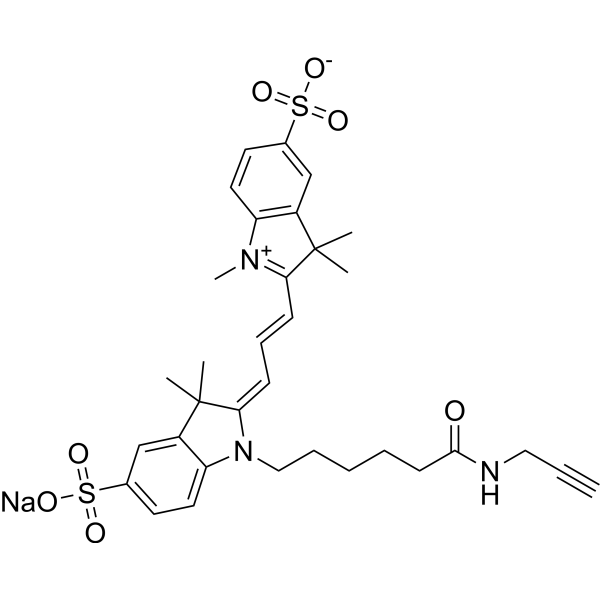
diSulfo-Cy3 alkyne
diSulfo-Cy3 alkyne is a water-soluble dye and a Click Chemistry reagent containing an alkyne group. Absorbance and emission of the dye are identical to Cy3 fluorophore. diSulfo-Cy3 alkyne can be used for the labeling of proteins, and even intact biological objects in water phase.
For research use only. We do not sell to patients.
- CAS No.: 2055138-88-8
- Formula: C33H38N3NaO7S2
- Molecular Weight:675.79
-
Storage:
Please store the product under the recommended conditions in the Certificate of Analysis.

To place orders, for customer services and technical support, please contact: MedChemExpress USA
Tel: 609-228-6898 E-mail: [email protected] [email protected]


-
 Biological Activity
-
Chemical Information
- Protocols
- Purity & Documentation
- References
-
 Help & FAQs




Biological Activity
Description
Emission (Em)
570
Excitation (Ex)
550


Chemical Information
-
CAS No. 2055138-88-8
-
Molecular Weight 675.79
-
Formula C33H38N3NaO7S2
-
SMILES
O=C(CCCCCN1C2=CC=C(S(=O)(O[Na])=O)C=C2C(C)(C)/C1=C\C=C\C3=[N+](C)C4=C(C3(C)C)C=C(S(=O)([O-])=O)C=C4)NCC#C
-
Shipping
Room temperature in continental US; may vary elsewhere.
-
Storage
Please store the product under the recommended conditions in the Certificate of Analysis.

Protocols
-
EdU Incorporation Assay (Click Chemistry-Based DNA Synthesis Measurement)
The EdU incorporation assay measures DNA synthesis by adding the thymidine analog 5-ethynyl-2′-deoxyuridine to cells or tissues, where it is incorporated into newly synthesized DNA during S phase. Incorporated EdU is detected by copper-catalyzed azide-alkyne cycloaddition, in which a fluorescent azide covalently reacts with the ethynyl group on EdU, allowing S-phase cells to be detected by fluorescence microscopy, flow cytometry, or high-content imaging. EdU detection does not require DNA denaturation or anti-BrdU antibody access, which preserves sample structure and improves compatibility with immunostaining and multiparameter cytometry compared with BrdU-based detection. EdU can be cytotoxic in a cell-type- and exposure-dependent manner, so pulse duration, concentration, and continuous-labeling designs should be validated for each cell type.


Purity & Documentation
References

Calculators
Concentration (start) × Volume (start) = Concentration (final) × Volume (final)


diSulfo-Cy3 alkyne Related Classifications
HY-151756 Related Classifications
 Powered by Bioz