



Azaribine

Based on 1 Customer Validation
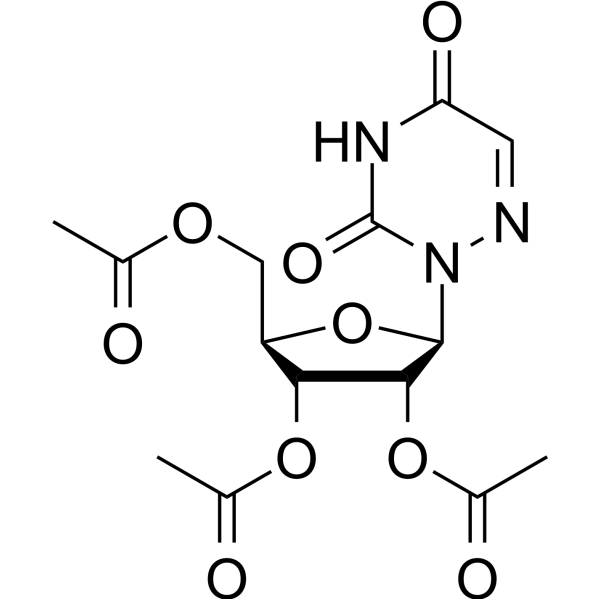
Azaribine (2',3',5'-Tri-O-acetyl-6-azauridine) is a potent orotidine monophosphate decarboxylase (OMPD) inhibitor. Azaribine is an antiviral inhibitor of several RNA viruses and inhibits viral genome replication and gene transcription. Azaribine shows broad-spectrum antiviral activity (EC50=3.80 nM-1.73 μM against influenza A and B viruses; EC50=1.62 μM against ZIKV Paraiba). Azaribine, a triacetate salt of Azauridine, has the potential for psoriasis research.
For research use only. We do not sell to patients.
- Purity : 98.8%
- CAS No.: 2169-64-4
- Formula: C14H17N3O9
- Molecular Weight:371.30
-
Storage:
-20°C, stored under nitrogen
* In solvent : -80°C, 6 months; -20°C, 1 month (stored under nitrogen)

To place orders, for customer services and technical support, please contact: MedChemExpress USA
Tel: 609-228-6898 E-mail: [email protected] [email protected]


-
 Biological Activity
-
Chemical Information
-
Solvent & Solubility
- Protocols
- Purity & Documentation
- References
-
 Help & FAQs


-
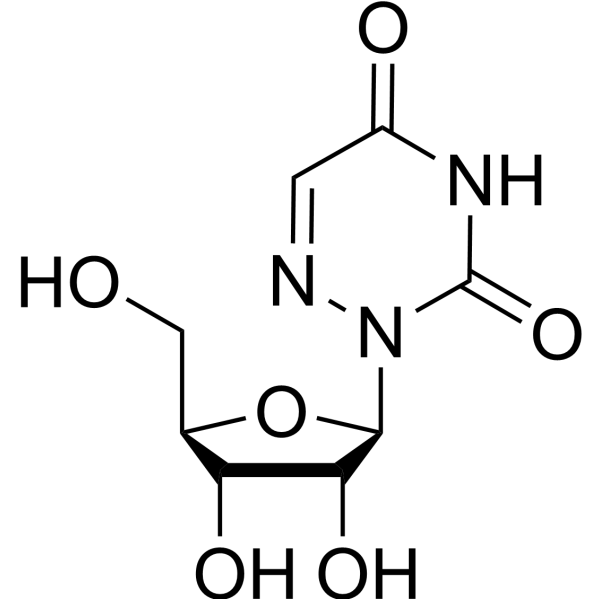
HY-131611
6-AzuridinePurine Nucleoside Analog -
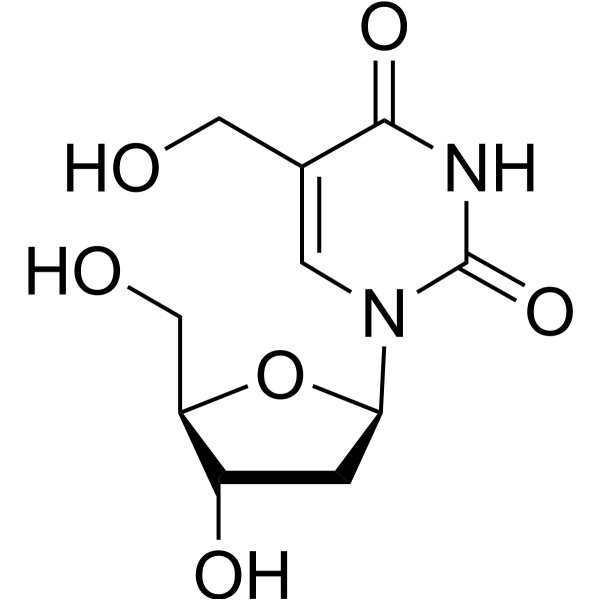
HY-129983
5-Hydroxymethyl-2'-deoxyuridineNucleoside Analog -
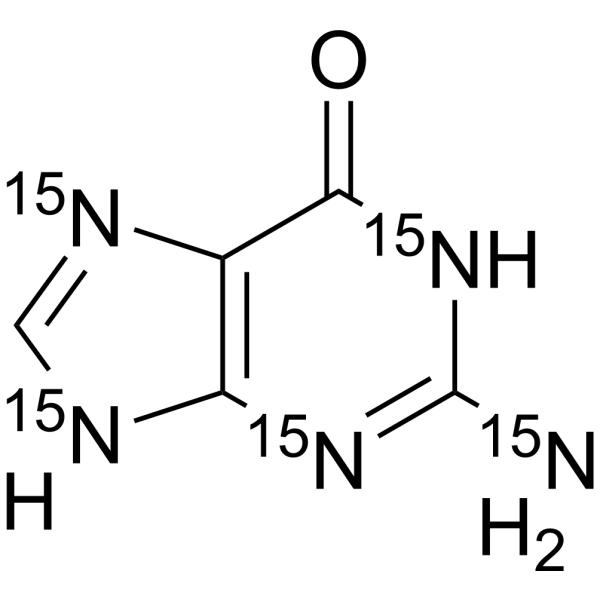
HY-Y1055S3
Guanine-15N5Stable Isotope -

HY-W012311
3′-DeoxythymidineDNA Polymerase Inhibtior -

HY-129861
5'-Ethynyl-2'-deoxycytidineHSV Inhibitor -
HY-B1826S2
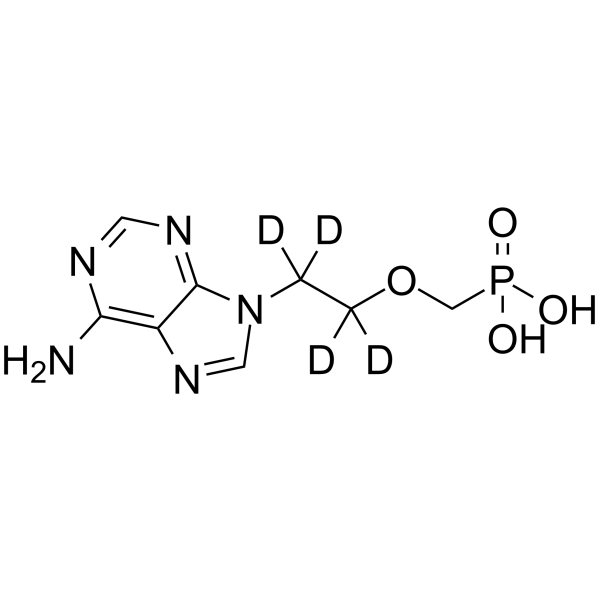
Adefovir-d4Stable Isotope -
HY-I0626S1
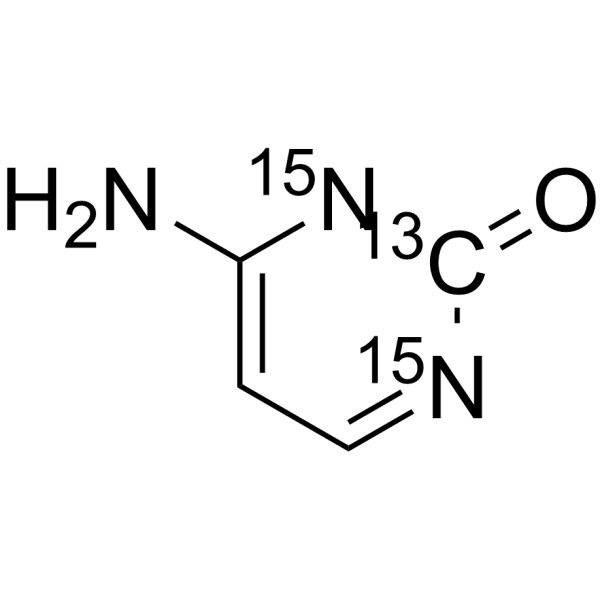
Cytosine-13C,15N2Stable Isotope -

HY-129983R
5-Hydroxymethyl-2'-deoxyuridine (Standard)Nucleoside Analog -
HY-I0960S
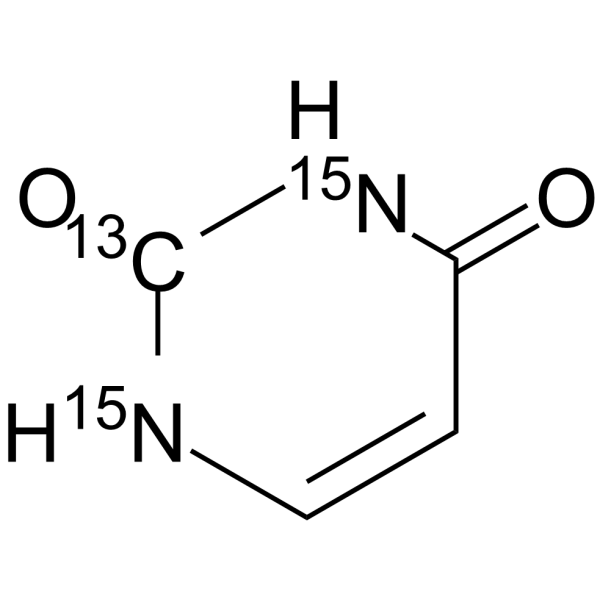
Uracil-13C2,15N2Stable Isotope -

HY-W010450S5
Thymine-13C5,15N2Stable Isotope


Biological Activity
Description
In Vitro
Azaribine (2',3',5'-Tri-O-acetyl-6-azauridine; 0-2 μM; 48 h) has cytotoxicity on MDCK cells (MTT: CC50=19.66 μM)[1].
Azaribine shows a potent inhibitory effect on BIRFLU multiplication (MDCK cells: EC50=0.29 μM; A549 cells: EC50=0.55 μM)[1].
Azaribine shows against seasonal H1N1 and H3N2 IAVs and IBV during posttreatment in MDCK cells with EC50 of 0.60 μM, 0.77 μM, 0.80 μM[1].
Azaribine is against NC H1N1 during posttreatment in 16HBE cells (EC50=1.58 μM)[1].
MedChemExpress (MCE) has not independently confirmed the accuracy of these methods. They are for reference only. Further protocols information, click here.
-
Cell Line:MDCK cells
-
Concentration:0-2 μM
-
Incubation Time:48 h
-
Result:Had cytotoxicity on MDCK cells (CC50=19.66 μM).


Chemical Information
-
CAS No. 2169-64-4
-
Appearance Solid
-
Molecular Weight 371.30
-
Formula C14H17N3O9
-
Color White to off-white
-
SMILES
CC(OC[C@@H]1[C@@H](OC(C)=O)[C@@H](OC(C)=O)[C@H](N2N=CC(NC2=O)=O)O1)=O
-
Synonyms
2',3',5'-Tri-O-acetyl-6-azauridine
-
Shipping
Room temperature in continental US; may vary elsewhere.
-
Storage
-20°C, stored under nitrogen
* In solvent : -80°C, 6 months; -20°C, 1 month (stored under nitrogen)


Solvent & Solubility
In Vitro:
DMSO : 3.8 mg/mL (10.23 mM; Need ultrasonic and warming; Hygroscopic DMSO has a significant impact on the solubility of product, please use newly opened DMSO)
Please refer to the solubility information to select the appropriate solvent. Once prepared, please aliquot and store the solution to prevent product inactivation from repeated freeze-thaw cycles.
Storage method and period of stock solution: -80°C, 6 months; -20°C, 1 month (stored under nitrogen). When stored at -80°C, please use it within 6 months. When stored at -20°C, please use it within 1 month.
Please refer to the solubility information to select the appropriate solvent. Once prepared, please aliquot and store the solution to prevent product inactivation from repeated freeze-thaw cycles.
Storage method and period of stock solution: -80°C, 6 months; -20°C, 1 month (stored under nitrogen). When stored at -80°C, please use it within 6 months. When stored at -20°C, please use it within 1 month.
Concentration (start) × Volume (start) = Concentration (final) × Volume (final)

Protocols
-
Research Protocol for Infectious Diseases
Infectious-disease experiments test how pathogens interact with host barriers, innate immune receptors, inflammatory signaling, pathogen replication, and tissue injury; pattern-recognition receptors such as TLRs, RIG-I-like receptors, NOD-like receptors, and inflammasomes detect microbial molecules and activate NF-κB, interferon, and cytokine responses. The central hypothesis is that infection severity reflects the balance between pathogen burden and host response: protective inflammation restricts pathogen growth, whereas excessive or mislocalized inflammation contributes to tissue damage and disease phenotype. Unresolved questions include which host pathways are protective versus pathogenic, why some infection models fail to translate to human disease, and which combined readouts best predict clinically relevant infection outcomes.
-
Imiquimod-Induced Psoriasiform Dermatitis
Imiquimod (IMQ)-induced psoriasiform dermatitis is a widely used murine model in which topical application of IMQ, a Toll-like receptor 7 (TLR7) agonist, triggers innate immune activation in the skin and induces a psoriasis-like inflammatory cascade characterized by epidermal hyperplasia, immune cell infiltration, and cytokine production dominated by the IL-23/IL-17 axis. This inflammatory response is mediated through activation of dendritic cells and downstream induction of IL-23, IL-17A, IL-22, and related pro-inflammatory mediators, recapitulating key features of human plaque psoriasis and enabling mechanistic and therapeutic studies. The model is commonly induced using Aldara (5% IMQ cream) applied topically to murine skin, resulting in rapid onset of erythema, scaling, and thickening that can be quantified as disease severity indices and validated histologically.


Purity & Documentation
-
Data Sheet (278 KB)
-
SDS (252 KB)
- English - EN (252 KB)
- Français - FR (252 KB)
- Deutsch - DE (252 KB)
- Norwegian - NO (252 KB)
- Español - ES (252 KB)
- Swedish - SV (252 KB)
- Italian - IT (252 KB)
- Korean - KR (252 KB)
- Portuguese - PT (252 KB)
-
Handling Instructions (2659 KB)
References
[1]. Jun-Gyu Park, et al. Identification and Characterization of Novel Compounds with Broad-Spectrum Antiviral Activity against Influenza A and B Viruses. J Virol. 2020 Mar 17;94(7):e02149-19. [Content Brief]
[2]. Desarey Morales Vasquez, et al. Identification of Inhibitors of ZIKV Replication. Viruses. 2020 Sep 18;12(9):1041. [Content Brief]


Complete Stock Solution Preparation Table
Please refer to the solubility information to select the appropriate solvent. Once prepared, please aliquot and store the solution to prevent product inactivation from repeated freeze-thaw cycles.
Storage method and period of stock solution: -80°C, 6 months; -20°C, 1 month (stored under nitrogen). When stored at -80°C, please use it within 6 months. When stored at -20°C, please use it within 1 month.
| Optional Solvent | Concentration Solvent Mass | 1 mg | 5 mg | 10 mg | 25 mg |
|---|---|---|---|---|---|
| DMSO | 1 mM | 2.6932 mL | 13.4662 mL | 26.9324 mL | 67.3310 mL |
| 5 mM | 0.5386 mL | 2.6932 mL | 5.3865 mL | 13.4662 mL | |
| 10 mM | 0.2693 mL | 1.3466 mL | 2.6932 mL | 6.7331 mL |


Azaribine Related Classifications
HY-B1537 Related Classifications
 Powered by Bioz