



Azumolene sodium
Based on 3 publication(s) in Google Scholar
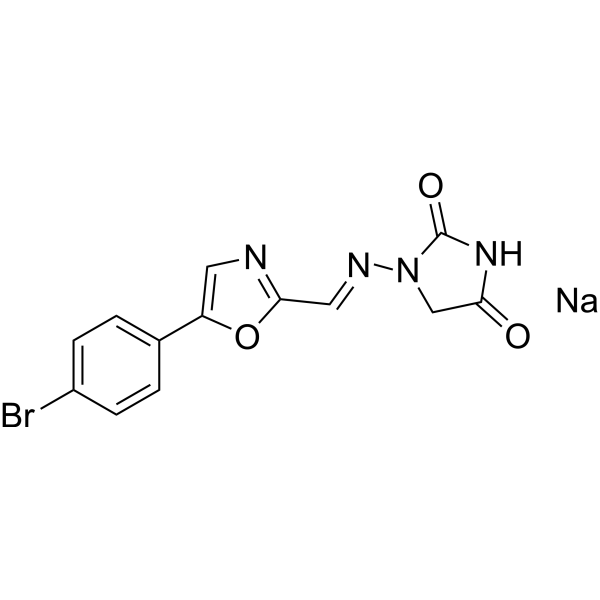
Azumolene sodium (EU4093) is an analog of Dantrolene (HY-12542) that inhibits malignant hyperthermia (MH) syndrome and intracellular Ca2+ homeostasis failure caused by Halothane (HY-B1010)/Succinylcholine. Azumolene sodium (0.5-2.0 mg/kg) reduces [Ca2+]i (from 207 nM to 38 nM) in MH-susceptible skeletal muscle following intramuscular injection.
For research use only. We do not sell to patients.
- CAS No.: 105336-14-9
- Formula: C13H9BrN4NaO3
- Molecular Weight:372.13
-
Storage:
Please store the product under the recommended conditions in the Certificate of Analysis.

To place orders, for customer services and technical support, please contact: MedChemExpress USA
Tel: 609-228-6898 E-mail: [email protected] [email protected]


-
 Biological Activity
-
Chemical Information
- Protocols
- Purity & Documentation
- References
-
 Help & FAQs


Publications Citing Use of MedChemExpress (MCE) Azumolene sodium
MoreAll Calcium Channel Isoforms
More

Biological Activity
Description


Chemical Information
-
CAS No. 105336-14-9
-
Molecular Weight 372.13
-
Formula C13H9BrN4NaO3
-
SMILES
O=C1NC(CN1/N=C/C2=NC=C(C3=CC=C(Br)C=C3)O2)=O.[Na]
-
Synonyms
EU4093
-
Shipping
Room temperature in continental US; may vary elsewhere.
-
Storage
Please store the product under the recommended conditions in the Certificate of Analysis.


Publications (3)
-
Journal Impact Factor
-
Most Recent
-
Nat Commun
Crystal structures of Ryanodine Receptor reveal dantrolene and azumolene interactions guiding inhibitor development. [Abstract]2025 Nov 18;16(1):10110. PMID: 41253812 -
Cell Death Dis
Pathological convergence of APP and SNCA deficiency in hippocampal degeneration of young rats. [Abstract]2023 May 13;14(5):325. PMID: 37179386 -
Small
2025 Mar;21(12):e2408139. PMID: 40012250

Protocols
-
How to Select the Route of Administration for Mammals
Route-of-administration selection in mammals is a pharmacokinetic, pharmacodynamic, formulation, animal-welfare, and translational decision, not a default technical choice. The selected route should match the study goal: intravenous dosing is most useful when complete systemic exposure and rapid onset are required, oral dosing is most translational for orally intended medicines but is affected by absorption and first-pass metabolism, subcutaneous or intramuscular dosing can provide slower systemic exposure, and intraperitoneal dosing can be useful in rodent proof-of-concept studies but may have limited clinical translation. Published route-comparison studies show that the same compound can produce different exposure, onset, bioavailability, tissue distribution, and tolerability depending on route; therefore, route choice should be supported by pilot pharmacokinetic or pharmacodynamic evidence when the literature is insufficient. Unresolved questions include how to standardize route sel
-
Ca2+ Staining Technique
Ca2+ staining is an experimental technique that utilizes specific fluorescent probes (such as Fluo-4 AM, Fura-2, etc.) to qualitatively or quantitatively detect dynamic changes in intracellular Ca2+ concentrations; this is achieved by monitoring the changes in fluorescent signals generated when these probes bind to free intracellular calcium ions. The underlying principle relies primarily on the presence of chelating groups within the probe's molecular structure that possess high affinity for calcium ions.


Purity & Documentation
References

Calculators
Concentration (start) × Volume (start) = Concentration (final) × Volume (final)


Azumolene sodium Related Classifications
HY-113920 Related Classifications
 Powered by Bioz