



BChE-IN-4
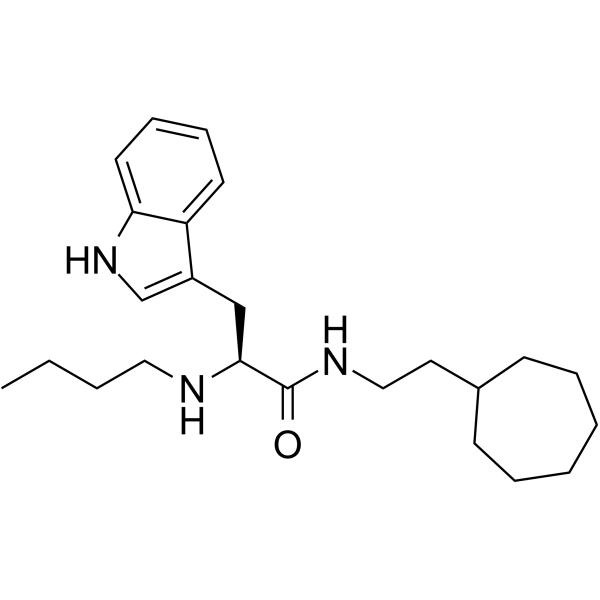
BChE-IN-4 is a potent and cross the blood-brain barrier BChE inhibitor. BChE-IN-4 attenuates learning and memory deficits caused by cholinergic deficit in mouse model. BChE-IN-4 has the potential for the research of alzheimer’s disease.
For research use only. We do not sell to patients.
- CAS No.: 2304818-41-3
- Formula: C24H37N3O
- Molecular Weight:383.57
-
Storage:
Please store the product under the recommended conditions in the Certificate of Analysis.

To place orders, for customer services and technical support, please contact: MedChemExpress USA
Tel: 609-228-6898 E-mail: [email protected] [email protected]


-
 Biological Activity
-
Chemical Information
- Protocols
- Purity & Documentation
- References
-
 Help & FAQs




Biological Activity
Description
IC50 & Target
BChE[1]
In Vivo
BChE-IN-4 (30 mg/kg) dose not induce adverse motor effects in vivo[1].
MedChemExpress (MCE) has not independently confirmed the accuracy of these methods. They are for reference only.
-
Animal Model:Adult male Albino Swiss CD-1 mice (Scopolamine-induced memory-impaired CD-1 mice)[1]
-
Dosage:10, 20, 30 mg/kg
-
Administration:I.p.
-
Result:Significantly prolonged the step-through latencies in memory impaired mice.
-
Animal Model:18-22 g, C57BL/6J mice[1]
-
Dosage:30 mg/kg
-
Administration:I.p.
-
Result:Did not enhance learning abilities and working memory in the acquisition phase or the short-term memory retrieval on day 5, but did significantly improve long-term memory retrieval, as observed on day 12 of the BM ( Barnes maze) task.
-
Animal Model:Mice[1]
-
Dosage:30 mg/kg (suspended in 1% Tween 80)
-
Administration:I.p
-
Result:Neither altered the number of light-beam interruptions in the locomotor activity test nor induced any motor deficits at 6, 18 and 24 rpm in the rotarod test.


Chemical Information
-
CAS No. 2304818-41-3
-
Molecular Weight 383.57
-
Formula C24H37N3O
-
SMILES
O=C(NCCC1CCCCCC1)[C@@H](NCCCC)CC2=CNC3=CC=CC=C23
-
Shipping
Room temperature in continental US; may vary elsewhere.
-
Storage
Please store the product under the recommended conditions in the Certificate of Analysis.

Protocols
-
Protocol for Shuttle Box Test (TDPA)
The Shuttle Box Test for TDPA, or temporally dissociated passive avoidance, measures hippocampus-dependent associative learning by testing whether a rodent avoids entering a dark compartment that was previously paired with foot shock after a temporal delay between dark-compartment entry and shock delivery. The main behavioral readout is crossover or step-through latency from the light chamber into the dark chamber; increased latency across training or retention trials reflects learned avoidance memory rather than motor performance alone.
-
Protocol for Water Maze
The Morris Water Maze is a rodent spatial learning and memory assay in which a mouse or rat swims in opaque water to find an escape platform; in the hidden-platform version, the animal cannot see the platform and must use distal extra-maze cues to learn its fixed spatial location. The assay primarily measures hippocampus-dependent spatial learning during acquisition trials and spatial reference memory during probe trials after platform removal; readouts include escape latency, swim path length, swim speed, quadrant occupancy, platform-site crossings, and proximity to the former platform location.
-
How to Choose the Right Model Animal
Choosing the right model animal is a validity-driven decision in which the species, strain, sex, age, genetic background, disease-induction method, outcome measures, and welfare burden must match the scientific question rather than laboratory tradition or convenience. A model should be selected by judging face validity, construct validity, and predictive validity: whether it resembles the human phenotype, whether it reproduces relevant mechanisms, and whether results are likely to predict human biology or treatment response. Animal studies often fail to translate because of species differences, weak disease resemblance, poor experimental design, inadequate reporting, publication bias, and underuse of randomization, blinding, and sample-size justification. Unresolved questions include how to rank competing models objectively, how much human-disease complexity must be reproduced for a given objective, and when non-animal systems such as organoids, ex vivo tissue, or computational models


Purity & Documentation
References

Calculators
Concentration (start) × Volume (start) = Concentration (final) × Volume (final)


BChE-IN-4 Related Classifications
HY-143464 Related Classifications
 Powered by Bioz