



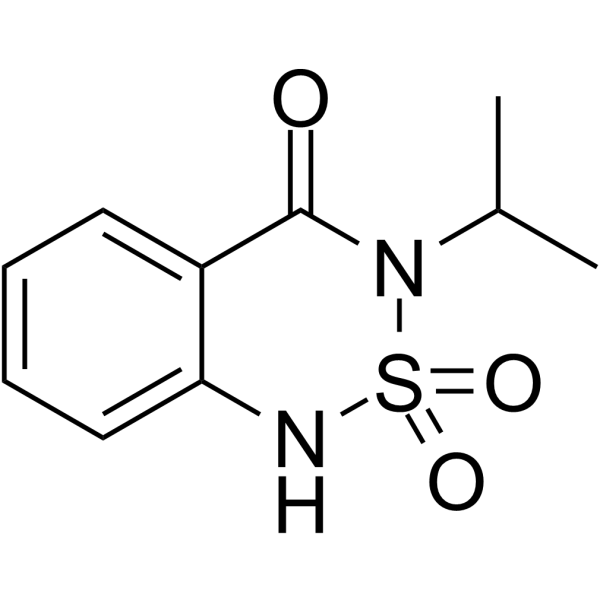
Bentazone
Bentazone is a selective post-emergence herbicide and a Photosystem II inhibitor targeting the quinone B binding site, with activity against broadleaf weeds. Bentazone interferes with photosynthetic electron transport, blocks sunlight-dependent energy production, and acts as a phytotoxin to induce leaf damage, growth inhibition, lipid peroxidation, and reduced chlorophyll content.
For research use only. We do not sell to patients.
- CAS No.: 25057-89-0
- Formula: C10H12N2O3S
- Molecular Weight:240.28
-
Storage:Powder -20°C, 3 years ; In solvent -80°C, 6 months , -20°C, 1 month

To place orders, for customer services and technical support, please contact: MedChemExpress USA
Tel: 609-228-6898 E-mail: [email protected] [email protected]


-
 Biological Activity
-
Chemical Information
- Protocols
- Purity & Documentation
- References
-
 Help & FAQs




Biological Activity
Description
In Vitro
Bentazone (0-1.0 mg/L; 2-6 days) induces dose- and time-dependent increases in antioxidant (SOD, POD, root CAT) and detoxification (GST, GT, CYP450) enzyme activities in three-leaf stage japonica rice seedlings, with peak induction at 0.8 mg/L for 6 days[3].
Bentazone (0.8 mg/L; 6 days) alters global gene expression in three-leaf stage japonica rice seedlings, with more DEGs in roots than shoots, and upregulates genes involved in oxidative stress response, xenobiotic metabolism, and detoxification pathways[3].
Bentazone - tolerant and bentazone-sensitive soybean genotypes translocate 7-13% of absorbed foliar-applied bentazone from the treated leaf, with slow acropetal movement observed in soybeans[1].
Bentazone (0-1.0 mg/L; 2-6 days) impairs growth, membrane integrity, chlorophyll synthesis, and photosynthetic function in three-leaf stage japonica rice seedlings in a concentration- and time-dependent manner, with the strongest inhibitory effects observed at 1.0 mg/L for 6 days[3].
Bentazone (0-1.0 mg/L; 2-6 days) accumulates in three-leaf stage japonica rice seedlings in a concentration- and time-dependent manner, with higher accumulation in roots than shoots, limited translocation to shoots, and decreasing bioconcentration at higher exposure concentrations[3].
Bentazone (0.8 mg/L; 6 days) is metabolized in three-leaf stage japonica rice seedlings via phase I reactions (hydroxylation, hydrolysis, demethylation) and phase II reactions (acetylation, glycosylation, amino acid conjugation), producing seven distinct metabolites and fourteen distinct conjugates[3].
MedChemExpress (MCE) has not independently confirmed the accuracy of these methods. They are for reference only. Further protocols information, click here.


Chemical Information
-
CAS No. 25057-89-0
-
Appearance Solid
-
Molecular Weight 240.28
-
Formula C10H12N2O3S
-
Color White to off-white
-
SMILES
O=C1N(C(C)C)S(NC2=CC=CC=C12)(=O)=O
-
Shipping
Room temperature in continental US; may vary elsewhere.
-
Storage
Powder -20°C 3 years In solvent -80°C 6 months -20°C 1 month

Protocols
-
Ferroptosis Solutions
Ferroptosis is an iron-dependent, non-apoptotic form of regulated cell death characterized by lethal lipid peroxidation and sensitivity to suppression by iron chelators or lipophilic radical-trapping antioxidants. The core pathway links cystine uptake through system Xc−, glutathione availability, GPX4-dependent detoxification of phospholipid hydroperoxides, iron-dependent oxidative reactions, and polyunsaturated-phospholipid metabolism into a cell-death program that is biochemically and morphologically distinct from apoptosis, necrosis, and autophagy. The ferroptosis pathway is experimentally linked to phenotype through chemical and genetic perturbation. Erastin induces ferroptosis by inhibiting cystine uptake through system Xc− and weakening antioxidant defenses, while GPX4 inhibition or depletion causes lipid peroxide accumulation and ferroptotic cancer-cell death. ACSL4 and oxidizable arachidonoyl- or adrenoyl-containing phosphatidylethanolamines shape ferroptosis sensitivity by con


Purity & Documentation
-
Data Sheet (287 KB)
-
SDS (252 KB)
- Français - FR (252 KB)
- Deutsch - DE (252 KB)
- Norwegian - NO (252 KB)
- Español - ES (252 KB)
- Swedish - SV (252 KB)
- Italian - IT (252 KB)
- Korean - KR (252 KB)
- Portuguese - PT (252 KB)
-
Handling Instructions (2659 KB)
References
[2]. Shi L, et al. Herbicide applications increase greenhouse gas emissions of alfalfa pasture in the inland arid region of northwest China. PeerJ. 2020;8:e9231. [Content Brief]
[3]. Qiao Y, et al. Multiple Metabolism Pathways of Bentazone Potentially Regulated by Metabolic Enzymes in Rice. Journal of agricultural and food chemistry. 2023 Jul 26;71(29):11204-11216. [Content Brief]

Calculators
Concentration (start) × Volume (start) = Concentration (final) × Volume (final)


Bentazone Related Classifications
HY-B2039 Related Classifications
 Powered by Bioz