



Euparin

Based on 1 Customer Validation
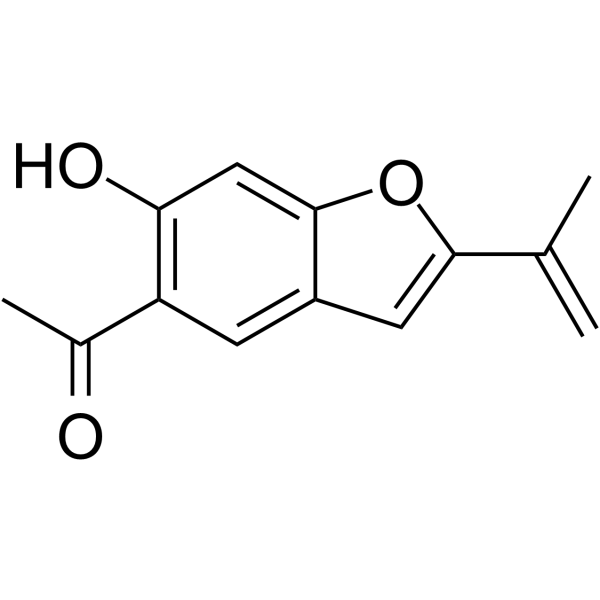
Euparin, a monomeric compound of Benzofuran, is a reactive oxygen species (ROS) inhibitor. Euparin shows antiviral activity against poliovirus, and also has antidepressant effects.
For research use only. We do not sell to patients.
- Purity : 99.0%
- CAS No.: 532-48-9
- Formula: C13H12O3
- Molecular Weight:216.23
-
Storage:
-20°C, sealed storage, away from moisture and light
* In solvent : -80°C, 6 months; -20°C, 1 month (sealed storage, away from moisture and light)

To place orders, for customer services and technical support, please contact: MedChemExpress USA
Tel: 609-228-6898 E-mail: [email protected] [email protected]


-
 Biological Activity
-
Chemical Information
- Protocols
- Purity & Documentation
- References
-
 Help & FAQs




Biological Activity
Description
Cellular Effect
|
Cell Line

|
Type | Value | Description | References |
|---|---|---|---|---|
| A549 | ED50 |
22 μg/mL
Compound: 5
|
Cytotoxicity against human A549 cells after 7 days by MTT assay
Cytotoxicity against human A549 cells after 7 days by MTT assay
|
[PMID: 8882437] |
| HT-29 | ED50 |
6 μg/mL
Compound: 5
|
Cytotoxicity against human HT29 cells after 7 days by MTT assay
Cytotoxicity against human HT29 cells after 7 days by MTT assay
|
[PMID: 8882437] |
| MCF7 | ED50 |
6 μg/mL
Compound: 5
|
Cytotoxicity against human MCF7 cells after 7 days by MTT assay
Cytotoxicity against human MCF7 cells after 7 days by MTT assay
|
[PMID: 8882437] |
In Vitro
In Vero cells, Euparin shows antiviral activity against poliovirus types 1, 2, and 3 with EC50 values of 0.47 µg/mL, 0.12 µg/mL, and 0.15 µg/mL, respectively[1].
MedChemExpress (MCE) has not independently confirmed the accuracy of these methods. They are for reference only. Further protocols information, click here.
In Vivo
MedChemExpress (MCE) has not independently confirmed the accuracy of these methods. They are for reference only.


Chemical Information
-
CAS No. 532-48-9
-
Appearance Solid
-
Molecular Weight 216.23
-
Formula C13H12O3
-
Color Light yellow to yellow
-
SMILES
CC(C1=C(O)C=C(OC(C(C)=C)=C2)C2=C1)=O
-
Structure Classification
-
Shipping
Room temperature in continental US; may vary elsewhere.
-
Storage
-20°C, sealed storage, away from moisture and light
* In solvent : -80°C, 6 months; -20°C, 1 month (sealed storage, away from moisture and light)

Protocols
-
Research Protocol for Infectious Diseases
Infectious-disease experiments test how pathogens interact with host barriers, innate immune receptors, inflammatory signaling, pathogen replication, and tissue injury; pattern-recognition receptors such as TLRs, RIG-I-like receptors, NOD-like receptors, and inflammasomes detect microbial molecules and activate NF-κB, interferon, and cytokine responses. The central hypothesis is that infection severity reflects the balance between pathogen burden and host response: protective inflammation restricts pathogen growth, whereas excessive or mislocalized inflammation contributes to tissue damage and disease phenotype. Unresolved questions include which host pathways are protective versus pathogenic, why some infection models fail to translate to human disease, and which combined readouts best predict clinically relevant infection outcomes.
-
ROS/oxidative-stress fluorescent staining
ROS/oxidative-stress fluorescent staining uses cell-permeant fluorogenic probes that become fluorescent after oxidation inside cells or tissues; commonly used examples include DCFH-DA/DCFDA for broad cellular oxidant detection, DHE for superoxide-related signal detection, MitoSOX for mitochondrial superoxide-related signal detection, and CellROX probes for oxidative-stress-associated fluorescence readouts. The assay detects probe oxidation rather than a single ROS species unless the probe and analysis method have been chemically validated for that species. DCFH-DA enters cells, is deacetylated by intracellular esterases to DCFH, and produces fluorescent DCF after oxidation, so the readout is used as an operational measure of total cellular oxidative stress rather than a species-specific ROS measurement. DHE and MitoSOX can report superoxide-related oxidation, but red fluorescence alone can include non-specific ethidium-like oxidation products; HPLC or optimized spectral approaches are


Purity & Documentation
-
Data Sheet (270 KB)
-
SDS (252 KB)
- English - EN (252 KB)
- Français - FR (252 KB)
- Deutsch - DE (252 KB)
- Norwegian - NO (252 KB)
- Español - ES (252 KB)
- Swedish - SV (252 KB)
- Italian - IT (252 KB)
- Korean - KR (252 KB)
- Portuguese - PT (252 KB)
-
Handling Instructions (2659 KB)
References
[1]. aría Florencia Visintini Jaime, et al. Antipoliovirus Activity of the Organic Extract of Eupatorium buniifolium: Isolation of Euparin as an Active Compound. Evid Based Complement Alternat Med. 2013;2013:402364. [Content Brief]
[2]. Xu-Meng Han, et al. Antidepressant Activity of Euparin: Involvement of Monoaminergic Neurotransmitters and SAT1/NMDAR2B/BDNF Signal Pathway. Biol Pharm Bull. 2020 Oct 1;43(10):1490-1500. [Content Brief]

Calculators
Concentration (start) × Volume (start) = Concentration (final) × Volume (final)


Euparin Related Classifications
HY-N4161 Related Classifications
 Powered by Bioz