



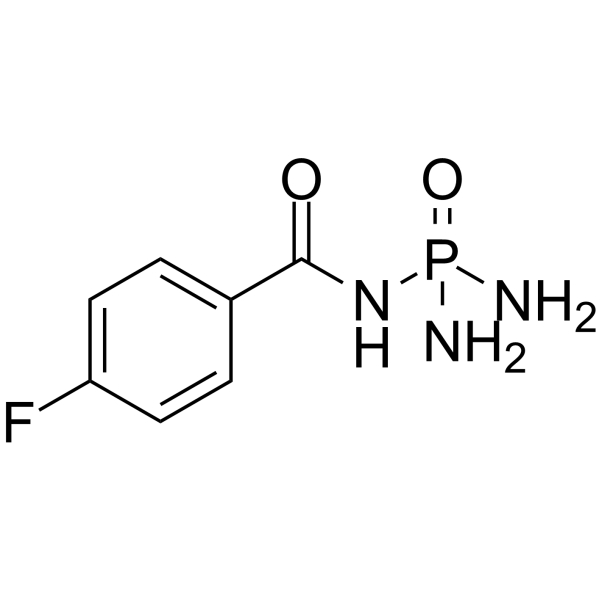
Flurofamide

Based on 1 Customer Validation
Flurofamide is an effective bacterial urease inhibitor and antibacterial agent. Flurofamide inhibits urease and partially inhibits the chemotactic activity of Helicobacter pylori strain CPY3401. Flurofamide inhibits the growth of Ureaplasma urealyticum. Flurofamide reduces blood ammonia. Flurofamide can be used in the research of infectious urinary stones.
For research use only. We do not sell to patients.
- Purity : 99.06%
- CAS No.: 70788-28-2
- Formula: C7H9FN3O2P
- Molecular Weight:217.14
-
Storage:Powder -20°C, 3 years , 4°C, 2 years ; In solvent -80°C, 6 months , -20°C, 1 month

To place orders, for customer services and technical support, please contact: MedChemExpress USA
Tel: 609-228-6898 E-mail: [email protected] [email protected]


-
 Biological Activity
-
Chemical Information
-
Solvent & Solubility
- Protocols
- Purity & Documentation
- References
-
 Help & FAQs




Biological Activity
Description
In Vitro
Flufatamide inhibits NH3 production in 4 isolates of Ureaplasma parvum and 5 isolates of Ureaplasma urealyticum, with the minimum urease inhibition concentration ≤ 2 μM, confirming that it is a broad-spectrum Ureaplasma urease inhibitor[1].
Flurofamide (0.01-10 μM) partially inhibits the chemotactic activity of Helicobacter pylori CPY3401 strain in chemotactic buffer containing 3% Polyvinylpyrrolidone (simulating a viscous environment)[2].
MedChemExpress (MCE) has not independently confirmed the accuracy of these methods. They are for reference only.
In Vivo
MedChemExpress (MCE) has not independently confirmed the accuracy of these methods. They are for reference only.
-
Animal Model:C3H male and female mice (18-22 g), pharmacologically immunosuppressed with methylprednisone, tacrolimus, and mycophenolate mofetil for 7 days, and administered 40 g/L urea ad libitum in drinking water for 10 min to induce mild uremia, then infected with Ureaplasma parvum IDRL-10774 via intratracheal (IT) and intraperitoneal (IP) routes[1]
-
Dosage:6 mg/kg
-
Administration:Intraperitoneal (IP) injection; for prophylaxis group, administered 1 hour prior to IT and IP Ureaplasma challenge; for treatment group, administered 24 hours after IT and IP infection
-
Result:Showed the average blood NH3 level of 10.9 μM (in the prophylaxis group, 24 hours after infection).
Caused a 56.4% decrease in blood NH3 concentration in infected mice with initial blood NH3 concentration >30 μM, which was significantly higher than the 9.1% decrease in blood NH3 concentration in untreated infected mice (in the treatment group, 6 h after administration).


Chemical Information
-
CAS No. 70788-28-2
-
Appearance Solid
-
Molecular Weight 217.14
-
Formula C7H9FN3O2P
-
Color White to off-white
-
SMILES
O=C(NP(N)(N)=O)C1=CC=C(F)C=C1
-
Shipping
Room temperature in continental US; may vary elsewhere.
-
Storage
Powder -20°C 3 years 4°C 2 years In solvent -80°C 6 months -20°C 1 month


Solvent & Solubility
In Vitro:
DMSO : 14.29 mg/mL (65.81 mM; ultrasonic and warming and heat to 60°C; Hygroscopic DMSO has a significant impact on the solubility of product, please use newly opened DMSO)
Please refer to the solubility information to select the appropriate solvent. Once prepared, please aliquot and store the solution to prevent product inactivation from repeated freeze-thaw cycles.
Storage method and period of stock solution: -80°C, 6 months; -20°C, 1 month. When stored at -80°C, please use it within 6 months. When stored at -20°C, please use it within 1 month.
Please refer to the solubility information to select the appropriate solvent. Once prepared, please aliquot and store the solution to prevent product inactivation from repeated freeze-thaw cycles.
Storage method and period of stock solution: -80°C, 6 months; -20°C, 1 month. When stored at -80°C, please use it within 6 months. When stored at -20°C, please use it within 1 month.
Concentration (start) × Volume (start) = Concentration (final) × Volume (final)
In Vivo:
Select the appropriate dissolution method based on your experimental animal and administration route.
- For the following dissolution methods, please ensure to first prepare a clear stock solution using an In Vitro approach and then sequentially add co-solvents:
- To ensure reliable experimental results, the clarified stock solution can be appropriately stored based on storage conditions. As for the working solution for In Vivo experiments, it is recommended to prepare freshly and use it on the same day.
- The percentages shown for the solvents indicate their volumetric ratio in the final prepared solution. If precipitation or phase separation occurs during preparation, heat and/or sonication can be used to aid dissolution.
In Vivo Dissolution Calculator
Please enter the basic information of animal experiments:
-
-
-
-
Recommended: Prepare an additional quantity of animals to account for potential losses during experiments.
Please enter your animal formula composition:
-
%DMSO +
Recommended: Keep the proportion of DMSO in working solution below 2% if your animal is weak.
-
%+
-
+%Tween-80 + +
-
%Saline +
The co-solvents required include: DMSO, . All of co-solvents are available by MedChemExpress (MCE). , Tween 80. All of co-solvents are available by MedChemExpress (MCE).
Working solution concentration: 0.22 mg/mL
Method for preparing stock solution: mg drug dissolved in μL DMSO. Stock solution concentration: mg/mL.
1. Take μL DMSO stock solution;
2. Add μL .
μL , mix evenly;
3. Then add μL Tween 80, mix evenly;
4. Then add μL
Please ensure that the stock solution in the first step is dissolved to a clear state, and add co-solvents in sequence. You can use ultrasonic heating (ultrasonic cleaner, recommended frequency 20-40 kHz), vortexing, etc. to assist dissolution.


Purity & Documentation
-
Data Sheet (274 KB)
-
SDS (254 KB)
- English - EN (254 KB)
- Français - FR (254 KB)
- Deutsch - DE (254 KB)
- Norwegian - NO (254 KB)
- Español - ES (254 KB)
- Swedish - SV (254 KB)
- Italian - IT (254 KB)
- Korean - KR (254 KB)
- Portuguese - PT (254 KB)
-
Handling Instructions (2659 KB)
References
[1]. Millner OE Jr, et al. Flurofamide: a potent inhibitor of bacterial urease with potential clinical utility in the treatment of infection induced urinary stones. J Urol. 1982 Feb;127(2):346-50. [Content Brief]
[2]. Fleming D, et al. Flurofamide Prevention and Treatment of Ureaplasma-Induced Hyperammonemia. Microbiol Spectr. 2022 Oct 26;10(5):e0192722. [Content Brief]
[3]. Nakamura H, et al. Urease plays an important role in the chemotactic motility of Helicobacter pylori in a viscous environment. Infect Immun. 1998 Oct;66(10):4832-7. [Content Brief]
[4]. Kenny GE. Inhibition of the growth of Ureaplasma urealyticum by a new urease inhibitor, flurofamide. Yale J Biol Med. 1983 Sep-Dec;56(5-6):717-22. [Content Brief]


Complete Stock Solution Preparation Table
Please refer to the solubility information to select the appropriate solvent. Once prepared, please aliquot and store the solution to prevent product inactivation from repeated freeze-thaw cycles.
Storage method and period of stock solution: -80°C, 6 months; -20°C, 1 month. When stored at -80°C, please use it within 6 months. When stored at -20°C, please use it within 1 month.
| Optional Solvent | Concentration Solvent Mass | 1 mg | 5 mg | 10 mg | 25 mg |
|---|---|---|---|---|---|
| DMSO | 1 mM | 4.6053 mL | 23.0266 mL | 46.0532 mL | 115.1331 mL |
| 5 mM | 0.9211 mL | 4.6053 mL | 9.2106 mL | 23.0266 mL | |
| 10 mM | 0.4605 mL | 2.3027 mL | 4.6053 mL | 11.5133 mL | |
| 15 mM | 0.3070 mL | 1.5351 mL | 3.0702 mL | 7.6755 mL | |
| 20 mM | 0.2303 mL | 1.1513 mL | 2.3027 mL | 5.7567 mL | |
| 25 mM | 0.1842 mL | 0.9211 mL | 1.8421 mL | 4.6053 mL | |
| 30 mM | 0.1535 mL | 0.7676 mL | 1.5351 mL | 3.8378 mL | |
| 40 mM | 0.1151 mL | 0.5757 mL | 1.1513 mL | 2.8783 mL | |
| 50 mM | 0.0921 mL | 0.4605 mL | 0.9211 mL | 2.3027 mL | |
| 60 mM | 0.0768 mL | 0.3838 mL | 0.7676 mL | 1.9189 mL |


Flurofamide Related Classifications
HY-100956 Related Classifications
 Powered by Bioz