



Jarin-1
Based on 6 publication(s) in Google Scholar
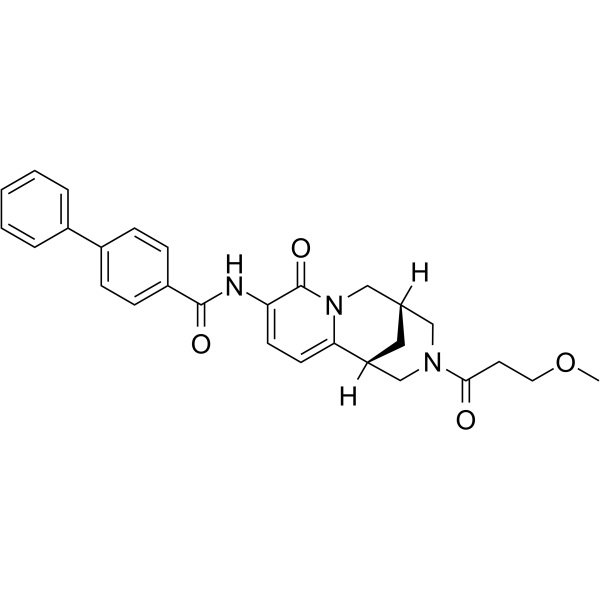
Jarin-1 is a jasmonic acid-amido synthetase (JAR1) inhibitor with an IC50 of 3.8 μM. Jarin-1 specific inhibits bioactive JA (jasmonoyl-isoleucine, JA-Ile) biosynthesis in Arabidopsis and other plants.
Nos produits utilisent uniquement pour la recherche. Nous ne vendons pas aux patients.
- Pureté : 99.17%
- CAS No.: 1212704-51-2
- Formule: C28H29N3O4
- Masse moléculaire:471.55
-
Stockage:Powder -20°C, 3 years ; In solvent -80°C, 6 months , -20°C, 1 month

To place orders, for customer services and technical support, please contact: MedChemExpress USA
Tel: 609-228-6898 E-mail: [email protected] [email protected]


-
 Activité biologique
-
Chemical Information
-
Solvant et solubilité
- Protocole
- Pureté et documentation
- Références
-
 Help & FAQs


Publications Citing Use of MedChemExpress (MCE) Jarin-1
MoreVoir tous les produits spécifiques à Isoform Phytohormone
More

Activité biologique
Description
IC50 & Target
In Vitro
A higher redness of strawberry fruit skin and anthocyanin content in MeJA-treated fruits with respect to Jarin-1-treated ones concomitant with an upregulation of FaANS and FaUFGT genes is found. Inversely, the proanthocyanidin (PA) content was higher in Jarin-1- and MeJA + Jarin-1-treated than in MeJA-treated fruits. MeJA + Jarin-1 treatment resulted in an upregulation of FaANR and associated transcription factors such as FabHLH33 and FaMYB9/11 along with FaJMT and FaJAR1.2. JA-responsive elements in the promoter regions of FaMYB1/9/10/11 genes is found. PA biosynthesis-related genes can be upregulated by the application of Jarin-1 to MeJA-treated fruit, thus increasing PA accumulation in strawberry[1].
MedChemExpress (MCE) has not independently confirmed the accuracy of these methods. They are for reference only. Further protocols information, click here.


Chemical Information
-
CAS No. 1212704-51-2
-
Appearance Solid
-
Masse moléculaire 471.55
-
Formule C28H29N3O4
-
Color White to off-white
-
SMILES
O=C(C1=CC=C(C2=CC=CC=C2)C=C1)NC(C3=O)=CC=C4N3C[C@]5([H])CN(C(CCOC)=O)C[C@@]4([H])C5
-
Livraison
Room temperature in continental US; may vary elsewhere.
-
Stockage
Powder -20°C 3 years In solvent -80°C 6 months -20°C 1 month


Publications (6)
-
Journal Impact Factor
-
Most Recent
-
Mol Plant
The jasmonate pathway promotes nodule symbiosis and suppresses host plant defense in Medicago truncatula. [Abstract]2024 Aug 5;17(8):1183-1203. PMID: 38859588 -
ISME J
Rhizosphere microbial shifts drive amygdalin detoxification and jasmonate-mediated alleviation of peach autotoxicity. [Abstract]2026 Jan 14;20(1):wrag095. PMID: 41989100 -
Plant Physiol
ERF026 balances the growth and drought stress response of Medicago sativa L. by regulating jasmonic acid metabolism. [Abstract]2025 Nov 26;199(4):kiaf606. PMID: 41264840 -
Curr Biol
Tissue-specific regulation of volatile emissions moves predators from flowers to attacked leaves. [Abstract]2023 Jun 5;33(11):2321-2329.e5. PMID: 37224808 -
Plants
Integrative Analysis of Metabolic Signature and Phytohormone Response in Potato Under Heat, Drought and Salt Stresses. [Abstract]2026 Mar 9;15(5):844. PMID: 41829874 -


Solvant et solubilité
In Vitro:
DMSO : 33.33 mg/mL (70.68 mM; Need ultrasonic; Hygroscopic DMSO has a significant impact on the solubility of product, please use newly opened DMSO)
Please refer to the solubility information to select the appropriate solvent. Once prepared, please aliquot and store the solution to prevent product inactivation from repeated freeze-thaw cycles.
Storage method and period of stock solution: -80°C, 6 months; -20°C, 1 month. When stored at -80°C, please use it within 6 months. When stored at -20°C, please use it within 1 month.
Please refer to the solubility information to select the appropriate solvent. Once prepared, please aliquot and store the solution to prevent product inactivation from repeated freeze-thaw cycles.
Storage method and period of stock solution: -80°C, 6 months; -20°C, 1 month. When stored at -80°C, please use it within 6 months. When stored at -20°C, please use it within 1 month.
Concentration (start) × Volume (start) = Concentration (final) × Volume (final)
In Vivo:
Select the appropriate dissolution method based on your experimental animal and administration route.
- For the following dissolution methods, please ensure to first prepare a clear stock solution using an In Vitro approach and then sequentially add co-solvents:
- To ensure reliable experimental results, the clarified stock solution can be appropriately stored based on storage conditions. As for the working solution for In Vivo experiments, it is recommended to prepare freshly and use it on the same day.
- The percentages shown for the solvents indicate their volumetric ratio in the final prepared solution. If precipitation or phase separation occurs during preparation, heat and/or sonication can be used to aid dissolution.
Add each solvent one by one: 10% DMSO 40% PEG300 5% Tween-80 45% Saline
Solubility: ≥ 2.5 mg/mL (5.30 mM); Clear solution
This protocol yields a clear solution of ≥ 2.5 mg/mL (saturation unknown).
Taking 1 mL working solution as an example, add 100 μL DMSO stock solution (25.0 mg/mL) to 400 μL PEG300, and mix evenly; then add 50 μL Tween-80 and mix evenly; then add 450 μL Saline to adjust the volume to 1 mL.
Preparation of Saline: Dissolve 0.9 g sodium chloride in ddH₂O and dilute to 100 mL to obtain a clear Saline solution.
Add each solvent one by one: 10% DMSO 90% (20% SBE-β-CD in Saline)
Solubility: ≥ 2.5 mg/mL (5.30 mM); Clear solution
This protocol yields a clear solution of ≥ 2.5 mg/mL (saturation unknown).
Taking 1 mL working solution as an example, add 100 μL DMSO stock solution (25.0 mg/mL) to 900 μL 20% SBE-β-CD in Saline, and mix evenly.
Preparation of 20% SBE-β-CD in Saline (4°C, storage for one week): 2 g SBE-β-CD powder is dissolved in 10 mL Saline, completely dissolve until clear.
In Vivo Dissolution Calculator
Please enter the basic information of animal experiments:
-
-
-
-
Recommended: Prepare an additional quantity of animals to account for potential losses during experiments.
Please enter your animal formula composition:
-
%DMSO +
Recommended: Keep the proportion of DMSO in working solution below 2% if your animal is weak.
-
%+
-
+%Tween-80 + +
-
%Saline +
The co-solvents required include: DMSO, . All of co-solvents are available by MedChemExpress (MCE). , Tween 80. All of co-solvents are available by MedChemExpress (MCE).
Working solution concentration: 0.22 mg/mL
Method for preparing stock solution: mg drug dissolved in μL DMSO. Stock solution concentration: mg/mL.
1. Take μL DMSO stock solution;
2. Add μL .
μL , mix evenly;
3. Then add μL Tween 80, mix evenly;
4. Then add μL
Please ensure that the stock solution in the first step is dissolved to a clear state, and add co-solvents in sequence. You can use ultrasonic heating (ultrasonic cleaner, recommended frequency 20-40 kHz), vortexing, etc. to assist dissolution.

Protocole
-
Cell Cytotoxicity Assay
Cytotoxicity assays are usually based on the assessment of cell membrane damage, which can also be indirectly detected by measuring cell viability. Detection methods include MTT assay, CKK-8 assay, LDH assay and ATP assay, etc.


Pureté et documentation
-
Fiche technique (273 KB)
-
SDS (393 KB)
- English - EN (393 KB)
- Français - FR (393 KB)
- Deutsch - DE (393 KB)
- Norwegian - NO (393 KB)
- Español - ES (393 KB)
- Swedish - SV (393 KB)
- Italian - IT (393 KB)
- Korean - KR (393 KB)
- Portuguese - PT (393 KB)
-
Instruction de manipulation (2659 KB)
Références
[1]. Delgado LD, et al. Application of a JA-Ile Biosynthesis Inhibitor to Methyl Jasmonate-Treated Strawberry Fruit Induces Upregulation of Specific MBW Complex-Related Genes and Accumulation of Proanthocyanidins. Molecules. 2018 Jun 13;23(6). pii: E1433. [Content Brief]
[2]. Meesters C, et al. A chemical inhibitor of jasmonate signaling targets JAR1 in Arabidopsis thaliana. Nat Chem Biol. 2014 Oct;10(10):830-6. [Content Brief]


Complete Stock Solution Preparation Table
Please refer to the solubility information to select the appropriate solvent. Once prepared, please aliquot and store the solution to prevent product inactivation from repeated freeze-thaw cycles.
Storage method and period of stock solution: -80°C, 6 months; -20°C, 1 month. When stored at -80°C, please use it within 6 months. When stored at -20°C, please use it within 1 month.
| Optional Solvent | Concentration Solvent Mass | 1 mg | 5 mg | 10 mg | 25 mg |
|---|---|---|---|---|---|
| DMSO | 1 mM | 2.1207 mL | 10.6033 mL | 21.2067 mL | 53.0166 mL |
| 5 mM | 0.4241 mL | 2.1207 mL | 4.2413 mL | 10.6033 mL | |
| 10 mM | 0.2121 mL | 1.0603 mL | 2.1207 mL | 5.3017 mL | |
| 15 mM | 0.1414 mL | 0.7069 mL | 1.4138 mL | 3.5344 mL | |
| 20 mM | 0.1060 mL | 0.5302 mL | 1.0603 mL | 2.6508 mL | |
| 25 mM | 0.0848 mL | 0.4241 mL | 0.8483 mL | 2.1207 mL | |
| 30 mM | 0.0707 mL | 0.3534 mL | 0.7069 mL | 1.7672 mL | |
| 40 mM | 0.0530 mL | 0.2651 mL | 0.5302 mL | 1.3254 mL | |
| 50 mM | 0.0424 mL | 0.2121 mL | 0.4241 mL | 1.0603 mL | |
| 60 mM | 0.0353 mL | 0.1767 mL | 0.3534 mL | 0.8836 mL |


Jarin-1 Related Classifications
HY-115521 Related Classifications
 Powered by Bioz