



Lipid 5
Based on 3 publication(s) in Google Scholar
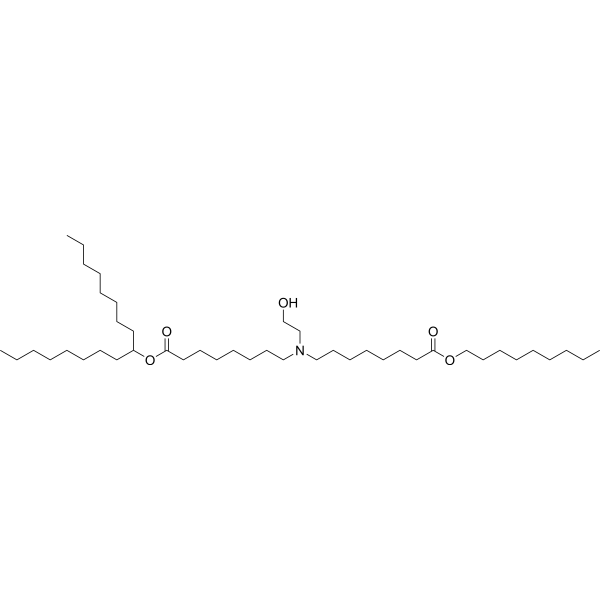
Lipid 5 is an amino lipid that affords efficient mRNA delivery in rodent and primate models. Lipid 5 shows optimal pharmacokinetics and non-toxic side effects.
Nos produits utilisent uniquement pour la recherche. Nous ne vendons pas aux patients.
- Pureté : 99.91%
- CAS No.: 2089251-33-0
- Formule: C44H87NO5
- Masse moléculaire:710.17
-
Stockage:Pure form -20°C, 3 years , 4°C, 2 years ; In solvent -80°C, 6 months , -20°C, 1 month

To place orders, for customer services and technical support, please contact: MedChemExpress USA
Tel: 609-228-6898 E-mail: [email protected] [email protected]


-
 Activité biologique
-
Chemical Information
-
Solvant et solubilité
- Protocole
- Pureté et documentation
- Références
-
 Help & FAQs


-
HY-112251
D-Lin-MC3-DMAsiRNA Delivery Vehicle -
HY-148648
Lipid 29Lipid -
HY-147332
TCL053Nucleic Acid Carrier -
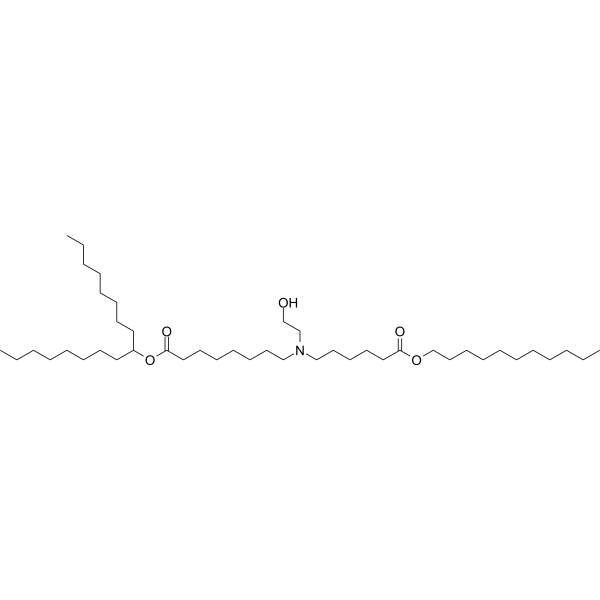
HY-134541
SM-102Ionizable Amino Lipid -
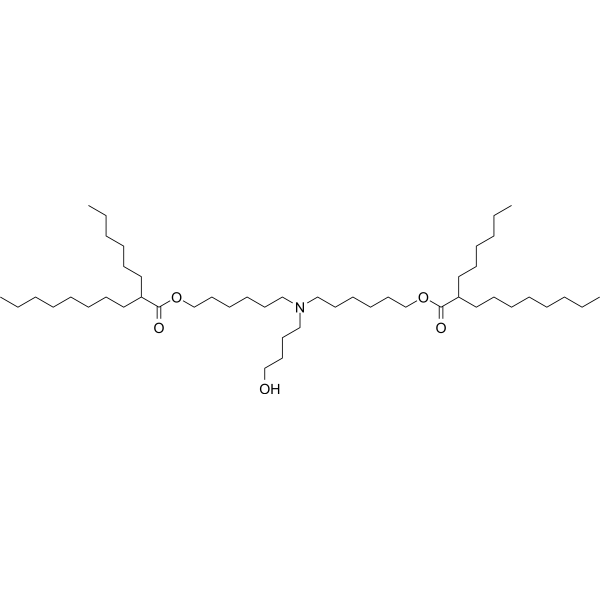
HY-138170
ALC-0315Lipid Nanoparticle Component -
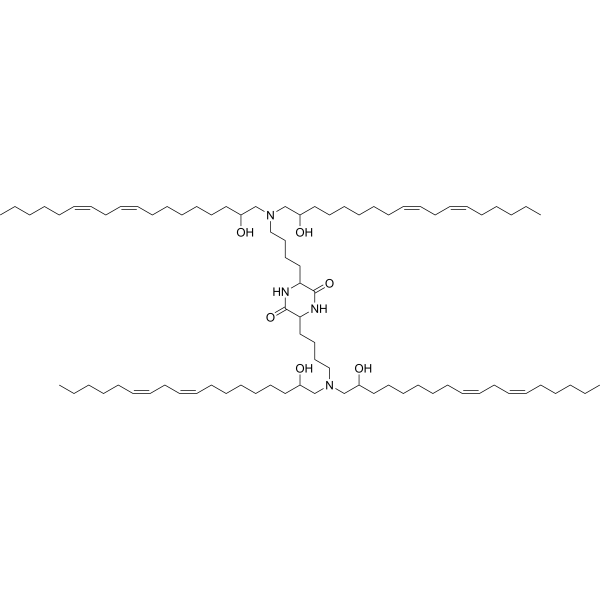
HY-145795
OF-02Ionizable Lipid -
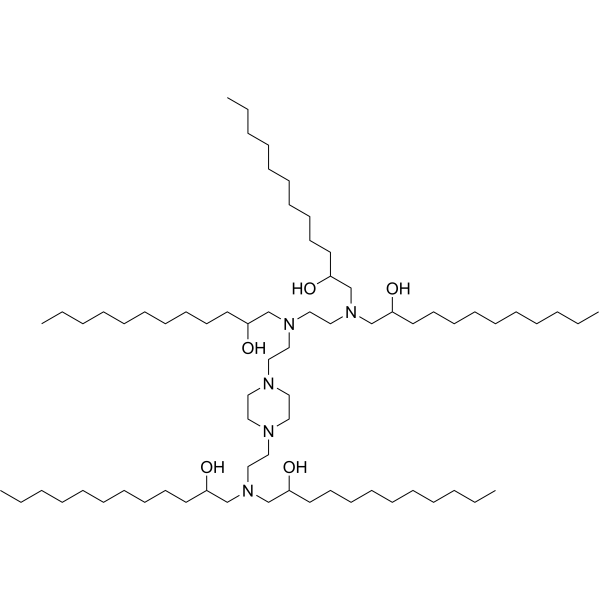
HY-145405
C12-200Cationic Lipidoid -
HY-N0171A
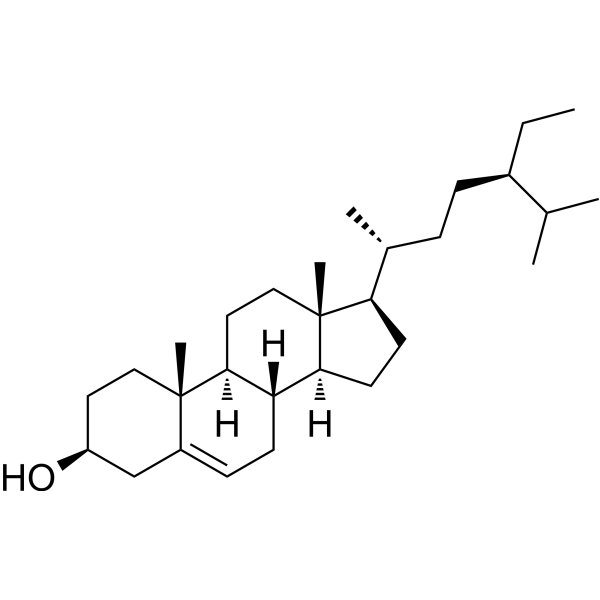
Beta-Sitosterol (purity>98%)Dietary Plant Sterols -
HY-46760
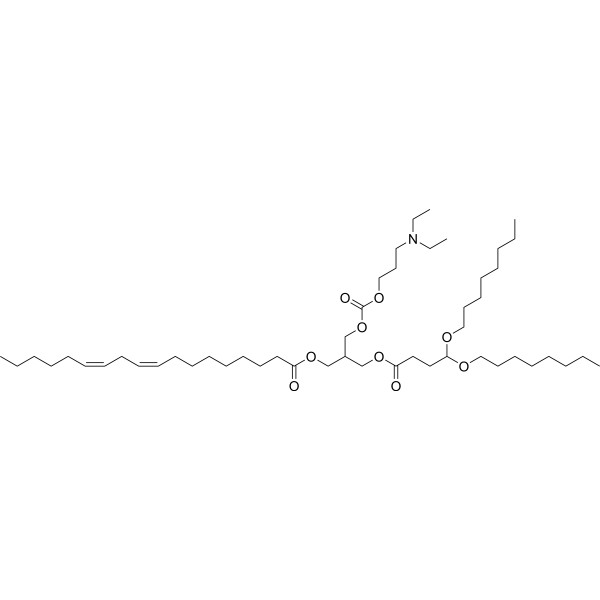
LP01Cationic Lipid -
HY-130149
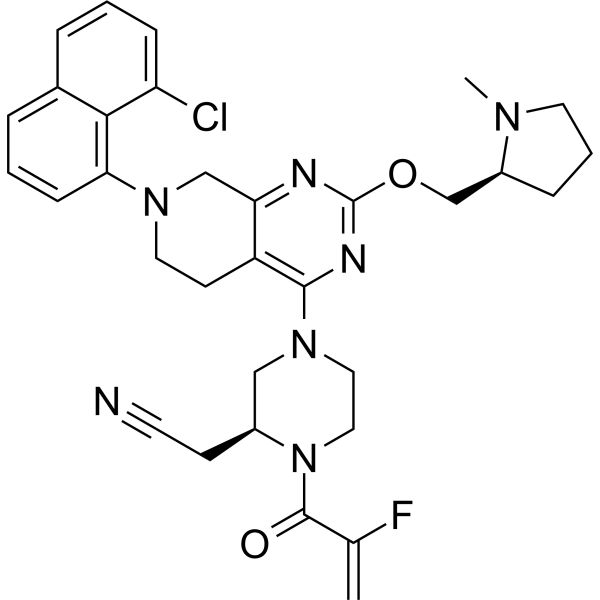
AdagrasibKRAS G12C Inhibitor -
HY-112758
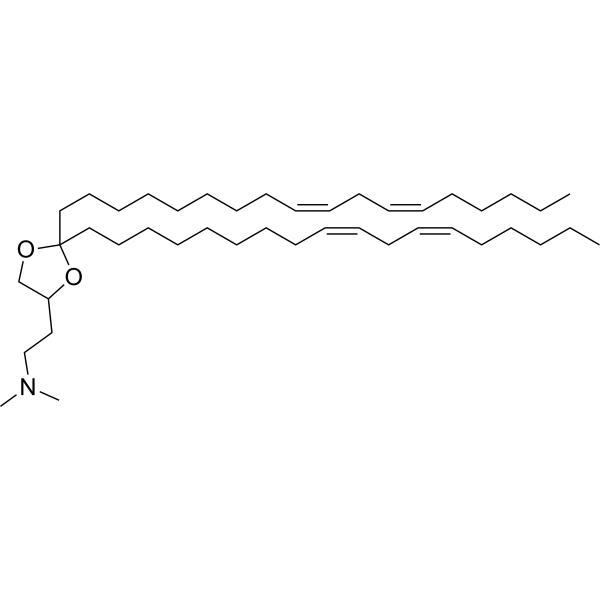
DLin-KC2-DMAIonizable Cationic Lipid -
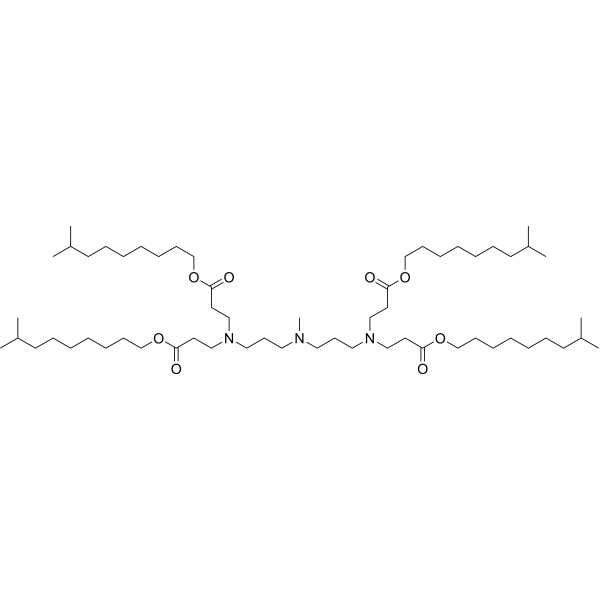
HY-151507
306Oi10Ionizable Lipidoid
Publications Citing Use of MedChemExpress (MCE) Lipid 5
More Customer Validation & Images

-
Bio/Physico-chemical Assay
-
Bio/Physico-chemical Assay
-
Bio/Physico-chemical Assay


Activité biologique
Description
In Vitro
Replacement of the linoleic tail with a primary ester-containing lipid tail (Lipid 5) provids increased expression and optimal tissue clearance. The metabolite identification studies with Lipid 5 indicated that hydrolysis of the primary ester is the first step in the metabolism of the lipid[1].
MedChemExpress (MCE) has not independently confirmed the accuracy of these methods. They are for reference only.
In Vivo
MedChemExpress (MCE) has not independently confirmed the accuracy of these methods. They are for reference only.


Chemical Information
-
CAS No. 2089251-33-0
-
Appearance Liquid (Density: 0.925 g/cm3)
-
Masse moléculaire 710.17
-
Formule C44H87NO5
-
Color Colorless to light yellow
-
SMILES
O=C(OC(CCCCCCCC)CCCCCCCC)CCCCCCCN(CCO)CCCCCCCC(OCCCCCCCCC)=O
-
Livraison
Room temperature in continental US; may vary elsewhere.
-
Stockage
Pure form -20°C 3 years 4°C 2 years In solvent -80°C 6 months -20°C 1 month


Publications (3)
-
Journal Impact Factor
-
Most Recent
-
Int J Nanomedicine
Intraperitoneal Co-Delivery of Claudin18.2×41BB and EpCAM×CD3 Bispecific Antibodies via mRNA-LNPs Synergistically Suppresses Gastric Cancer Peritoneal Metastasis Through T Cell Co-Activation. [Abstract]2026 Mar 20:21:577606. PMID: 41884275 -
Int J Pharm
Lipid nanoparticle properties explored using online asymmetric flow field-flow fractionation coupled with small angle X-ray scattering: Beyond average characterisation. [Abstract]2025 Jan 5:668:124940. PMID: 39532273
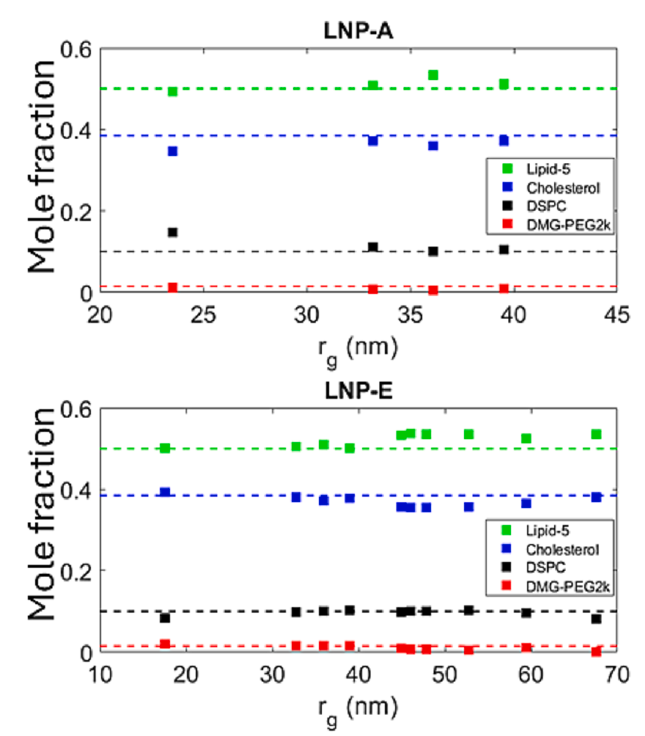
Lipid 5 purchased from MedChemExpress. Usage Cited in: Int J Pharm. 2025 Jan 5:668:124940. [Abstract]
Mole fraction of Lipid 5 (2.125 mM) as a function of particle size of LNPs.
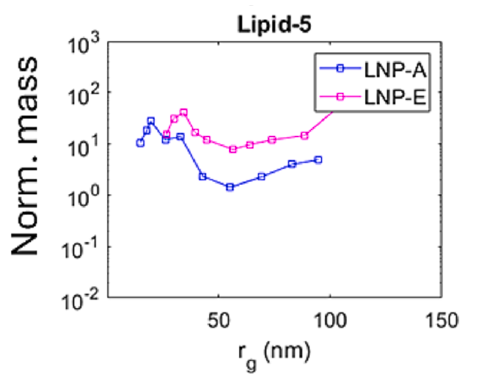
Lipid 5 purchased from MedChemExpress. Usage Cited in: Int J Pharm. 2025 Jan 5:668:124940. [Abstract]
Lipid 5 (2.125 mM) in LNP formulations against lipid concentration (obtained from AF4-dRI signal) were plotted versus Rg.
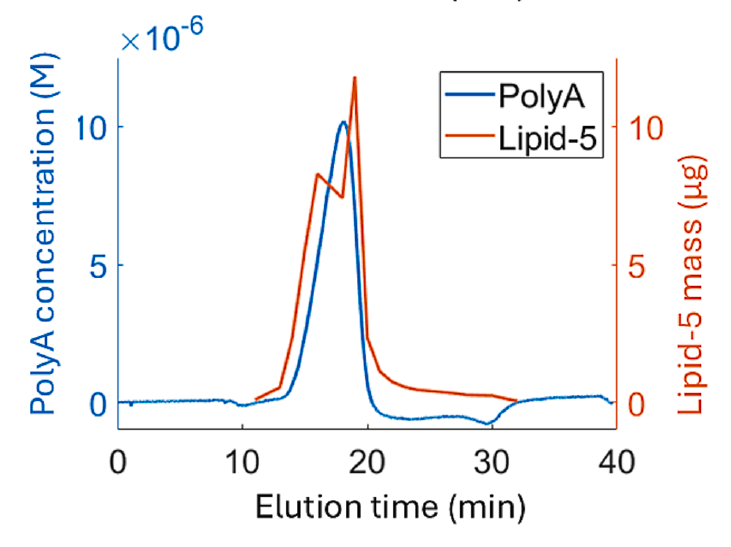
Lipid 5 purchased from MedChemExpress. Usage Cited in: Int J Pharm. 2025 Jan 5:668:124940. [Abstract]
The overlay of Lipid 5 (2.125 mM) mass (orange) and polyA (blue) was plotted against time.
-
bioRxiv
Structural heterogeneity in mRNA-LNP subpopulations revealed by AF4-SAXS: implications for cargo loading and cell transfection. [Abstract]2026 Jan 17:2026.01.16.699683. PMID: 41648519


Solvant et solubilité
In Vitro:
DMSO : 100 mg/mL (140.81 mM; Need ultrasonic; Hygroscopic DMSO has a significant impact on the solubility of product, please use newly opened DMSO)
Ethanol : 20 mg/mL (28.16 mM; Need ultrasonic)
Please refer to the solubility information to select the appropriate solvent. Once prepared, please aliquot and store the solution to prevent product inactivation from repeated freeze-thaw cycles.
Storage method and period of stock solution: -80°C, 6 months; -20°C, 1 month. When stored at -80°C, please use it within 6 months. When stored at -20°C, please use it within 1 month.
Please refer to the solubility information to select the appropriate solvent. Once prepared, please aliquot and store the solution to prevent product inactivation from repeated freeze-thaw cycles.
Storage method and period of stock solution: -80°C, 6 months; -20°C, 1 month. When stored at -80°C, please use it within 6 months. When stored at -20°C, please use it within 1 month.
Concentration (start) × Volume (start) = Concentration (final) × Volume (final)
In Vivo:
Select the appropriate dissolution method based on your experimental animal and administration route.
- For the following dissolution methods, please ensure to first prepare a clear stock solution using an In Vitro approach and then sequentially add co-solvents:
- To ensure reliable experimental results, the clarified stock solution can be appropriately stored based on storage conditions. As for the working solution for In Vivo experiments, it is recommended to prepare freshly and use it on the same day.
- The percentages shown for the solvents indicate their volumetric ratio in the final prepared solution. If precipitation or phase separation occurs during preparation, heat and/or sonication can be used to aid dissolution.
Add each solvent one by one: 10% DMSO 40% PEG300 5% Tween-80 45% Saline
Solubility: 2.5 mg/mL (3.52 mM); Suspended solution; Need ultrasonic
This protocol yields a suspended solution of 2.5 mg/mL. Suspended solution can be used for oral and intraperitoneal injection.
Taking 1 mL working solution as an example, add 100 μL DMSO stock solution (25.0 mg/mL) to 400 μL PEG300, and mix evenly; then add 50 μL Tween-80 and mix evenly; then add 450 μL Saline to adjust the volume to 1 mL.
Preparation of Saline: Dissolve 0.9 g sodium chloride in ddH₂O and dilute to 100 mL to obtain a clear Saline solution.
Add each solvent one by one: 10% DMSO 90% (20% SBE-β-CD in Saline)
Solubility: 2.5 mg/mL (3.52 mM); Suspended solution; Need ultrasonic
This protocol yields a suspended solution of 2.5 mg/mL. Suspended solution can be used for oral and intraperitoneal injection.
Taking 1 mL working solution as an example, add 100 μL DMSO stock solution (25.0 mg/mL) to 900 μL 20% SBE-β-CD in Saline, and mix evenly.
Preparation of 20% SBE-β-CD in Saline (4°C, storage for one week): 2 g SBE-β-CD powder is dissolved in 10 mL Saline, completely dissolve until clear.
In Vivo Dissolution Calculator
Please enter the basic information of animal experiments:
-
-
-
-
Recommended: Prepare an additional quantity of animals to account for potential losses during experiments.
Please enter your animal formula composition:
-
%DMSO +
Recommended: Keep the proportion of DMSO in working solution below 2% if your animal is weak.
-
%+
-
+%Tween-80 + +
-
%Saline +
The co-solvents required include: DMSO, . All of co-solvents are available by MedChemExpress (MCE). , Tween 80. All of co-solvents are available by MedChemExpress (MCE).
Working solution concentration: 0.22 mg/mL
Method for preparing stock solution: mg drug dissolved in μL DMSO. Stock solution concentration: mg/mL.
1. Take μL DMSO stock solution;
2. Add μL .
μL , mix evenly;
3. Then add μL Tween 80, mix evenly;
4. Then add μL
Please ensure that the stock solution in the first step is dissolved to a clear state, and add co-solvents in sequence. You can use ultrasonic heating (ultrasonic cleaner, recommended frequency 20-40 kHz), vortexing, etc. to assist dissolution.


Pureté et documentation
-
Fiche technique (271 KB)
-
SDS (419 KB)
- English - EN (419 KB)
- Français - FR (419 KB)
- Deutsch - DE (419 KB)
- Norwegian - NO (419 KB)
- Español - ES (419 KB)
- Swedish - SV (419 KB)
- Italian - IT (419 KB)
- Korean - KR (419 KB)
- Portuguese - PT (419 KB)
-
Instruction de manipulation (2659 KB)
Références


Complete Stock Solution Preparation Table
Please refer to the solubility information to select the appropriate solvent. Once prepared, please aliquot and store the solution to prevent product inactivation from repeated freeze-thaw cycles.
Storage method and period of stock solution: -80°C, 6 months; -20°C, 1 month. When stored at -80°C, please use it within 6 months. When stored at -20°C, please use it within 1 month.
| Optional Solvent | Concentration Solvent Mass | 1 mg | 5 mg | 10 mg | 25 mg |
|---|---|---|---|---|---|
| Ethanol / DMSO | 1 mM | 1.4081 mL | 7.0406 mL | 14.0811 mL | 35.2028 mL |
| 5 mM | 0.2816 mL | 1.4081 mL | 2.8162 mL | 7.0406 mL | |
| 10 mM | 0.1408 mL | 0.7041 mL | 1.4081 mL | 3.5203 mL | |
| 15 mM | 0.0939 mL | 0.4694 mL | 0.9387 mL | 2.3469 mL | |
| 20 mM | 0.0704 mL | 0.3520 mL | 0.7041 mL | 1.7601 mL | |
| 25 mM | 0.0563 mL | 0.2816 mL | 0.5632 mL | 1.4081 mL | |
| DMSO | 30 mM | 0.0469 mL | 0.2347 mL | 0.4694 mL | 1.1734 mL |
| 40 mM | 0.0352 mL | 0.1760 mL | 0.3520 mL | 0.8801 mL | |
| 50 mM | 0.0282 mL | 0.1408 mL | 0.2816 mL | 0.7041 mL | |
| 60 mM | 0.0235 mL | 0.1173 mL | 0.2347 mL | 0.5867 mL | |
| 80 mM | 0.0176 mL | 0.0880 mL | 0.1760 mL | 0.4400 mL | |
| 100 mM | 0.0141 mL | 0.0704 mL | 0.1408 mL | 0.3520 mL |


Lipid 5 Related Classifications
HY-138171 Related Classifications
 Powered by Bioz