



Transtorine

Based on 1 Customer Validation
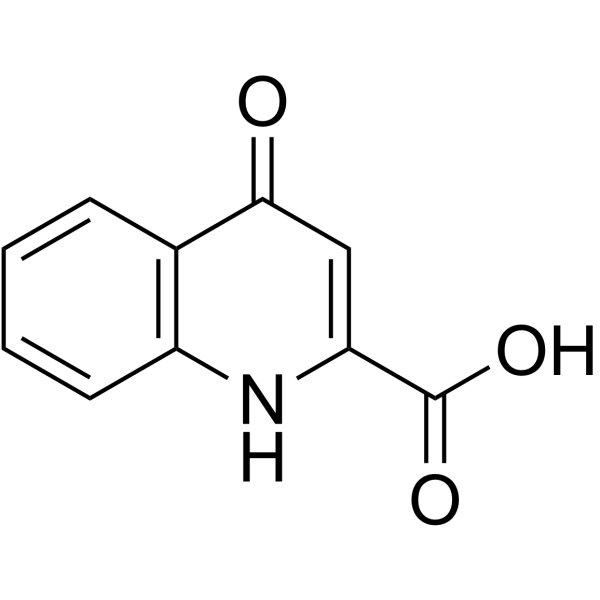
Transtorine is a quinoline alkaloid, found from Ephedra transitoria, with antibacterial activity.
Nos produits utilisent uniquement pour la recherche. Nous ne vendons pas aux patients.
- Pureté : 99.84%
- CAS No.: 13593-94-7
- Formule: C10H7NO3
- Masse moléculaire:189.17
-
Stockage:Powder -20°C, 3 years , 4°C, 2 years ; In solvent -80°C, 6 months , -20°C, 1 month

To place orders, for customer services and technical support, please contact: MedChemExpress USA
Tel: 609-228-6898 E-mail: [email protected] [email protected]


-
 Activité biologique
-
Chemical Information
-
Solvant et solubilité
- Protocole
- Pureté et documentation
- Références
-
 Help & FAQs




Activité biologique
Description
Cellular Effect
|
Cell Line

|
Type | Value | Description | References |
|---|---|---|---|---|
| CHO | EC50 |
217 μM
Compound: 1
|
Agonist activity at human GPR35 expressed in CHO cells assessed as induction of beta-arrestin recruitment after 90 mins by beta-galactosidase reporter gene assay
Agonist activity at human GPR35 expressed in CHO cells assessed as induction of beta-arrestin recruitment after 90 mins by beta-galactosidase reporter gene assay
|
[PMID: 23713606] |
| CHO | EC50 |
39.2 μM
Compound: 1
|
Agonist activity at human GPR35 expressed in CHO cells assessed as increase in intracellular Ca2+ measured over 20 secs by Aequorin assay
Agonist activity at human GPR35 expressed in CHO cells assessed as increase in intracellular Ca2+ measured over 20 secs by Aequorin assay
|
[PMID: 23888932] |
| CHO | EC50 |
66 μM
Compound: 1
|
Agonist activity at rat GPR35 expressed in CHO cells assessed as induction of beta-arrestin recruitment after 90 mins by beta-galactosidase reporter gene assay
Agonist activity at rat GPR35 expressed in CHO cells assessed as induction of beta-arrestin recruitment after 90 mins by beta-galactosidase reporter gene assay
|
[PMID: 23713606] |
| HT-29 | EC50 |
152 μM
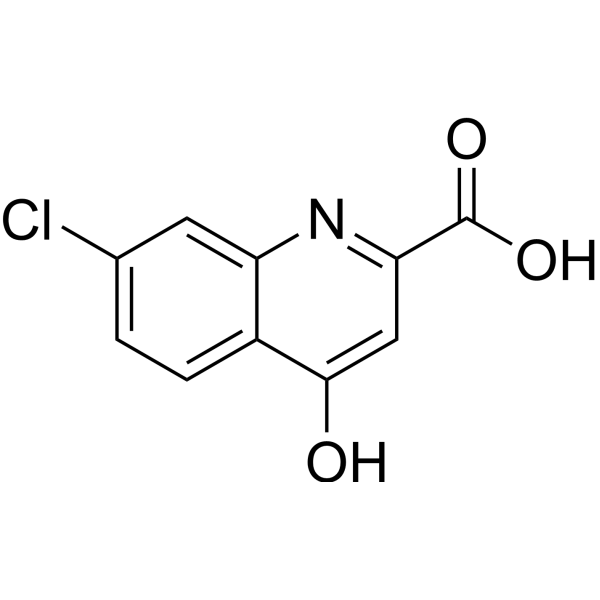
Compound: Kynurenic acid
|
Agonist activity at GPR35 in human HT-29 cells by dynamic mass redistribution assay
Agonist activity at GPR35 in human HT-29 cells by dynamic mass redistribution assay
|
[PMID: 22572579] |
| U2OS | EC50 |
>500 μM
Compound: Kynurenic acid
|
Agonist activity at GPR35 in human U20S cells expressing beta-lactamase and Gal4-VP16 transcription factor assessed as beta arrestin translocation after 5 hrs by Tango assay
Agonist activity at GPR35 in human U20S cells expressing beta-lactamase and Gal4-VP16 transcription factor assessed as beta arrestin translocation after 5 hrs by Tango assay
|
[PMID: 22572579] |
In Vitro
Transtorine shows growth inhibitory activity against Staphylococcus aureus, Pseudomonas aeruginosa and Enterobacter cloacae, with MIC 0.38, 0.5, and 0.45 mg/mL, respectively[1].
MedChemExpress (MCE) has not independently confirmed the accuracy of these methods. They are for reference only. Further protocols information, click here.


Chemical Information
-
CAS No. 13593-94-7
-
Appearance Solid
-
Masse moléculaire 189.17
-
Formule C10H7NO3
-
Color White to off-white
-
SMILES
O=C(C(NC1=C2C=CC=C1)=CC2=O)O
-
Structure Classification
-
Initial Source
-
Livraison
Room temperature in continental US; may vary elsewhere.
-
Stockage
Powder -20°C 3 years 4°C 2 years In solvent -80°C 6 months -20°C 1 month


Solvant et solubilité
In Vitro:
DMSO : 3.33 mg/mL (17.60 mM; ultrasonic and warming and heat to 60°C; Hygroscopic DMSO has a significant impact on the solubility of product, please use newly opened DMSO)
Please refer to the solubility information to select the appropriate solvent. Once prepared, please aliquot and store the solution to prevent product inactivation from repeated freeze-thaw cycles.
Storage method and period of stock solution: -80°C, 6 months; -20°C, 1 month. When stored at -80°C, please use it within 6 months. When stored at -20°C, please use it within 1 month.
Please refer to the solubility information to select the appropriate solvent. Once prepared, please aliquot and store the solution to prevent product inactivation from repeated freeze-thaw cycles.
Storage method and period of stock solution: -80°C, 6 months; -20°C, 1 month. When stored at -80°C, please use it within 6 months. When stored at -20°C, please use it within 1 month.
Concentration (start) × Volume (start) = Concentration (final) × Volume (final)

Protocole
-
Research Protocol for Infectious Diseases
Infectious-disease experiments test how pathogens interact with host barriers, innate immune receptors, inflammatory signaling, pathogen replication, and tissue injury; pattern-recognition receptors such as TLRs, RIG-I-like receptors, NOD-like receptors, and inflammasomes detect microbial molecules and activate NF-κB, interferon, and cytokine responses. The central hypothesis is that infection severity reflects the balance between pathogen burden and host response: protective inflammation restricts pathogen growth, whereas excessive or mislocalized inflammation contributes to tissue damage and disease phenotype. Unresolved questions include which host pathways are protective versus pathogenic, why some infection models fail to translate to human disease, and which combined readouts best predict clinically relevant infection outcomes.
-
Bacterial live/dead nucleic-acid viability staining
The LIVE/DEAD bacterial viability staining method is based on differential permeability of nucleic-acid-binding fluorescent dyes, most commonly SYTO 9 and propidium iodide (PI), which enables discrimination of bacterial populations with intact versus compromised cytoplasmic membranes. SYTO 9 penetrates both intact and damaged bacterial membranes and binds nucleic acids to produce green fluorescence, whereas propidium iodide penetrates only cells with compromised membranes and fluoresces red while also reducing SYTO 9 signal through competitive binding and fluorescence interactions. The resulting fluorescence pattern is interpreted as a proxy for membrane integrity, which is widely used as an indicator of bacterial viability in microscopy, flow cytometry, and spectroscopic platforms. However, mechanistic studies show that SYTO 9 and PI interactions involve displacement and fluorescence resonance energy transfer effects, which can influence signal interpretation depending on dye ratios a


Pureté et documentation
-
Fiche technique (271 KB)
-
SDS (393 KB)
- English - EN (393 KB)
- Français - FR (393 KB)
- Deutsch - DE (393 KB)
- Norwegian - NO (393 KB)
- Español - ES (393 KB)
- Swedish - SV (393 KB)
- Italian - IT (393 KB)
- Korean - KR (393 KB)
- Portuguese - PT (393 KB)
-
Instruction de manipulation (2659 KB)
Références


Complete Stock Solution Preparation Table
Please refer to the solubility information to select the appropriate solvent. Once prepared, please aliquot and store the solution to prevent product inactivation from repeated freeze-thaw cycles.
Storage method and period of stock solution: -80°C, 6 months; -20°C, 1 month. When stored at -80°C, please use it within 6 months. When stored at -20°C, please use it within 1 month.
| Optional Solvent | Concentration Solvent Mass | 1 mg | 5 mg | 10 mg | 25 mg |
|---|---|---|---|---|---|
| DMSO | 1 mM | 5.2863 mL | 26.4313 mL | 52.8625 mL | 132.1563 mL |
| 5 mM | 1.0573 mL | 5.2863 mL | 10.5725 mL | 26.4313 mL | |
| 10 mM | 0.5286 mL | 2.6431 mL | 5.2863 mL | 13.2156 mL | |
| 15 mM | 0.3524 mL | 1.7621 mL | 3.5242 mL | 8.8104 mL |


Transtorine Related Classifications
HY-W110662 Related Classifications
 Powered by Bioz