



Carbomer 940

Based on 1 Customer Validation
Carbomer 940 (CBM 940) is an acrylic polymer with high viscosity, good thermal stability and histocompatibility. Carbomer 940 serves as a transdermal drug delivery carrier and an external gel matrix. Carbomer 940 has no cytotoxicity, and it can also improve blood supply in the stasis zone of burns and promote wound repair. Carbomer 940 is applicable to pharmaceutical research.
For research use only. We do not sell to patients.
- Purity : 95.0%
- CAS No.: 9007-20-9
-
Storage:Powder -20°C, 3 years , 4°C, 2 years ; In solvent -80°C, 6 months , -20°C, 1 month


To place orders, for customer services and technical support, please contact: MedChemExpress USA
Tel: 609-228-6898 E-mail: [email protected] [email protected]


-
 Biological Activity
-
Chemical Information
-
Solvent & Solubility
- Protocols
- Purity & Documentation
- References
-
 Help & FAQs


-
HY-Y0921
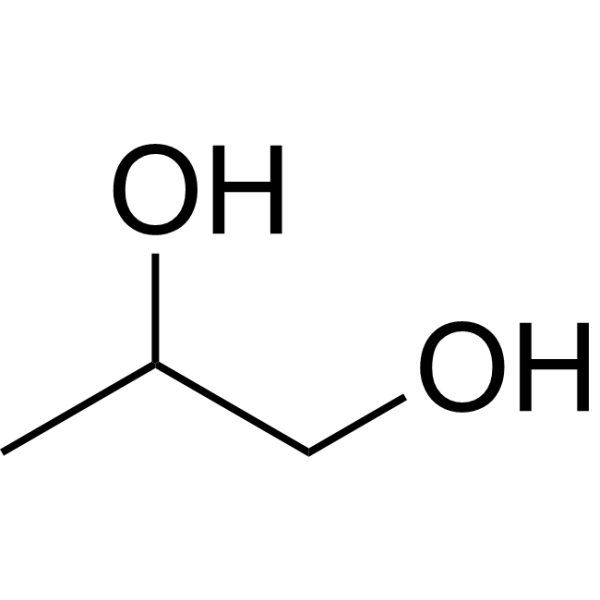
(±)-1,2-PropanediolCosolvent -

HY-W250721C
Carbomer 941Acrylic Acid Polymer -

HY-W250721B
Carbomer 934Biochemical Assay Reagent -

HY-W250721
Carbomer 980Biochemical Assay Reagent -

HY-W250721D
CarbomerAcrylic Acid Polymer -
HY-W250721E
Carbomer copolymerPharmaceutical Excipient -
HY-W250721F
Carbomer homopolymerAcrylic Acid Polymer -
HY-W250721G
Carbomer interpolymerAcrylic Acid Polymer -

HY-W250721H
Carbomer 970Thickening Agent -

HY-W250721I
Carbomer 990Thickening Agent -

HY-W250721J
Carbomer 960Thickening Agent -

HY-W250721K
Carbomer 996Thickening Agent


Biological Activity
Description
In Vitro
Carbomer 940 (24 h) shows no cytotoxicity to rat epithelial fibroblasts as determined by the MTT assay[1].
MedChemExpress (MCE) has not independently confirmed the accuracy of these methods. They are for reference only.
In Vivo
MedChemExpress (MCE) has not independently confirmed the accuracy of these methods. They are for reference only.
-
Animal Model:Wistar rats (male, adult, 300-350 g, full-thickness burn model)[1]
-
Dosage:1%
-
Administration:topical; daily; up to 21 days; in the form of hydrogel
-
Result:Improved tissue perfusion in the burn stasis zone, reduced the area of necrotic tissue.
Had no cytotoxicity, and promoted epithelial regeneration, collagen deposition and fibroplasia in the stasis zone.


Chemical Information
-
CAS No. 9007-20-9
-
Appearance Solid
-
Color White to off-white
-
SMILES
[Carbomer 940]
-
Synonyms
CBM 940
-
Shipping
Room temperature in continental US; may vary elsewhere.
-
Storage
Powder -20°C 3 years 4°C 2 years In solvent -80°C 6 months -20°C 1 month


Solvent & Solubility
In Vitro:
DMSO : 10 mg/mL (Need ultrasonic; Hygroscopic DMSO has a significant impact on the solubility of product, please use newly opened DMSO)


Purity & Documentation
-
Data Sheet (268 KB)
-
SDS (476 KB)
- English - EN (476 KB)
- Français - FR (476 KB)
- Deutsch - DE (476 KB)
- Norwegian - NO (476 KB)
- Español - ES (476 KB)
- Swedish - SV (476 KB)
- Italian - IT (476 KB)
- Korean - KR (476 KB)
- Portuguese - PT (476 KB)
-
Handling Instructions (2659 KB)
References

Calculators
Concentration (start) × Volume (start) = Concentration (final) × Volume (final)


Carbomer 940 Related Classifications
HY-W250721A Related Classifications
 Powered by Bioz