



67920-64-3
67920-64-3
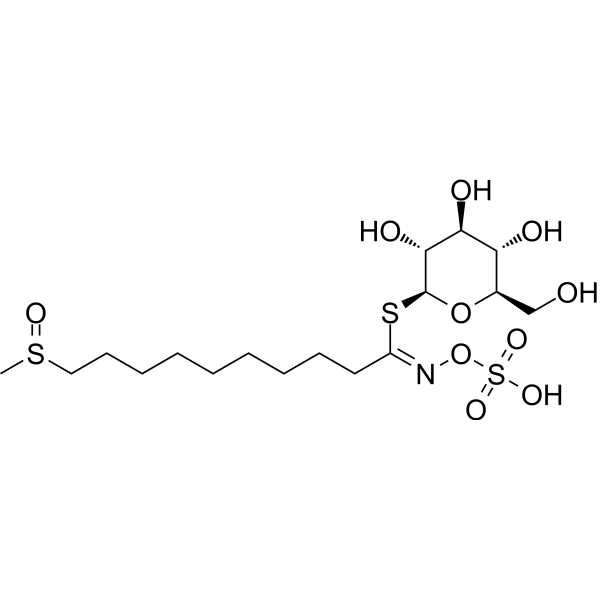
Chemical Structure
Glucoarabin
- CAS. Nr.: 67920-64-3
- Formula:C17H33NO10S3
- Molecular Weight:507.64
IUPAC Name: potassium ((Z)-1-(((2S,3R,4S,5S,6R)-3,4,5-trihydroxy-6-(hydroxymethyl)tetrahydro-2H-pyran-2-yl)thio)hex-5-en-1-ylidene)amino sulfate
InChIKey: UZAVCHRZWLGWMH-FMDIWTLESA-N
SMILES: CS(CCCCCCCCC/C(S[C@@H]1O[C@@H]([C@H]([C@@H]([C@H]1O)O)O)CO)=N/OS(=O)(O)=O)=O
Biological Activity: Glucoarabin is a glucosinolate. Glucoarabin upregulates NQO1. Glucoarabin is used in antioxidant research[1][2].
| Art. -Nr. | Produktname | Reinheit | Beschreibung | Pricing | |||||||||||||||||||
|---|---|---|---|---|---|---|---|---|---|---|---|---|---|---|---|---|---|---|---|---|---|---|---|
|
|
Glucoarabin | Glucoarabin is a glucosinolate. Glucoarabin upregulates NQO1. Glucoarabin is used in antioxidant research. | |||||||||||||||||||||
|
loading...
/
|
|||||||||||||||||||||||
References
- [1]. Pagnotta E, et al. Exploring the Camelina sativa value chain: a new opportunity for bio-based products and overall crop sustainability. Rivista Italiana delle Sostanze Grasse. 2019 Oct 1;96(4):259.
- [2]. Tavarini S, et al. Flaxseed and Camelina Meals as Potential Sources of Health-Beneficial Compounds. Plants (Basel, Switzerland). 2021 Jan 14;10(1):156.



