



74050-97-8
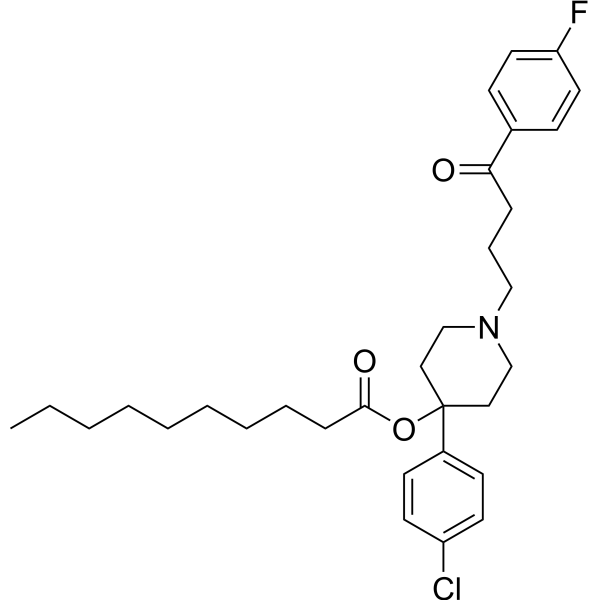
Chemical Structure
Haloperidol decanoate
- CAS No.: 74050-97-8
- Formula:C31H41ClFNO3
- Molecular Weight:530.11
IUPAC Name: 4-(4-chlorophenyl)-1-(4-(4-fluorophenyl)-4-oxobutyl)piperidin-4-yl decanoate
InChIKey: GUTXTARXLVFHDK-UHFFFAOYSA-N
SMILES: CCCCCCCCCC(OC1(C2=CC=C(Cl)C=C2)CCN(CCCC(C3=CC=C(F)C=C3)=O)CC1)=O
Biological Activity: Haloperidol decanoate is a depot preparation of haloperidol, a commonly used butyrophenone derivative with antipsychotic activity. Haloperidol decanoate can increase the striatal D2 receptor in rat. Haloperidol decanoate can improve conditions of psychoses (mainly schizophrenia). Haloperidol decanoate can lead to increased accumulation of the dopamine metabolites homo-vanillic acid. Haloperidol decanoate can reduce intestinal transport, increase gastric emptying and reduce acid output in rat model[1][4].
| Cat. No. | Product Name | Purity | Description | Pricing | |||||||||||||||||||
|---|---|---|---|---|---|---|---|---|---|---|---|---|---|---|---|---|---|---|---|---|---|---|---|
|
|
Haloperidol decanoate | 99.67% | Haloperidol decanoate is a depot preparation of haloperidol, a commonly used butyrophenone derivative with antipsychotic activity. Haloperidol decanoate can increase the striatal D2 receptor in rat. Haloperidol decanoate can improve conditions of psychoses (mainly schizophrenia). Haloperidol decanoate can lead to increased accumulation of the dopamine metabolites homo-vanillic acid. Haloperidol decanoate can reduce intestinal transport, increase gastric emptying and reduce acid output in rat model. | ||||||||||||||||||||
|
loading...
/
|
|||||||||||||||||||||||
|
|
Haloperidol decanoate (Standard) | ≥98% | Haloperidol decanoate (Standard) is the analytical standard of Haloperidol decanoate. This product is intended for research and analytical applications. Haloperidol decanoate is a depot preparation of haloperidol, a commonly used butyrophenone derivative with antipsychotic activity. Haloperidol decanoate can increase the striatal D2 receptor in rat. Haloperidol decanoate can improve conditions of psychoses (mainly schizophrenia). Haloperidol decanoate can lead to increased accumulation of the dopamine metabolites homo-vanillic acid. Haloperidol decanoate can reduce intestinal transport, increase gastric emptying and reduce acid output in rat model. | ||||||||||||||||||||
|
loading...
/
|
|||||||||||||||||||||||
-
Similarity Score 0.99
 HY-Z19603Haloperidol impurity 1 hydrachloride
-
Similarity Score 0.98
 HY-Z8190Haloperidol impurity 15
-
Similarity Score 0.98
 HY-Z8189Haloperidol impurity 14
-
Similarity Score 0.96
 HY-Z8191Haloperidol impurity 16
-
Similarity Score 0.96
 HY-Z8188Haloperidol impurity 13
-
Similarity Score 0.91
 HY-118551Bromperidol decanoate
-
Similarity Score 0.88
 HY-Z8186Haloperidol impurity 9
-
Similarity Score 0.86
 HY-Z8194Haloperidol impurity 11
-
Similarity Score 0.83
 HY-Z8187Haloperidol impurity 12
-

Explore the MedChemAI to find more analogs


References
- [1]. R Beresford, et al. Haloperidol decanoate. A preliminary review of its pharmacodynamic and pharmacokinetic properties and therapeutic use in psychosis. Drugs. 1987 Jan;33(1):31-49. [Content Brief]
- [4]. Akiyama, K., et al., (1987). Effect of chronic administration of haloperidol (intermittently) and haloperidol-decanoate (continuously) on D2 dopamine and muscarinic cholinergic receptors and on carbachol-stimulated phosphoinositide hydrolysis in the rat striatum. The Japanese journal of psychiatry and neurology, 41(2), 311–320. [Content Brief]



