



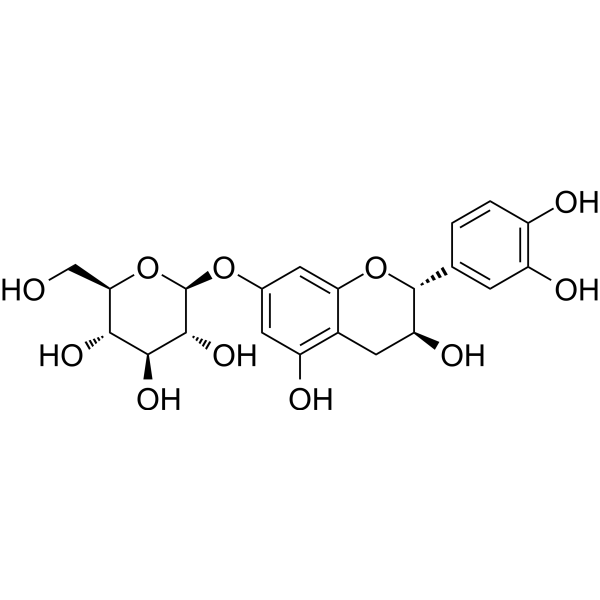
Catechin 7-O-β-D-glucopyranoside

Based on 1 Customer Validation
Catechin 7-O-beta-D-glucopyranoside is an orally active natural product found in Ulmus davidiana and Paeonia obovata. Catechin 7-O-β-D-glucopyranoside shows antioxidant and anti-inflammatory activities, and attenuates mitochondrial dysfunction. Catechin 7-O-beta-D-glucopyranoside can be used in intestinal inflammatory disease research.
For research use only. We do not sell to patients.
- Purity : 99.67%
- CAS No.: 65597-47-9
- Formula: C21H24O11
- Molecular Weight:452.41
-
Storage:
4°C, protect from light
* In solvent : -80°C, 6 months; -20°C, 1 month (protect from light)

To place orders, for customer services and technical support, please contact: MedChemExpress USA
Tel: 609-228-6898 E-mail: [email protected] [email protected]


-
 Biological Activity
-
Chemical Information
-
Solvent & Solubility
- Protocols
- Purity & Documentation
- References
-
 Help & FAQs




Biological Activity
Description
In Vitro
Catechin 7-O-β-D-glucopyranoside (10 μg/mL; 24 h) shows protective effect against Streptozotocin-induced cell damage by its antioxidant effects and the attenuation of mitochondrial dysfunction[3].
MedChemExpress (MCE) has not independently confirmed the accuracy of these methods. They are for reference only. Further protocols information, click here.
-
Cell Line:RINm5F rat pancreatic β-cells
-
Concentration:10 μg/mL
-
Incubation Time:24 hours
-
Result:Increased the MnSOD level attenuated by Streptozotocin treatment.
Restored the Streptozotocin-induced reduction in mitochondrial CAT level.
In Vivo
Catechin 7-O-β-D-glucopyranoside (oral administration; 10 mg/kg; once daily; 7 d) treatment prevents intestinal inflammatory damages in TNBS model of rat colitis[2].
MedChemExpress (MCE) has not independently confirmed the accuracy of these methods. They are for reference only.
-
Animal Model:Mice injected with LPS/D-GalN[1]
-
Dosage:10 mg/kg
-
Administration:Intraperitoneal injection; 10 mg/kg; once
-
Result:Showed 80% LPS/DGalN-induced lethality in mice.
-
Animal Model:Rat model of trinitrobenzenesulfonic acid (TNBS)-induced colitis [2]
-
Dosage:10 mg/kg
-
Administration:Oral administration; 10 mg/kg; once daily; 7 days
-
Result:Suppressed body weight loss and intestinal inflammatory damages in TNBS-induced colitic rats.
Reduced myeloperoxidase activity and malondialdehyde level, but increased glutathione level in the TNBS colitic rats.


Chemical Information
-
CAS No. 65597-47-9
-
Appearance Solid
-
Molecular Weight 452.41
-
Formula C21H24O11
-
Color White to off-white
-
SMILES
OC1=C2C(O[C@H](C3=CC(O)=C(C=C3)O)[C@H](C2)O)=CC(O[C@@H]4O[C@@H]([C@H]([C@@H]([C@H]4O)O)O)CO)=C1
-
Structure Classification
-
Shipping
Room temperature in continental US; may vary elsewhere.
-
Storage
4°C, protect from light
* In solvent : -80°C, 6 months; -20°C, 1 month (protect from light)


Solvent & Solubility
In Vitro:
DMSO : 125 mg/mL (276.30 mM; Need ultrasonic; Hygroscopic DMSO has a significant impact on the solubility of product, please use newly opened DMSO)
Please refer to the solubility information to select the appropriate solvent. Once prepared, please aliquot and store the solution to prevent product inactivation from repeated freeze-thaw cycles.
Storage method and period of stock solution: -80°C, 6 months; -20°C, 1 month (protect from light). When stored at -80°C, please use it within 6 months. When stored at -20°C, please use it within 1 month.
Please refer to the solubility information to select the appropriate solvent. Once prepared, please aliquot and store the solution to prevent product inactivation from repeated freeze-thaw cycles.
Storage method and period of stock solution: -80°C, 6 months; -20°C, 1 month (protect from light). When stored at -80°C, please use it within 6 months. When stored at -20°C, please use it within 1 month.
Concentration (start) × Volume (start) = Concentration (final) × Volume (final)

Protocols
-
Mitochondrial membrane-potential and mitochondrial mass staining
Mitochondrial membrane potential staining measures the electrochemical polarization across the mitochondrial inner membrane in live cells using lipophilic cationic fluorescent probes; early rhodamine-based work showed that selective mitochondrial dye accumulation is lost when the mitochondrial transmembrane potential is dissipated. JC-1 reports mitochondrial polarization by shifting from green monomer fluorescence to red J-aggregate fluorescence as dye concentration increases within energized mitochondria; therefore, the red/green fluorescence ratio is used as a relative readout of mitochondrial membrane potential. TMRE or TMRM staining provides a single-channel relative readout because these cationic rhodamine esters accumulate in polarized mitochondria, and lower fluorescence indicates reduced mitochondrial polarization when acquisition and dye-loading conditions are controlled. Mitochondrial mass staining is commonly performed with MitoTracker Green FM or related MitoTracker dyes as
-
Research Protocol for Inflammation-related Diseases
The NLRP3 inflammasome is a cytosolic innate immune signaling platform that integrates priming signals and danger-signal activation to promote caspase-1 activation, maturation of IL-1β and IL-18, and gasdermin D-mediated pyroptotic cell death. The core experimental logic is to determine whether inflammatory disease phenotypes are driven by increased NLRP3 expression, ASC-containing inflammasome assembly, caspase-1 cleavage, GSDMD cleavage, and extracellular release of IL-1β/IL-18 rather than by nonspecific cell injury alone. The pathway is strongly linked to inflammation-related disease phenotypes because monosodium urate crystals activate NALP3/NLRP3 inflammasome signaling in gout-like crystal inflammation, cholesterol crystals activate NLRP3 inflammasomes in atherogenesis models, and DSS-induced intestinal inflammation has been reported to involve NLRP3 inflammasome activity. However, experimental colitis studies also show context-dependent protective effects of NLRP3 inflammasome co


Purity & Documentation
-
Data Sheet (275 KB)
-
SDS (252 KB)
- English - EN (252 KB)
- Français - FR (252 KB)
- Deutsch - DE (252 KB)
- Norwegian - NO (252 KB)
- Español - ES (252 KB)
- Swedish - SV (252 KB)
- Italian - IT (252 KB)
- Korean - KR (252 KB)
- Portuguese - PT (252 KB)
-
Handling Instructions (2659 KB)
References
[1]. Zheng MS, et al. Protective constituents against sepsis in mice from the root barks of Ulmus davidiana var. japonica. Arch Pharm Res. 2011 Sep;34(9):1443-50. [Content Brief]
[2]. Kook SH, et al. Catechin-7-O-β-D-glucopyranoside isolated from the seed of Phaseolus calcaratus Roxburgh ameliorates experimental colitis in rats. Int Immunopharmacol. 2015 Dec;29(2):521-527. [Content Brief]
[3]. Kim KC, et al. Cytoprotective effects of catechin 7-O-β-D glucopyranoside against mitochondrial dysfunction damaged by streptozotocin in RINm5F cells. Cell Biochem Funct. 2010 Dec 2;28(8):651-60. [Content Brief]


Complete Stock Solution Preparation Table
Please refer to the solubility information to select the appropriate solvent. Once prepared, please aliquot and store the solution to prevent product inactivation from repeated freeze-thaw cycles.
Storage method and period of stock solution: -80°C, 6 months; -20°C, 1 month (protect from light). When stored at -80°C, please use it within 6 months. When stored at -20°C, please use it within 1 month.
| Optional Solvent | Concentration Solvent Mass | 1 mg | 5 mg | 10 mg | 25 mg |
|---|---|---|---|---|---|
| DMSO | 1 mM | 2.2104 mL | 11.0519 mL | 22.1038 mL | 55.2596 mL |
| 5 mM | 0.4421 mL | 2.2104 mL | 4.4208 mL | 11.0519 mL | |
| 10 mM | 0.2210 mL | 1.1052 mL | 2.2104 mL | 5.5260 mL | |
| 15 mM | 0.1474 mL | 0.7368 mL | 1.4736 mL | 3.6840 mL | |
| 20 mM | 0.1105 mL | 0.5526 mL | 1.1052 mL | 2.7630 mL | |
| 25 mM | 0.0884 mL | 0.4421 mL | 0.8842 mL | 2.2104 mL | |
| 30 mM | 0.0737 mL | 0.3684 mL | 0.7368 mL | 1.8420 mL | |
| 40 mM | 0.0553 mL | 0.2763 mL | 0.5526 mL | 1.3815 mL | |
| 50 mM | 0.0442 mL | 0.2210 mL | 0.4421 mL | 1.1052 mL | |
| 60 mM | 0.0368 mL | 0.1842 mL | 0.3684 mL | 0.9210 mL | |
| 80 mM | 0.0276 mL | 0.1381 mL | 0.2763 mL | 0.6907 mL | |
| 100 mM | 0.0221 mL | 0.1105 mL | 0.2210 mL | 0.5526 mL |


Catechin 7-O-β-D-glucopyranoside Related Classifications
HY-N10587 Related Classifications
 Powered by Bioz