



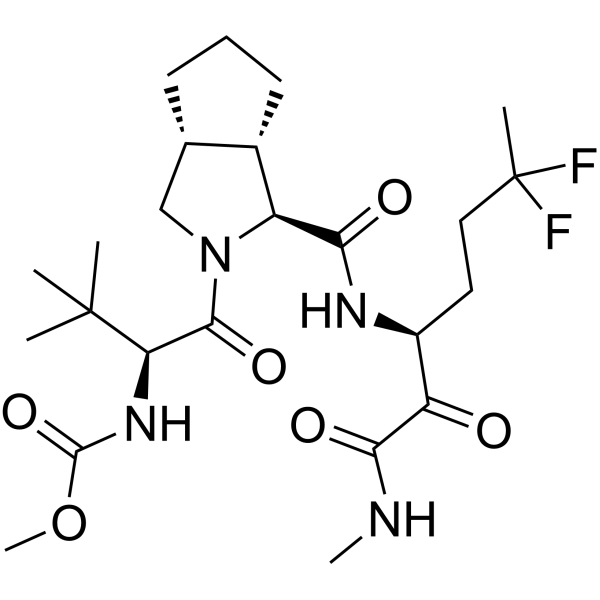
MK-7845
MK-7845 is an orally active and selective SARS-CoV-2 3CL protease (Mpro) inhibitor with an IC50 of 8.7 nM. MK-7845 forms a reversible covalent adduct with the catalytic cysteine, interacting with histidine through its difluorobutyl P1 group. MK-7845 exhibits antiviral activity against the WA1/2020 wild-type, Delta, and Omicron strains. MK-7845 demonstrates in vivo efficacy in a mouse SARS-CoV-2 infection model, reducing lung viral load and preventing body weight loss. MK-7845 can be used for research related to SARS-CoV-2 viral infection.
Nur für Forschungszwecke. Wir verkaufen nicht an Patienten.
- CAS. Nr.: 2952554-69-5
- Formel: C24H38F2N4O6
- Molecular Weight:516.58
-
Speicherung:
Please store the product under the recommended conditions in the Certificate of Analysis.

To place orders, for customer services and technical support, please contact: MedChemExpress USA
Tel: 609-228-6898 E-mail: [email protected] [email protected]


-
 Biologische Aktivität
-
Chemical Information
- Protokoll
- Reinheit & Dokumentation
- Verweise
-
 Help & FAQs




Biologische Aktivität
Beschreibung
IC50 & Target
IC50: 8.7 nM (3CLPro)[1]
In Vitro
MK-7845 (compound 27) inhibits SARS-CoV-2 3CLPro WT with an IC50 of 8.7 nM and the P132H mutant with an IC50 of 15 nM in a FRET biochemical assay[1].
MK-7845 inhibited the SARS-CoV-2 reporter replicon in A549 cells with an IC50 of 15 nM; it also prevented SARS-CoV-2-induced cytopathic effect in A549-ACE2-TMPRSS2 cells, with EC50 values of 444 nM, 351 nM, and 215 nM against the WA1/2020, Delta AY.2, and Omicron B.1.1.529+R346K strains, respectively.
MK-7845 showed modest 3.3-fold selectivity for cathepsin S and 82-fold to >1000-fold selectivity against eight other host proteases[1].
MK-7845 has a PXR IC50 >30 μM, with an Emax of 29% at 30 μM[1].
MK-7845 does not induce CYP1A2 in human hepatocytes, minimally induces CYP2B6, and at 20 μM induces CYP3A4 mRNA to 22-48% of the positive control[1].
MK-7845 is a weak reversible inhibitor of CYP enzymes in human liver microsomes and exhibits time-dependent inhibition of CYP3A, with a Ki of 110 μM and a kinact of 0.033 min−1[1].
MK-7845 undergoes epimerization in buffer and plasma, generating a mixture of diastereomers at the stereocenter adjacent to the ketoamide[1].
MK-7845 showed an MDCK Papp of 5.7 × 10⁻⁶ cm/s[1].
MedChemExpress (MCE) has not independently confirmed the accuracy of these methods. They are for reference only. Further protocols information, click here.
Parmacokinetics
In Vivo
MedChemExpress (MCE) has not independently confirmed the accuracy of these methods. They are for reference only.
-
Animal Model:Female transgenic B6 Cg-Tg (K18-ACE2) 2Prlmn/J mice (approximately 8-10 weeks old, infected with 50 μL of the virus stock with a final infection dose of 4.6 × 10⁴ TCID50)[1]
-
Dosage:100 mg/kg, 250 mg/kg, and 500 mg/kg
-
Administration:1 h before viral inoculation and 9 h after inoculation on day 0; twice daily on days 1-3 post inoculation (doses 10 h apart)
-
Result:Produced dose-dependent reductions in lung viral load beginning at 250 mg/kg, with a maximal decrease of about 5 orders of magnitude at 500 mg/kg on day 4 post inoculation.
Reduced viral RNA in lung tissue dose-dependently.
Provided full protection from bodyweight loss at all doses tested (100, 250, and 500 mg/kg).
Anwendung
1. This compound can be used as a tracer
2. This compound can be used as an internal standard for quantitative analysis by NMR, GC-MS, or LC-MS.


Chemical Information
-
CAS. Nr. 2952554-69-5
-
Molecular Weight 516.58
-
Formel C24H38F2N4O6
-
SMILES
CNC(C([C@@H](NC([C@@H]1[C@H]2CCC[C@H]2CN1C([C@H](C(C)(C)C)NC(OC)=O)=O)=O)CCC(F)(F)C)=O)=O
-
Versand
Room temperature in continental US; may vary elsewhere.
-
Speicherung
Please store the product under the recommended conditions in the Certificate of Analysis.

Protokoll
-
Research Protocol for Infectious Diseases
Infectious-disease experiments test how pathogens interact with host barriers, innate immune receptors, inflammatory signaling, pathogen replication, and tissue injury; pattern-recognition receptors such as TLRs, RIG-I-like receptors, NOD-like receptors, and inflammasomes detect microbial molecules and activate NF-κB, interferon, and cytokine responses. The central hypothesis is that infection severity reflects the balance between pathogen burden and host response: protective inflammation restricts pathogen growth, whereas excessive or mislocalized inflammation contributes to tissue damage and disease phenotype. Unresolved questions include which host pathways are protective versus pathogenic, why some infection models fail to translate to human disease, and which combined readouts best predict clinically relevant infection outcomes.
-
Cell Cytotoxicity Assay
Cytotoxicity assays are usually based on the assessment of cell membrane damage, which can also be indirectly detected by measuring cell viability. Detection methods include MTT assay, CKK-8 assay, LDH assay and ATP assay, etc.


Reinheit & Dokumentation
Verweise

Calculators
Konzentration (Stammlösung) × Volumen (Stammlösung) = Konzentration (Ziellösung) × Volumen (Ziellösung)


MK-7845 Related Classifications
HY-157778 Related Classifications
 Powered by Bioz