



Pro-xylane (30% in water)
Based on 1 publication(s) in Google Scholar
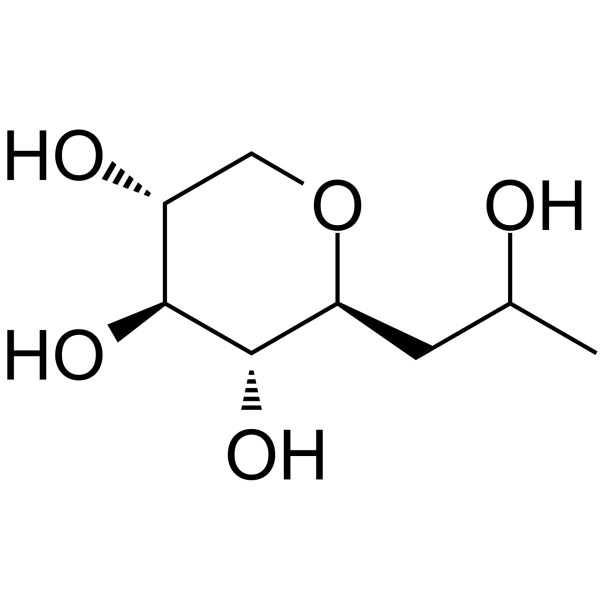
Pro-xylane (30% in water) (Hydroxypropyl tetrahydropyrantriol) is a bioactive C-glycoside that targets the biosynthesis pathway of glycosaminoglycans/mucopolysaccharides (GAGs) in the skin matrix and can be absorbed transdermally. Pro-xylane (30% in water) stimulates the biosynthesis of GAGs in fibroblasts, enhances the structural stability of the skin extracellular matrix, improves skin elasticity and moisturizing ability, and delays wrinkle formation. Pro-xylane (30% in water) can effectively promote the synthesis of collagen fibers and hyaluronic acid in the dermis. Pro-xylane (30% in water) is used in the field of anti-aging cosmetics to improve skin hydration and elasticity. Pro-xylane (30% in water) is eco-friendly and biodegradable.
Nur für Forschungszwecke. Wir verkaufen nicht an Patienten.
- Reinheit : 98.0%
- CAS. Nr.: 439685-79-7
- Formel: C8H16O5
- Molecular Weight:192.21
-
Speicherung:
Solution, -20°C, 2 years

To place orders, for customer services and technical support, please contact: MedChemExpress USA
Tel: 609-228-6898 E-mail: [email protected] [email protected]


-
 Biologische Aktivität
-
Chemical Information
- Protokoll
- Reinheit & Dokumentation
- Verweise
-
 Help & FAQs


Publications Citing Use of MedChemExpress (MCE) Pro-xylane (30% in water)
More

Biologische Aktivität
Beschreibung
In Vitro
Pro-xylane (30% in water) (0.3-3.0 mM; 96 h) stimulates the synthesis of GAGs in human fibroblasts[1].
Pro-xylane (30% in water) is the catalytic substrate of the recombinant carbonyl reductase R129E/D210F, whose key activity lies in the high stereoselectivity of the β-S configuration. Under the catalysis of R129E/D210F, Pro-xylane (30% in water) produces >99% β,S-diastereomeric excess[2].
Pro-xylane (30% in water) has the ability of efficient asymmetric synthesis[3].
MedChemExpress (MCE) has not independently confirmed the accuracy of these methods. They are for reference only.
In Vivo
MedChemExpress (MCE) has not independently confirmed the accuracy of these methods. They are for reference only.


Chemical Information
-
CAS. Nr. 439685-79-7
-
Appearance Liquid
-
Molecular Weight 192.21
-
Formel C8H16O5
-
Color Colorless to light yellow
-
SMILES
CC(O)C[C@H]1[C@@H]([C@H]([C@H](O)CO1)O)O
-
Synonyms
Hydroxypropyl tetrahydropyrantriol (30% in water)
-
Versand
Room temperature in continental US; may vary elsewhere.
-
Speicherung
Solution, -20°C, 2 years


Publications (1)
-
Journal Impact Factor
-
Most Recent
-
Mech Ageing Dev
Pro-Xylane alleviates ultraviolet-induced skin senescence through SGK1-mediated p21 ubiquitination and subcellular translocation. [Abstract]2026 Aug:232:112194. PMID: 42155870


Reinheit & Dokumentation
-
Data Sheet (273 KB)
-
SDS (393 KB)
- English - EN (393 KB)
- Français - FR (393 KB)
- Deutsch - DE (393 KB)
- Norwegian - NO (393 KB)
- Español - ES (393 KB)
- Swedish - SV (393 KB)
- Italian - IT (393 KB)
- Korean - KR (393 KB)
- Portuguese - PT (393 KB)
-
Handling Instructions (2659 KB)
Verweise
[1]. Cavezza A, et al. Synthesis of Pro-Xylane: a new biologically active C-glycoside in aqueous media. Bioorg Med Chem Lett. 2009 Feb 1;19(3):845-9. [Content Brief]
[2]. Dou Z, et al. Extensive gene mining and facile engineering of a novel carbonyl reductase for asymmetric synthesis of anti-aging (S)-Pro-Xylane from d-xylose. Int J Biol Macromol. 2025 May;305(Pt 2):140976. [Content Brief]
[3]. Zhao Y, et al. Engineering a Carbonyl Reductase for High-Efficiency Synthesis of Optically Pure (S)-Pro-Xylane: An Alternative Synthetic Route. J Agric Food Chem. 2025 Apr 23;73(16):9759-9768. [Content Brief]
[4]. Wu B, et al. Liposomal gel loaded with pro-xylane intermediate promotes chronic wound healing. Pak J Pharm Sci. 2024 Jul;37(4):723-730. [Content Brief]

Calculators
Konzentration (Stammlösung) × Volumen (Stammlösung) = Konzentration (Ziellösung) × Volumen (Ziellösung)


Pro-xylane (30% in water) Related Classifications
HY-108036 Related Classifications
 Powered by Bioz