



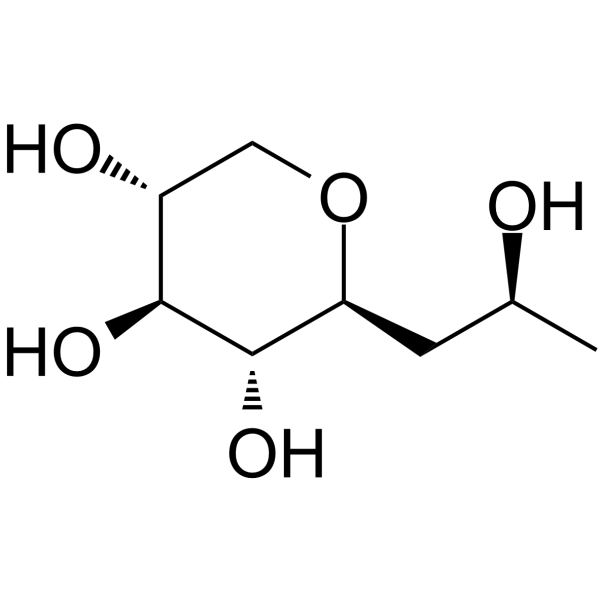
(S)-Pro-xylane

Based on 1 Customer Validation
(S)-Pro-xylane ((S)-Hydroxypropyl tetrahydropyrantriol) is a bioactive C-glycoside that targets the biosynthesis pathway of glycosaminoglycans/mucopolysaccharides (GAGs) in the skin matrix and can be absorbed transdermally. (S)-Pro-xylane stimulates the biosynthesis of GAGs in fibroblasts, enhances the structural stability of the skin extracellular matrix, improves skin elasticity and moisturizing ability, and delays wrinkle formation. (S)-Pro-xylane can effectively promote the synthesis of collagen fibers and hyaluronic acid in the dermis. (S)-Pro-xylane is used in the field of anti-aging cosmetics to improve skin hydration and elasticity. (S)-Pro-xylane is eco-friendly and biodegradable.
For research use only. We do not sell to patients.
- Purity : 99.72%
- CAS No.: 868156-46-1
- Formula: C8H16O5
- Molecular Weight:192.21
-
Storage:
4°C, sealed storage, away from moisture and light
* In solvent : -80°C, 6 months; -20°C, 1 month (sealed storage, away from moisture and light)

To place orders, for customer services and technical support, please contact: MedChemExpress USA
Tel: 609-228-6898 E-mail: [email protected] [email protected]


-
 Biological Activity
-
Chemical Information
-
Solvent & Solubility
- Protocols
- Purity & Documentation
- References
-
 Help & FAQs




Biological Activity
Description
In Vitro
(S)-Pro-xylane (0.3-3.0 mM; 96 h) stimulates the synthesis of GAGs in human fibroblasts[1].
(S)-Pro-xylane is the catalytic substrate of the recombinant carbonyl reductase R129E/D210F, whose key activity lies in the high stereoselectivity of the β-S configuration. Under the catalysis of R129E/D210F, (S)-Pro-xylane produces >99% β,S-diastereomeric excess[2].
(S)-Pro-xylane has the ability of efficient asymmetric synthesis[3].
MedChemExpress (MCE) has not independently confirmed the accuracy of these methods. They are for reference only.
In Vivo
MedChemExpress (MCE) has not independently confirmed the accuracy of these methods. They are for reference only.


Chemical Information
-
CAS No. 868156-46-1
-
Appearance Solid
-
Molecular Weight 192.21
-
Formula C8H16O5
-
Color White to off-white
-
SMILES
C[C@H](O)C[C@H](OC[C@H]1O)[C@@H]([C@H]1O)O
-
Synonyms
(S)-Hydroxypropyl tetrahydropyrantriol
-
Shipping
Room temperature in continental US; may vary elsewhere.
-
Storage
4°C, sealed storage, away from moisture and light
* In solvent : -80°C, 6 months; -20°C, 1 month (sealed storage, away from moisture and light)


Solvent & Solubility
In Vitro:
DMSO : 250 mg/mL (1300.66 mM; Need ultrasonic; Hygroscopic DMSO has a significant impact on the solubility of product, please use newly opened DMSO)
H2O : 100 mg/mL (520.26 mM; Need ultrasonic)
Please refer to the solubility information to select the appropriate solvent. Once prepared, please aliquot and store the solution to prevent product inactivation from repeated freeze-thaw cycles.
Storage method and period of stock solution: -80°C, 6 months; -20°C, 1 month (sealed storage, away from moisture and light). When stored at -80°C, please use it within 6 months. When stored at -20°C, please use it within 1 month.
* Note: If you choose water as the stock solution, please dilute it to the working solution, then filter and sterilize it with a 0.22 μm filter before use.
Please refer to the solubility information to select the appropriate solvent. Once prepared, please aliquot and store the solution to prevent product inactivation from repeated freeze-thaw cycles.
Storage method and period of stock solution: -80°C, 6 months; -20°C, 1 month (sealed storage, away from moisture and light). When stored at -80°C, please use it within 6 months. When stored at -20°C, please use it within 1 month.
* Note: If you choose water as the stock solution, please dilute it to the working solution, then filter and sterilize it with a 0.22 μm filter before use.
Concentration (start) × Volume (start) = Concentration (final) × Volume (final)
In Vivo:
Select the appropriate dissolution method based on your experimental animal and administration route.
- For the following dissolution methods, please ensure to first prepare a clear stock solution using an In Vitro approach and then sequentially add co-solvents:
- To ensure reliable experimental results, the clarified stock solution can be appropriately stored based on storage conditions. As for the working solution for In Vivo experiments, it is recommended to prepare freshly and use it on the same day.
- The percentages shown for the solvents indicate their volumetric ratio in the final prepared solution. If precipitation or phase separation occurs during preparation, heat and/or sonication can be used to aid dissolution.
Add each solvent one by one: 10% DMSO 40% PEG300 5% Tween-80 45% Saline
Solubility: ≥ 2.08 mg/mL (10.82 mM); Clear solution
This protocol yields a clear solution of ≥ 2.08 mg/mL (saturation unknown).
Taking 1 mL working solution as an example, add 100 μL DMSO stock solution (20.8 mg/mL) to 400 μL PEG300, and mix evenly; then add 50 μL Tween-80 and mix evenly; then add 450 μL Saline to adjust the volume to 1 mL.
Preparation of Saline: Dissolve 0.9 g sodium chloride in ddH₂O and dilute to 100 mL to obtain a clear Saline solution.
Add each solvent one by one: 10% DMSO 90% (20% SBE-β-CD in Saline)
Solubility: ≥ 2.08 mg/mL (10.82 mM); Clear solution
This protocol yields a clear solution of ≥ 2.08 mg/mL (saturation unknown).
Taking 1 mL working solution as an example, add 100 μL DMSO stock solution (20.8 mg/mL) to 900 μL 20% SBE-β-CD in Saline, and mix evenly.
Preparation of 20% SBE-β-CD in Saline (4°C, storage for one week): 2 g SBE-β-CD powder is dissolved in 10 mL Saline, completely dissolve until clear.
For the following dissolution methods, please prepare the working solution directly:
It is recommended to prepare fresh solutions and use them promptly within a short period of time.
The percentages shown for the solvents indicate their volumetric ratio in the final prepared solution. If precipitation or phase separation occurs during preparation, heat and/or sonication can be used to aid dissolution.
Add each solvent one by one: PBS
Solubility: 100 mg/mL (520.26 mM); Clear solution; Need ultrasonic
In Vivo Dissolution Calculator
Please enter the basic information of animal experiments:
-
-
-
-
Recommended: Prepare an additional quantity of animals to account for potential losses during experiments.
Working solution concentration: 0.22 mg/mL
This product has good water solubility, please refer to the measured solubility data in water/PBS/Saline for details.


Purity & Documentation
-
Data Sheet (276 KB)
-
SDS (393 KB)
- English - EN (393 KB)
- Français - FR (393 KB)
- Deutsch - DE (393 KB)
- Norwegian - NO (393 KB)
- Español - ES (393 KB)
- Swedish - SV (393 KB)
- Italian - IT (393 KB)
- Korean - KR (393 KB)
- Portuguese - PT (393 KB)
-
Handling Instructions (2659 KB)
References
[1]. Cavezza A, et al. Synthesis of Pro-Xylane: a new biologically active C-glycoside in aqueous media. Bioorg Med Chem Lett. 2009 Feb 1;19(3):845-9. [Content Brief]
[2]. Dou Z, et al. Extensive gene mining and facile engineering of a novel carbonyl reductase for asymmetric synthesis of anti-aging (S)-Pro-Xylane from d-xylose. Int J Biol Macromol. 2025 May;305(Pt 2):140976. [Content Brief]
[3]. Zhao Y, et al. Engineering a Carbonyl Reductase for High-Efficiency Synthesis of Optically Pure (S)-Pro-Xylane: An Alternative Synthetic Route. J Agric Food Chem. 2025 Apr 23;73(16):9759-9768. [Content Brief]
[4]. Wu B, et al. Liposomal gel loaded with pro-xylane intermediate promotes chronic wound healing. Pak J Pharm Sci. 2024 Jul;37(4):723-730. [Content Brief]


Complete Stock Solution Preparation Table
Please refer to the solubility information to select the appropriate solvent. Once prepared, please aliquot and store the solution to prevent product inactivation from repeated freeze-thaw cycles.
Storage method and period of stock solution: -80°C, 6 months; -20°C, 1 month (sealed storage, away from moisture and light). When stored at -80°C, please use it within 6 months. When stored at -20°C, please use it within 1 month.
| Optional Solvent | Concentration Solvent Mass | 1 mg | 5 mg | 10 mg | 25 mg |
|---|---|---|---|---|---|
| H2O / DMSO | 1 mM | 5.2026 mL | 26.0132 mL | 52.0264 mL | 130.0661 mL |
| 5 mM | 1.0405 mL | 5.2026 mL | 10.4053 mL | 26.0132 mL | |
| 10 mM | 0.5203 mL | 2.6013 mL | 5.2026 mL | 13.0066 mL | |
| 15 mM | 0.3468 mL | 1.7342 mL | 3.4684 mL | 8.6711 mL | |
| 20 mM | 0.2601 mL | 1.3007 mL | 2.6013 mL | 6.5033 mL | |
| 25 mM | 0.2081 mL | 1.0405 mL | 2.0811 mL | 5.2026 mL | |
| 30 mM | 0.1734 mL | 0.8671 mL | 1.7342 mL | 4.3355 mL | |
| 40 mM | 0.1301 mL | 0.6503 mL | 1.3007 mL | 3.2517 mL | |
| 50 mM | 0.1041 mL | 0.5203 mL | 1.0405 mL | 2.6013 mL | |
| 60 mM | 0.0867 mL | 0.4336 mL | 0.8671 mL | 2.1678 mL | |
| 80 mM | 0.0650 mL | 0.3252 mL | 0.6503 mL | 1.6258 mL | |
| 100 mM | 0.0520 mL | 0.2601 mL | 0.5203 mL | 1.3007 mL |
* Note: If you choose water as the stock solution, please dilute it to the working solution, then filter and sterilize it with a 0.22 μm filter before use.


(S)-Pro-xylane Related Classifications
HY-108036A Related Classifications
 Powered by Bioz