



Acipimox-d4

Based on 1 Customer Validation
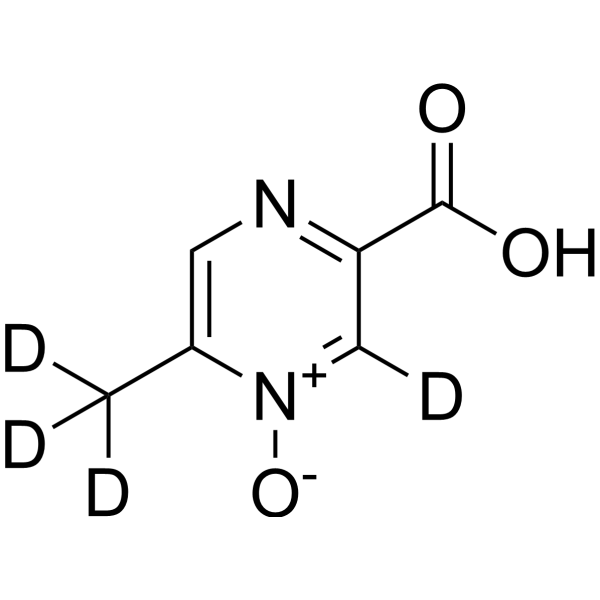
Acipimox-d4 is the deuterium labeled Acipimox. Acipimox (K-9321), a nicotinic acid analogue, is an antilipolytic compound. Acipimox acutely inhibits lipolysis and suppresses systemic levels of free fatty acids (FFAs) and improves insulin sensitivity.
Nos produits utilisent uniquement pour la recherche. Nous ne vendons pas aux patients.
- CAS No.: 1246816-28-3
- Formule: C6H2D4N2O3
- Masse moléculaire:158.15
-
Stockage:Powder -20°C, 3 years , 4°C, 2 years ; In solvent -80°C, 6 months , -20°C, 1 month

To place orders, for customer services and technical support, please contact: MedChemExpress USA
Tel: 609-228-6898 E-mail: [email protected] [email protected]


-
 Activité biologique
-
Chemical Information
- Protocole
- Pureté et documentation
- Références
-
 Help & FAQs




Activité biologique
Description
In Vitro
Stable heavy isotopes of hydrogen, carbon, and other elements have been incorporated into drug molecules, largely as tracers for quantitation during the drug development process. Deuteration has gained attention because of its potential to affect the pharmacokinetic and metabolic profiles of drugs[1].
MedChemExpress (MCE) has not independently confirmed the accuracy of these methods. They are for reference only. Further protocols information, click here.
Application
1. This compound can be used as a tracer
2. This compound can be used as an internal standard for quantitative analysis by NMR, GC-MS, or LC-MS.


Chemical Information
-
CAS No. 1246816-28-3
-
Unlabeled CAS 51037-30-0
-
Appearance Solid
-
Masse moléculaire 158.15
-
Formule C6H2D4N2O3
-
Color White to light brown
-
SMILES
[2H]C(C1=CN=C(C(O)=O)C([2H])=[N+]1[O-])([2H])[2H]
-
Synonyms
K-9321-d4
-
Livraison
Room temperature in continental US; may vary elsewhere.
-
Stockage
Powder -20°C 3 years 4°C 2 years In solvent -80°C 6 months -20°C 1 month

Protocole
-
Research Protocol for Endocrine Diseases
Endocrine diseases often arise from disrupted hormone production, hormone signaling, or target-tissue responsiveness; for diabetes-focused endocrine disease models, insulin signaling regulates glucose uptake, hepatic glucose output, lipid metabolism, and β-cell compensation. Type 2 diabetes develops through interacting defects in insulin resistance, β-cell dysfunction, adipose inflammation, hepatic glucose overproduction, altered incretin signaling, and ectopic lipid metabolism. A major unresolved question is whether endocrine dysfunction is driven primarily by target-tissue insulin resistance, intrinsic β-cell failure, immune/inflammatory stress, or combined multi-organ failure that differs by disease stage.


Pureté et documentation
-
Fiche technique (269 KB)
-
SDS (252 KB)
- Français - FR (252 KB)
- Deutsch - DE (252 KB)
- Norwegian - NO (252 KB)
- Español - ES (252 KB)
- Swedish - SV (252 KB)
- Italian - IT (252 KB)
- Korean - KR (252 KB)
- Portuguese - PT (252 KB)
-
Instruction de manipulation (2659 KB)
Références
[1]. Russak EM, et al. Impact of Deuterium Substitution on the Pharmacokinetics of Pharmaceuticals. Ann Pharmacother. 2019;53(2):211-216. [Content Brief]
[2]. Esben Thyssen Vestergaard, et al. Short‐term acipimox treatment is associated with decreased cardiac parasympathetic modulation. Br J Clin Pharmacol. 2017 Dec; 83(12): 2671-2677. [Content Brief]
[3]. Y-L Wang-Fisher, et al. Acipimox stimulates leptin production from isolated rat adipocytes. J Endocrinol. 2002 Aug;174(2):267-72. [Content Brief]
[4]. B Ahrén. Reducing plasma free fatty acids by acipimox improves glucose tolerance in high-fat fed mice. Acta Physiol Scand. 2001 Feb;171(2):161-7. [Content Brief]

Calculators
Concentration (start) × Volume (start) = Concentration (final) × Volume (final)


Acipimox-d4 Related Classifications
HY-B0283S Related Classifications
 Powered by Bioz