



DMNQ
Based on 11 publication(s) in Google Scholar
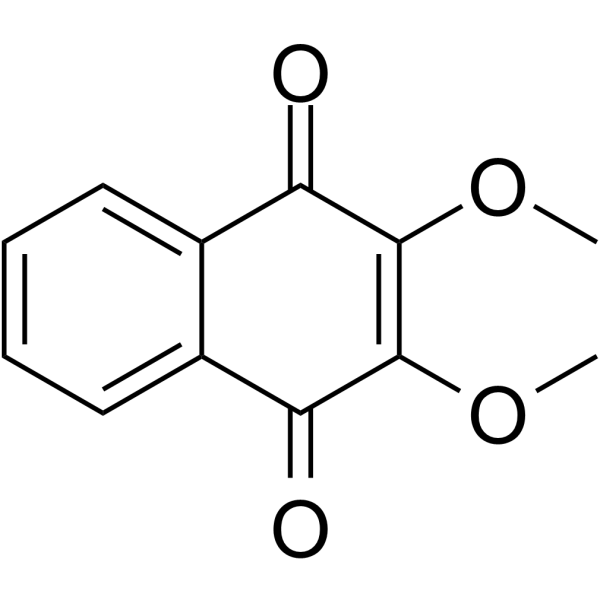
DMNQ is a redox cycling agent. DMNQ produces hydrogen peroxide in cells in a concentration-dependent manner. DMNQ can induce the increase of ROS production.
Nos produits utilisent uniquement pour la recherche. Nous ne vendons pas aux patients.
- Pureté : 98.69%
- CAS No.: 6956-96-3
- Formule: C12H10O4
- Masse moléculaire:218.21
-
Stockage:Powder -20°C, 3 years ; In solvent -80°C, 6 months , -20°C, 1 month

To place orders, for customer services and technical support, please contact: MedChemExpress USA
Tel: 609-228-6898 E-mail: [email protected] [email protected]


-
 Activité biologique
-
Chemical Information
-
Solvant et solubilité
- Protocole
- Pureté et documentation
- Références
-
 Help & FAQs


-
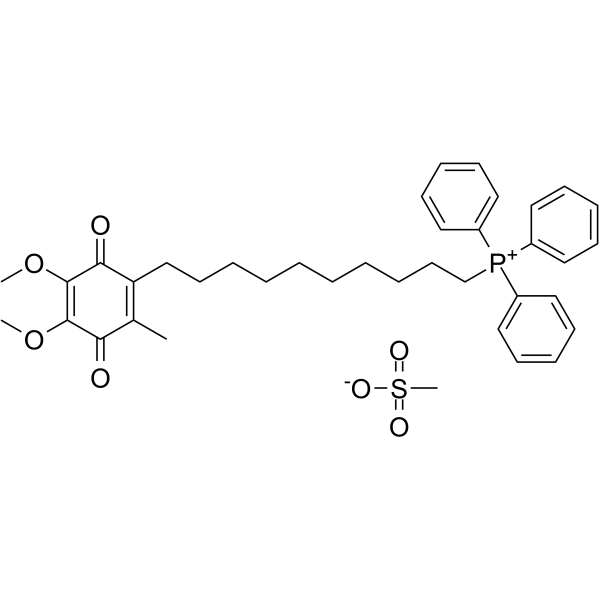
HY-100116A
Mitoquinone mesylateAntioxidant -
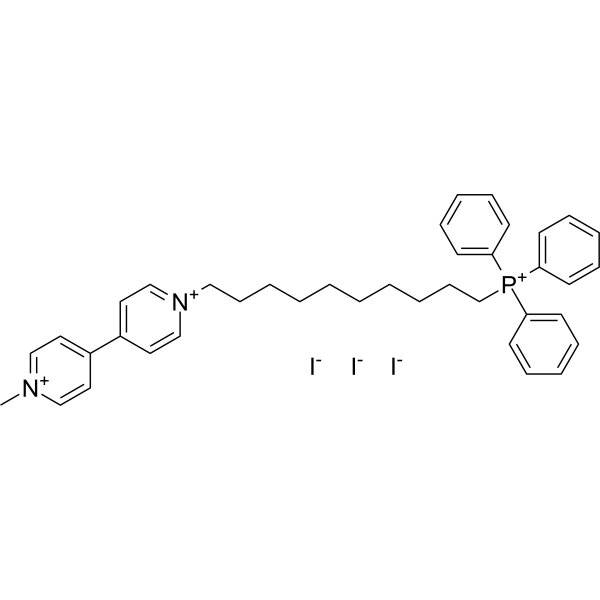
HY-130278
MitoPQRedox Cycler -
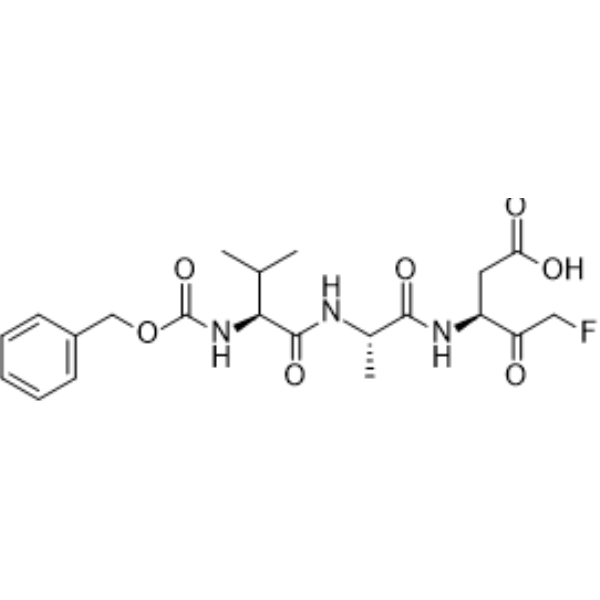
HY-16658B
Z-VAD-FMKPan-Caspase Inhibitor -
HY-15141
StaurosporinePKC/PKA Inhibitor -
HY-A0098
TunicamycinER Stress Inducer -
HY-D0187
L-Glutathione reducedAntioxidant -
HY-13555
β-LapachoneAutophagy Inducer -
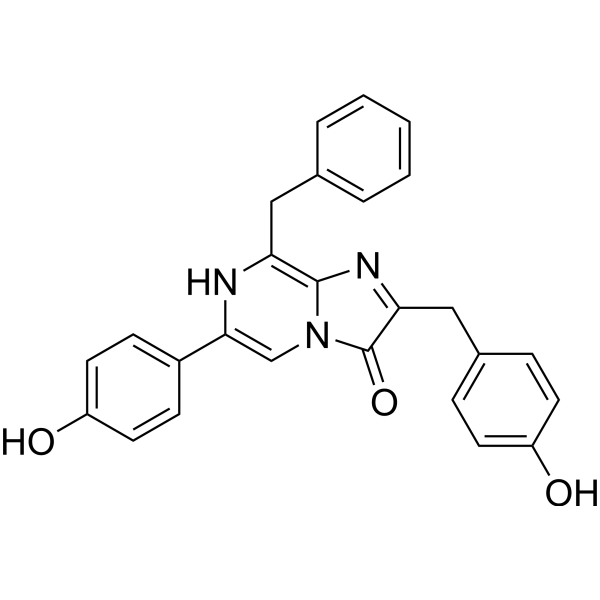
HY-18743
CoelenterazineLuminescent Enzyme Substrate -
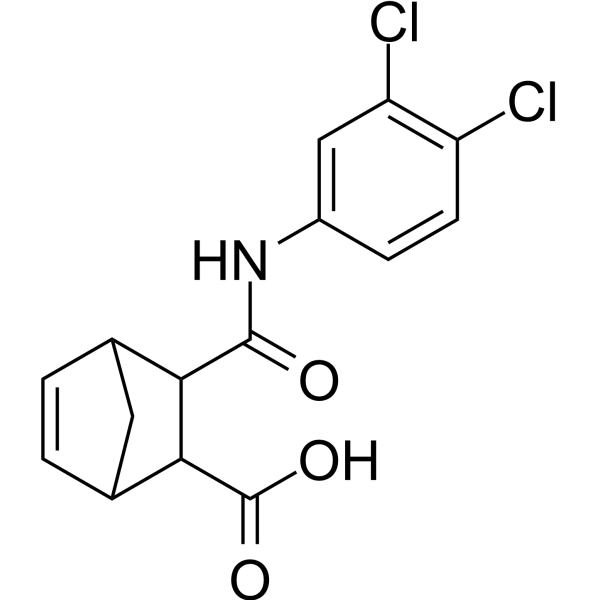
HY-107999
CADD522RUNX2-DNA binding inhibitor -
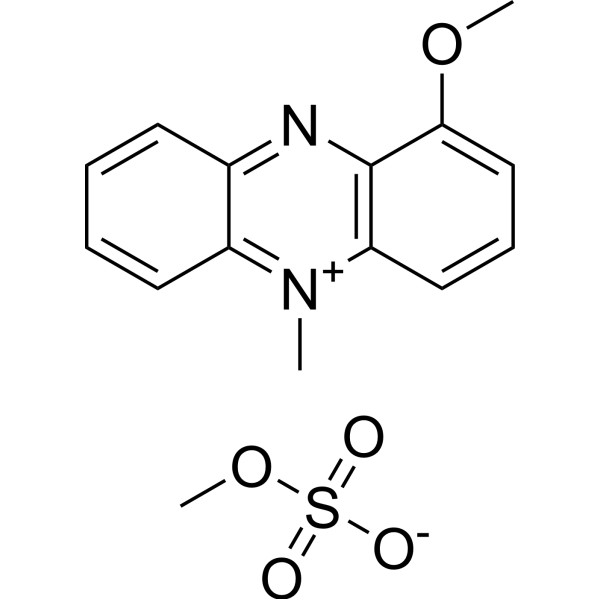
HY-D0937
Methoxy-PMSElectron Mediator -
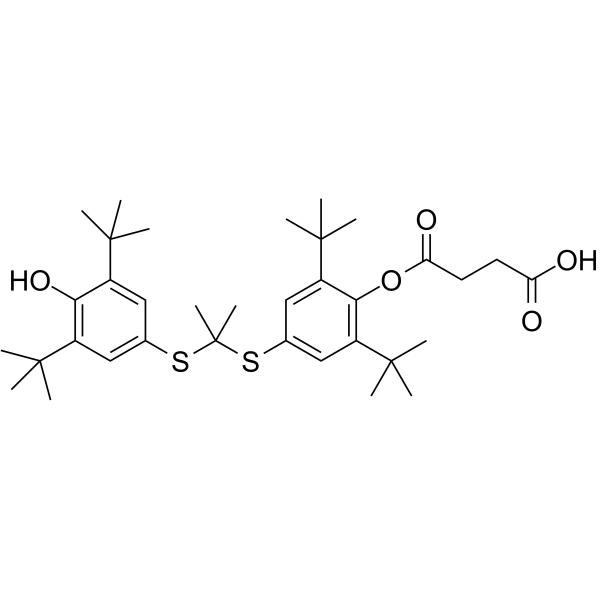
HY-14937
Succinobucol -
HY-111653
CycLuc1Luciferase Substrate
Publications Citing Use of MedChemExpress (MCE) DMNQ
More- Cell. 2026 Sep 14:S0092-8674(26)01003-2.
- Immunity. 2021 Aug 10;54(8):1728-1744.e7. [Abstract]
- Adv Sci (Weinh). 2026 Mar;13(16):e13310. [Abstract]
- Phytomedicine. 2026 Sep:159:158509.
- EMBO J. 2023 Oct 16;42(20):e113743. [Abstract]
- Food Funct. 2025 Jul 28;16(15):6051-6063. [Abstract]
- Int J Mol Sci. 2023 Dec 28;25(1):423. [Abstract]
- Mol Med Rep. 2025 Jul;32(1):186. [Abstract]
- Am J Pathol. 2026 Mar;196(3):816-835. [Abstract]
- Mediators Inflamm. 2020 Jun 6:2020:4321912. [Abstract]
- Mol Nutr Food Res. 2026 Aug;70(15):e70570.
 Customer Validation & Images

-
RT-PCR


Activité biologique
Description
IC50 & Target
γ-glutamylcysteine synthetase (γ-GCs)[2].
Cellular Effect
|
Cell Line

|
Type | Value | Description | References |
|---|---|---|---|---|
| A549 | IC50 |
15.6 μM
Compound: 15
|
Cytotoxicity against human A549 cells assessed as reduction in cell viability incubated for 24 hrs by CellTiter-Glo luminescent cell viability assay
Cytotoxicity against human A549 cells assessed as reduction in cell viability incubated for 24 hrs by CellTiter-Glo luminescent cell viability assay
|
[PMID: 31563013] |
| AGS | IC50 |
9.1 μM
Compound: 3
|
Antitumor against human AGS cells after 72 hrs by MTT assay
Antitumor against human AGS cells after 72 hrs by MTT assay
|
[PMID: 18299197] |
| HL-60 | IC50 |
5.4 μM
Compound: 15
|
Cytotoxicity against human HL60 cells assessed as reduction in cell viability incubated for 24 hrs by CellTiter-Glo luminescent cell viability assay
Cytotoxicity against human HL60 cells assessed as reduction in cell viability incubated for 24 hrs by CellTiter-Glo luminescent cell viability assay
|
[PMID: 31563013] |
| HL-60 | IC50 |
8.9 μM
Compound: 3
|
Antitumor against human HL60 cells after 72 hrs by MTT assay
Antitumor against human HL60 cells after 72 hrs by MTT assay
|
[PMID: 18299197] |
| J82 | IC50 |
16.1 μM
Compound: 3
|
Antitumor against human J82 cells after 72 hrs by MTT assay
Antitumor against human J82 cells after 72 hrs by MTT assay
|
[PMID: 18299197] |
| Jurkat | IC50 |
11.5 μM
Compound: 15
|
Cytotoxicity against human Jurkat cells assessed as reduction in cell viability incubated for 24 hrs by CellTiter-Glo luminescent cell viability assay
Cytotoxicity against human Jurkat cells assessed as reduction in cell viability incubated for 24 hrs by CellTiter-Glo luminescent cell viability assay
|
[PMID: 31563013] |
| LS174T | IC50 |
27.9 μM
Compound: 15
|
Cytotoxicity against human LS174T cells assessed as reduction in cell viability incubated for 24 hrs by CellTiter-Glo luminescent cell viability assay
Cytotoxicity against human LS174T cells assessed as reduction in cell viability incubated for 24 hrs by CellTiter-Glo luminescent cell viability assay
|
[PMID: 31563013] |
| MCF7 | IC50 |
6.3 μM
Compound: 15
|
Cytotoxicity against human MCF7 cells assessed as reduction in cell viability incubated for 24 hrs by CellTiter-Glo luminescent cell viability assay
Cytotoxicity against human MCF7 cells assessed as reduction in cell viability incubated for 24 hrs by CellTiter-Glo luminescent cell viability assay
|
[PMID: 31563013] |
| MONO-MAC-6 | IC50 |
3.6 μM
Compound: 15
|
Cytotoxicity against human MONO-MAC-6 cells assessed as reduction in cell viability incubated for 24 hrs by CellTiter-Glo luminescent cell viability assay
Cytotoxicity against human MONO-MAC-6 cells assessed as reduction in cell viability incubated for 24 hrs by CellTiter-Glo luminescent cell viability assay
|
[PMID: 31563013] |
| MRC5 | IC50 |
7.2 μM
Compound: 3
|
Cytotoxicity against human MRC5 cells after 72 hrs by MTT assay
Cytotoxicity against human MRC5 cells after 72 hrs by MTT assay
|
[PMID: 18299197] |
| PBMC | IC50 |
18.5 μM
Compound: 15
|
Cytotoxicity against human PBMC cells assessed as reduction in cell viability incubated for 24 hrs by CellTiter-Glo luminescent cell viability assay
Cytotoxicity against human PBMC cells assessed as reduction in cell viability incubated for 24 hrs by CellTiter-Glo luminescent cell viability assay
|
[PMID: 31563013] |
| SK-MES-1 | IC50 |
5.3 μM
Compound: 3
|
Antitumor against human SK-MES1 cells after 72 hrs by MTT assay
Antitumor against human SK-MES1 cells after 72 hrs by MTT assay
|
[PMID: 18299197] |
| SW982 | IC50 |
20.6 μM
Compound: 15
|
Cytotoxicity against human SW982 cells assessed as reduction in cell viability incubated for 24 hrs by CellTiter-Glo luminescent cell viability assay
Cytotoxicity against human SW982 cells assessed as reduction in cell viability incubated for 24 hrs by CellTiter-Glo luminescent cell viability assay
|
[PMID: 31563013] |
| THP-1 | IC50 |
8.2 μM
Compound: 15
|
Cytotoxicity against human THP1 cells assessed as reduction in cell viability incubated for 24 hrs by CellTiter-Glo luminescent cell viability assay
Cytotoxicity against human THP1 cells assessed as reduction in cell viability incubated for 24 hrs by CellTiter-Glo luminescent cell viability assay
|
[PMID: 31563013] |
| U-937 | IC50 |
11.3 μM
Compound: 15
|
Cytotoxicity against human U937 cells assessed as reduction in cell viability incubated for 24 hrs by CellTiter-Glo luminescent cell viability assay
Cytotoxicity against human U937 cells assessed as reduction in cell viability incubated for 24 hrs by CellTiter-Glo luminescent cell viability assay
|
[PMID: 31563013] |
In Vitro
DMNQ (20-100 μM; 30 min) can induce H2O2 production in a concentration-dependent manner in A549-S cells[1].
DMNQ (5-10 μM; 0-24 h) can increase glutathione (GSH) (physiological antioxidant) content in L2 cells in a time- and dose-dependent manner by enhancing the activity of γ-glutamylcysteine synthetase (γ-GCs) (70%) [2].
MedChemExpress (MCE) has not independently confirmed the accuracy of these methods. They are for reference only.
-
Cell Line:L2
-
Concentration:5 μM, 10 μM
-
Incubation Time:24 h
-
Result:Increased the level of γGCS-HS protein.


Chemical Information
-
CAS No. 6956-96-3
-
Appearance Solid
-
Masse moléculaire 218.21
-
Formule C12H10O4
-
Color Light yellow to yellow
-
SMILES
O=C1C(OC)=C(C(C2=CC=CC=C21)=O)OC
-
Livraison
Room temperature in continental US; may vary elsewhere.
-
Stockage
Powder -20°C 3 years In solvent -80°C 6 months -20°C 1 month


Publications (11)
-
Journal Impact Factor
-
Most Recent
-
-
Immunity
Multiomics analyses reveal a critical role of selenium in controlling T cell differentiation in Crohn's disease. [Abstract]2021 Aug 10;54(8):1728-1744.e7. PMID: 34343498 -
Adv Sci (Weinh)
2026 Mar;13(16):e13310. PMID: 41589654 -
-
EMBO J
A mitochondrial EglN1-AMPKα axis drives breast cancer progression by enhancing metabolic adaptation to hypoxic stress. [Abstract]2023 Oct 16;42(20):e113743. PMID: 37661833 -
Food Funct
Investigating the neuroprotective effects of polyunsaturated fatty acids in egg yolk phospholipids upon oxidative damage in HT22 cells. [Abstract]2025 Jul 28;16(15):6051-6063. PMID: 40341910 -
Int J Mol Sci
2023 Dec 28;25(1):423. PMID: 38203594 -
Mol Med Rep
Eburicoic acid inhibits endothelial cell pyroptosis and retards the development of atherosclerosis through the Keap1/Nrf2/HO‑1/ROS pathway. [Abstract]2025 Jul;32(1):186. PMID: 40314092 -
Am J Pathol
Targeting N-Cadherin and Tubulin α 1A in Neuroblastoma Bone Marrow Metastasis: Insights from Single-Cell Analysis and Drug Screening. [Abstract]2026 Mar;196(3):816-835. PMID: 41485549 -
Mediators Inflamm
CD137 Signaling Promotes Endothelial Apoptosis by Inhibiting Nrf2 Pathway, and Upregulating NF- κ B Pathway. [Abstract]2020 Jun 6:2020:4321912. PMID: 32587470
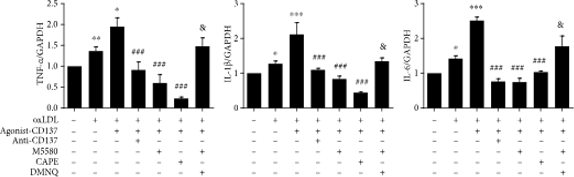
DMNQ purchased from MedChemExpress. Usage Cited in: Mediators Inflamm. 2020 Jun 6:2020:4321912. [Abstract]
qPCR shows that the levels of IL-6, IL-1β, and TNF-α in DMNQ group increased compared with the M5580 group, indicating that DMNQ could weaken the inhibitory effect of M5580 on inflammation production.
-


Solvant et solubilité
In Vitro:
DMSO : 50 mg/mL (229.14 mM; Need ultrasonic; Hygroscopic DMSO has a significant impact on the solubility of product, please use newly opened DMSO)
Please refer to the solubility information to select the appropriate solvent. Once prepared, please aliquot and store the solution to prevent product inactivation from repeated freeze-thaw cycles.
Storage method and period of stock solution: -80°C, 6 months; -20°C, 1 month. When stored at -80°C, please use it within 6 months. When stored at -20°C, please use it within 1 month.
Please refer to the solubility information to select the appropriate solvent. Once prepared, please aliquot and store the solution to prevent product inactivation from repeated freeze-thaw cycles.
Storage method and period of stock solution: -80°C, 6 months; -20°C, 1 month. When stored at -80°C, please use it within 6 months. When stored at -20°C, please use it within 1 month.
Concentration (start) × Volume (start) = Concentration (final) × Volume (final)
In Vivo:
Select the appropriate dissolution method based on your experimental animal and administration route.
- For the following dissolution methods, please ensure to first prepare a clear stock solution using an In Vitro approach and then sequentially add co-solvents:
- To ensure reliable experimental results, the clarified stock solution can be appropriately stored based on storage conditions. As for the working solution for In Vivo experiments, it is recommended to prepare freshly and use it on the same day.
- The percentages shown for the solvents indicate their volumetric ratio in the final prepared solution. If precipitation or phase separation occurs during preparation, heat and/or sonication can be used to aid dissolution.
Add each solvent one by one: 10% DMSO 40% PEG300 5% Tween-80 45% Saline
Solubility: 2.5 mg/mL (11.46 mM); Suspended solution; Need ultrasonic
This protocol yields a suspended solution of 2.5 mg/mL. Suspended solution can be used for oral and intraperitoneal injection.
Taking 1 mL working solution as an example, add 100 μL DMSO stock solution (25.0 mg/mL) to 400 μL PEG300, and mix evenly; then add 50 μL Tween-80 and mix evenly; then add 450 μL Saline to adjust the volume to 1 mL.
Preparation of Saline: Dissolve 0.9 g sodium chloride in ddH₂O and dilute to 100 mL to obtain a clear Saline solution.
Add each solvent one by one: 10% DMSO 90% (20% SBE-β-CD in Saline)
Solubility: 2.5 mg/mL (11.46 mM); Suspended solution; Need ultrasonic
This protocol yields a suspended solution of 2.5 mg/mL. Suspended solution can be used for oral and intraperitoneal injection.
Taking 1 mL working solution as an example, add 100 μL DMSO stock solution (25.0 mg/mL) to 900 μL 20% SBE-β-CD in Saline, and mix evenly.
Preparation of 20% SBE-β-CD in Saline (4°C, storage for one week): 2 g SBE-β-CD powder is dissolved in 10 mL Saline, completely dissolve until clear.
In Vivo Dissolution Calculator
Please enter the basic information of animal experiments:
-
-
-
-
Recommended: Prepare an additional quantity of animals to account for potential losses during experiments.
Please enter your animal formula composition:
-
%DMSO +
Recommended: Keep the proportion of DMSO in working solution below 2% if your animal is weak.
-
%+
-
+%Tween-80 + +
-
%Saline +
The co-solvents required include: DMSO, . All of co-solvents are available by MedChemExpress (MCE). , Tween 80. All of co-solvents are available by MedChemExpress (MCE).
Working solution concentration: 0.22 mg/mL
Method for preparing stock solution: mg drug dissolved in μL DMSO. Stock solution concentration: mg/mL.
1. Take μL DMSO stock solution;
2. Add μL .
μL , mix evenly;
3. Then add μL Tween 80, mix evenly;
4. Then add μL
Please ensure that the stock solution in the first step is dissolved to a clear state, and add co-solvents in sequence. You can use ultrasonic heating (ultrasonic cleaner, recommended frequency 20-40 kHz), vortexing, etc. to assist dissolution.


Pureté et documentation
-
Fiche technique (278 KB)
-
SDS (393 KB)
- English - EN (393 KB)
- Français - FR (393 KB)
- Deutsch - DE (393 KB)
- Norwegian - NO (393 KB)
- Español - ES (393 KB)
- Swedish - SV (393 KB)
- Italian - IT (393 KB)
- Korean - KR (393 KB)
- Portuguese - PT (393 KB)
-
Instruction de manipulation (2659 KB)
Références
[1]. Watanabe N, et al. Autoxidation of extracellular hydroquinones is a causative event for the cytotoxicity of menadione and DMNQ in A549-S cells. Arch Biochem Biophys. 2003 Mar 1;411(1):145-57. [Content Brief]
[2]. Shi MM, et al. Quinone-induced oxidative stress elevates glutathione and induces gamma-glutamylcysteine synthetase activity in rat lung epithelial L2 cells. J Biol Chem. 1994 Oct 21;269(42):26512-7. [Content Brief]


Complete Stock Solution Preparation Table
Please refer to the solubility information to select the appropriate solvent. Once prepared, please aliquot and store the solution to prevent product inactivation from repeated freeze-thaw cycles.
Storage method and period of stock solution: -80°C, 6 months; -20°C, 1 month. When stored at -80°C, please use it within 6 months. When stored at -20°C, please use it within 1 month.
| Optional Solvent | Concentration Solvent Mass | 1 mg | 5 mg | 10 mg | 25 mg |
|---|---|---|---|---|---|
| DMSO | 1 mM | 4.5827 mL | 22.9137 mL | 45.8274 mL | 114.5685 mL |
| 5 mM | 0.9165 mL | 4.5827 mL | 9.1655 mL | 22.9137 mL | |
| 10 mM | 0.4583 mL | 2.2914 mL | 4.5827 mL | 11.4569 mL | |
| 15 mM | 0.3055 mL | 1.5276 mL | 3.0552 mL | 7.6379 mL | |
| 20 mM | 0.2291 mL | 1.1457 mL | 2.2914 mL | 5.7284 mL | |
| 25 mM | 0.1833 mL | 0.9165 mL | 1.8331 mL | 4.5827 mL | |
| 30 mM | 0.1528 mL | 0.7638 mL | 1.5276 mL | 3.8190 mL | |
| 40 mM | 0.1146 mL | 0.5728 mL | 1.1457 mL | 2.8642 mL | |
| 50 mM | 0.0917 mL | 0.4583 mL | 0.9165 mL | 2.2914 mL | |
| 60 mM | 0.0764 mL | 0.3819 mL | 0.7638 mL | 1.9095 mL | |
| 80 mM | 0.0573 mL | 0.2864 mL | 0.5728 mL | 1.4321 mL | |
| 100 mM | 0.0458 mL | 0.2291 mL | 0.4583 mL | 1.1457 mL |


DMNQ Related Classifications
HY-121026 Related Classifications
 Powered by Bioz