



Cipepofol

Based on 1 Customer Validation
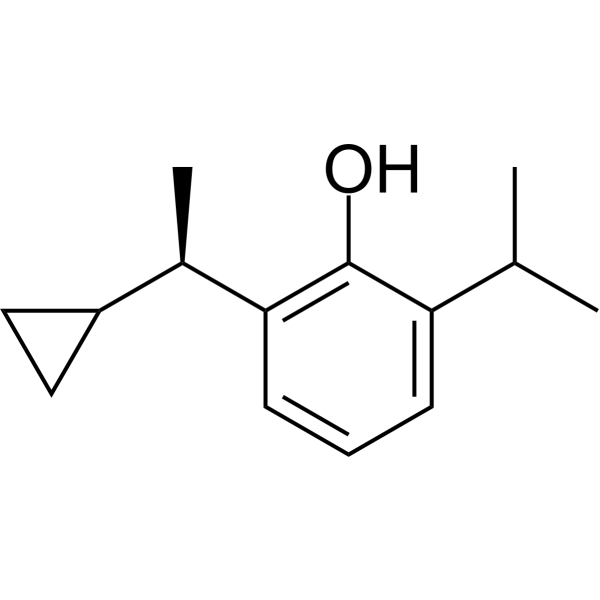
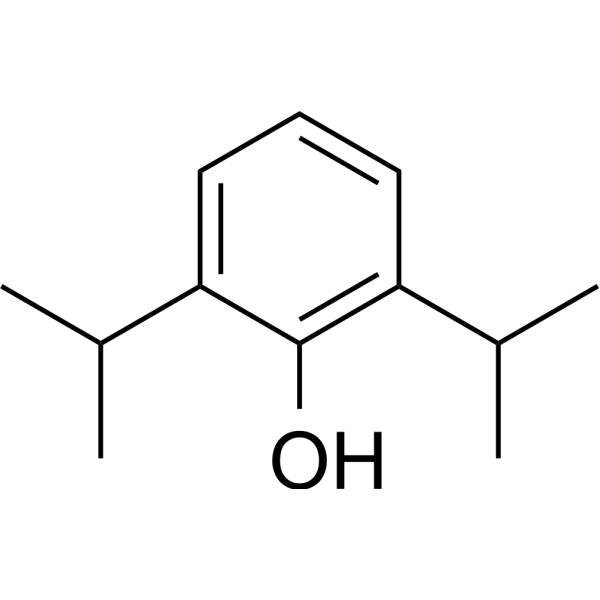
Cipepofol (Ciprofol), a novel 2,6-disubstituted phenol derivative, is a positive allosteric modulator and direct agonist of the GABAA receptor. Cipepofol can cause the central nerve inhibition and promote sleep based on the structural modification of Propofol (HY-B0649). Cipepofol can activate the sirtuin1 (Sirt1)/Nrf2 pathway. Cipepofol protects the heart against Isoproterenol (ISO; HY-B0468)-induced myocardial infarction by reducing cardiac oxidative stress, inflammatory response and cardiomyocyte apoptosis.
Nos produits utilisent uniquement pour la recherche. Nous ne vendons pas aux patients.
- Pureté: 99.82%
- CAS No.: 1637741-58-2
- Formule: C14H20O
- Masse moléculaire:204.31
-
Stockage:Pure form -20°C, 3 years , 4°C, 2 years ; In solvent -80°C, 6 months , -20°C, 1 month

To place orders, for customer services and technical support, please contact: MedChemExpress USA
Tel: 609-228-6898 E-mail: [email protected] [email protected]


-
 Activité biologique
-
Chemical Information
-
Solvant et solubilité
- Pureté et documentation
- Références
-
 Help & FAQs






Activité biologique
Cipepofol (Ciprofol) can trigger chloride influx by competitive binding to butylbicyclophosphorothionate and t-butylbicycloorthobenzoate targets in the chloride channels of GABAA receptors. The influx of chloride can cause hyperpolarization of nerve cell membranes by increasing the intracellular chloride concentration and further activating GABAergic neurons to achieve central nerve inhibition[1].
Cipepofol (5 μM before ISO insult for 6 h) blunts the contents of CK-MB, LDH and cTnT were increased in ISO-treated H9c2 cells. Cipepofol attenuates ISO-induced cardiomyocyte apoptosis in vitro[2].
MedChemExpress (MCE) has not independently confirmed the accuracy of these methods. They are for reference only.
MedChemExpress (MCE) has not independently confirmed the accuracy of these methods. They are for reference only.
-
Animal Model:Eighty male C57BL/6 mice (20-24 g, 8-10 weeks)[2]
-
Dosage:100 μl
-
Administration:Implanted into the abdomen of mice 1 h before ISO
-
Result:Attenuated increased the content of serum CK-MB, LDH, and cTnT by ISO insults (100 mg/kg; sc; for 2 consecutive days to induce experimental myocardial infarction).
Significantly improved ISO-induced LV systolic and diastolic dysfunction.
Largely suppressed the increases in IL-6 IL-17 and TNF-α expression.
| NCT Number | Sponsor | Condition | Start Date |
Phase

|
|---|---|---|---|---|
| NCT01329991 | Plexxikon| | 2011-05 | PHASE1 |


Chemical Information
-
CAS No. 1637741-58-2
-
Appearance Liquid (Density: 1.035±0.06 g/cm3)
-
Masse moléculaire 204.31
-
Formule C14H20O
-
Color Colorless to light yellow
-
SMILES
CC(C1=CC=CC([C@@H](C2CC2)C)=C1O)C
-
Synonyms
Ciprofol; HSK3486
-
Livraison
Room temperature in continental US; may vary elsewhere.
-
Stockage
Pure form -20°C 3 years 4°C 2 years In solvent -80°C 6 months -20°C 1 month


Solvant et solubilité
DMSO : 100 mg/mL (489.45 mM; Need ultrasonic; Hygroscopic DMSO has a significant impact on the solubility of product, please use newly opened DMSO)
Please refer to the solubility information to select the appropriate solvent. Once prepared, please aliquot and store the solution to prevent product inactivation from repeated freeze-thaw cycles.
Storage method and period of stock solution: -80°C, 6 months; -20°C, 1 month. When stored at -80°C, please use it within 6 months. When stored at -20°C, please use it within 1 month.
Please refer to the solubility information to select the appropriate solvent. Once prepared, please aliquot and store the solution to prevent product inactivation from repeated freeze-thaw cycles.
Storage method and period of stock solution: -80°C, 6 months; -20°C, 1 month. When stored at -80°C, please use it within 6 months. When stored at -20°C, please use it within 1 month.
Concentration (start) × Volume (start) = Concentration (final) × Volume (final)
Select the appropriate dissolution method based on your experimental animal and administration route.
- For the following dissolution methods, please ensure to first prepare a clear stock solution using an In Vitro approach and then sequentially add co-solvents:
- To ensure reliable experimental results, the clarified stock solution can be appropriately stored based on storage conditions. As for the working solution for In Vivo experiments, it is recommended to prepare freshly and use it on the same day.
- The percentages shown for the solvents indicate their volumetric ratio in the final prepared solution. If precipitation or phase separation occurs during preparation, heat and/or sonication can be used to aid dissolution.
Add each solvent one by one: 10% DMSO 40% PEG300 5% Tween-80 45% Saline
Solubility: ≥ 2.5 mg/mL (12.24 mM); Clear solution
This protocol yields a clear solution of ≥ 2.5 mg/mL (saturation unknown).
Taking 1 mL working solution as an example, add 100 μL DMSO stock solution (25.0 mg/mL) to 400 μL PEG300, and mix evenly; then add 50 μL Tween-80 and mix evenly; then add 450 μL Saline to adjust the volume to 1 mL.
Preparation of Saline: Dissolve 0.9 g sodium chloride in ddH₂O and dilute to 100 mL to obtain a clear Saline solution.
Add each solvent one by one: 10% DMSO 90% (20% SBE-β-CD in Saline)
Solubility: ≥ 2.5 mg/mL (12.24 mM); Clear solution
This protocol yields a clear solution of ≥ 2.5 mg/mL (saturation unknown).
Taking 1 mL working solution as an example, add 100 μL DMSO stock solution (25.0 mg/mL) to 900 μL 20% SBE-β-CD in Saline, and mix evenly.
Preparation of 20% SBE-β-CD in Saline (4°C, storage for one week): 2 g SBE-β-CD powder is dissolved in 10 mL Saline, completely dissolve until clear.
Please enter the basic information of animal experiments:
-
-
-
-
Recommended: Prepare an additional quantity of animals to account for potential losses during experiments.
Please enter your animal formula composition:
-
%DMSO +
Recommended: Keep the proportion of DMSO in working solution below 2% if your animal is weak.
-
%+
-
+%Tween-80 + +
-
%Saline +
The co-solvents required include: DMSO, . All of co-solvents are available by MedChemExpress (MCE). , Tween 80. All of co-solvents are available by MedChemExpress (MCE).
Working solution concentration: 0.22 mg/mL
Method for preparing stock solution: mg drug dissolved in μL DMSO. Stock solution concentration: mg/mL.
1. Take μL DMSO stock solution;
2. Add μL .
μL , mix evenly;
3. Then add μL Tween 80, mix evenly;
4. Then add μL
Please ensure that the stock solution in the first step is dissolved to a clear state, and add co-solvents in sequence. You can use ultrasonic heating (ultrasonic cleaner, recommended frequency 20-40 kHz), vortexing, etc. to assist dissolution.


Pureté et documentation
-
Fiche technique (273 KB)
-
SDS (252 KB)
- English - EN (252 KB)
- Français - FR (252 KB)
- Deutsch - DE (252 KB)
- Norwegian - NO (252 KB)
- Español - ES (252 KB)
- Swedish - SV (252 KB)
- Italian - IT (252 KB)
- Korean - KR (252 KB)
- Portuguese - PT (252 KB)
-
Instruction de manipulation (2659 KB)
Références
[1]. Ming Lu, et al. Ciprofol: A Novel Alternative to Propofol in Clinical Intravenous Anesthesia? Biomed Res Int. 2023 Jan 19:2023:7443226. [Content Brief]
[2]. Yunzhao Yang, et al. Ciprofol attenuates the isoproterenol-induced oxidative damage, inflammatory response and cardiomyocyte apoptosis. Front Pharmacol. 2022 Nov 22:13:1037151. [Content Brief]


Complete Stock Solution Preparation Table
Please refer to the solubility information to select the appropriate solvent. Once prepared, please aliquot and store the solution to prevent product inactivation from repeated freeze-thaw cycles.
Storage method and period of stock solution: -80°C, 6 months; -20°C, 1 month. When stored at -80°C, please use it within 6 months. When stored at -20°C, please use it within 1 month.
| Optional Solvent | Concentration Solvent Mass | 1 mg | 5 mg | 10 mg | 25 mg |
|---|---|---|---|---|---|
| DMSO | 1 mM | 4.8945 mL | 24.4726 mL | 48.9452 mL | 122.3631 mL |
| 5 mM | 0.9789 mL | 4.8945 mL | 9.7890 mL | 24.4726 mL | |
| 10 mM | 0.4895 mL | 2.4473 mL | 4.8945 mL | 12.2363 mL | |
| 15 mM | 0.3263 mL | 1.6315 mL | 3.2630 mL | 8.1575 mL | |
| 20 mM | 0.2447 mL | 1.2236 mL | 2.4473 mL | 6.1182 mL | |
| 25 mM | 0.1958 mL | 0.9789 mL | 1.9578 mL | 4.8945 mL | |
| 30 mM | 0.1632 mL | 0.8158 mL | 1.6315 mL | 4.0788 mL | |
| 40 mM | 0.1224 mL | 0.6118 mL | 1.2236 mL | 3.0591 mL | |
| 50 mM | 0.0979 mL | 0.4895 mL | 0.9789 mL | 2.4473 mL | |
| 60 mM | 0.0816 mL | 0.4079 mL | 0.8158 mL | 2.0394 mL | |
| 80 mM | 0.0612 mL | 0.3059 mL | 0.6118 mL | 1.5295 mL | |
| 100 mM | 0.0489 mL | 0.2447 mL | 0.4895 mL | 1.2236 mL |


Cipepofol Related Classifications
HY-116152 Related Classifications
 Powered by Bioz