



DCLK1-IN-2
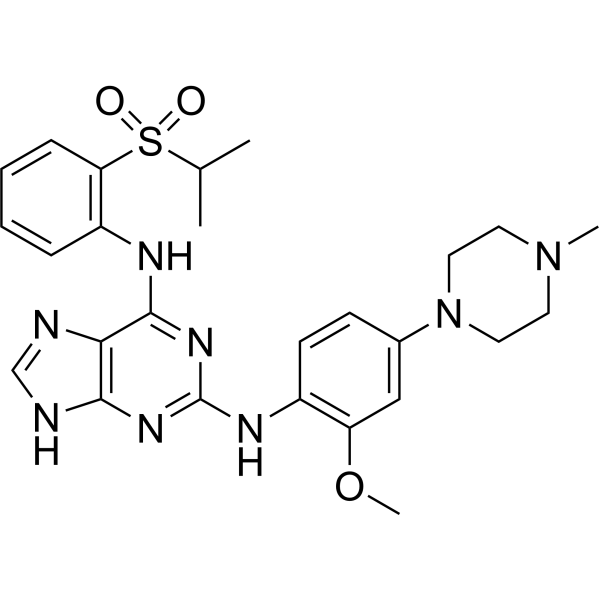
DCLK1-IN-2 (compound I-5) is a potent DCLK1 inhibitor with an IC50 of 171.3 nM. DCLK1-IN-2 shows remarkable antiproliferative effects on SW1990 cell lines (IC50 of 0.6 μM) and in vivo antitumor potency.
Nur für Forschungszwecke. Wir verkaufen nicht an Patienten.
- CAS. Nr.: 2978517-43-8
- Formel: C26H32N8O3S
- Molecular Weight:536.65
-
Speicherung:
Please store the product under the recommended conditions in the Certificate of Analysis.

To place orders, for customer services and technical support, please contact: MedChemExpress USA
Tel: 609-228-6898 E-mail: [email protected] [email protected]


-
 Biologische Aktivität
-
Chemical Information
- Protokoll
- Reinheit & Dokumentation
- Verweise
-
 Help & FAQs




Biologische Aktivität
Beschreibung
Cellular Effect
|
Cell Line

|
Type | Value | Description | References |
|---|---|---|---|---|
| CAKI-1 | IC50 |
10.1 μM
Compound: I-5
|
Antiproliferative activity against human CAKI-1 cells assessed as inhibition cell proliferation incubated for 6 days by MTT assay
Antiproliferative activity against human CAKI-1 cells assessed as inhibition cell proliferation incubated for 6 days by MTT assay
|
[PMID: 37862816] |
| HCT-116 | IC50 |
3 μM
Compound: I-5
|
Antiproliferative activity against human HCT-116 cells assessed as inhibition cell proliferation incubated for 6 days by MTT assay
Antiproliferative activity against human HCT-116 cells assessed as inhibition cell proliferation incubated for 6 days by MTT assay
|
[PMID: 37862816] |
| SW1990 | IC50 |
0.6 μM
Compound: I-5
|
Antiproliferative activity against human SW1990 cells assessed as inhibition cell proliferation incubated for 6 days by MTT assay
Antiproliferative activity against human SW1990 cells assessed as inhibition cell proliferation incubated for 6 days by MTT assay
|
[PMID: 37862816] |


Chemical Information
-
CAS. Nr. 2978517-43-8
-
Molecular Weight 536.65
-
Formel C26H32N8O3S
-
SMILES
CC(C)S(C1=C(NC2=NC(NC3=C(OC)C=C(N4CCN(C)CC4)C=C3)=NC5=C2N=CN5)C=CC=C1)(=O)=O
-
Versand
Room temperature in continental US; may vary elsewhere.
-
Speicherung
Please store the product under the recommended conditions in the Certificate of Analysis.


Reinheit & Dokumentation
Verweise

Calculators
Konzentration (Stammlösung) × Volumen (Stammlösung) = Konzentration (Ziellösung) × Volumen (Ziellösung)


DCLK1-IN-2 Related Classifications
HY-155303 Related Classifications
 Powered by Bioz