



ddUTP lithium, 100 mM in H2O

Based on 1 Customer Validation
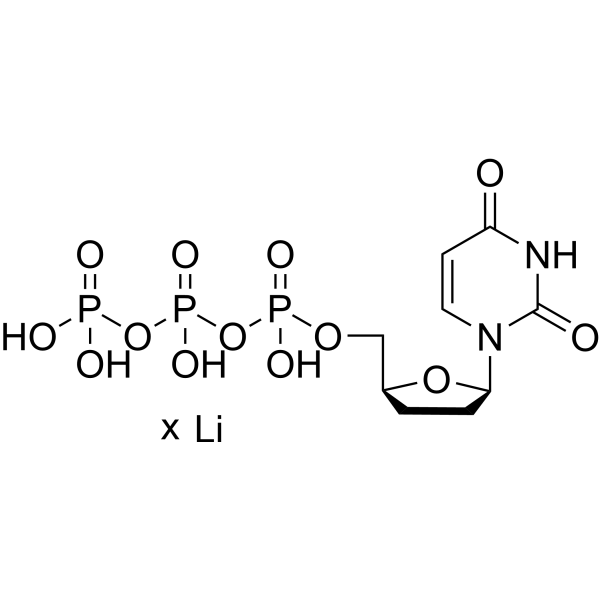
ddUTP (lithium), 100 mM in H2O is a nucleotide analog that can be incorporated into DNA, RNA, or other nucleic acids. ddUTP (lithium), 100 mM in H2O can be used to prepare DNA/RNA hybridization experiments, such as Southern blots and Northern blots.
For research use only. We do not sell to patients.
- Purity : 99.16%
- Formula: C9H15N2O13P3.xLi
-
Storage:
Solution, -20°C, 1 year

To place orders, for customer services and technical support, please contact: MedChemExpress USA
Tel: 609-228-6898 E-mail: [email protected] [email protected]


-
 Biological Activity
-
Chemical Information
- Protocols
- Purity & Documentation
-
 Help & FAQs




Biological Activity
Description


Chemical Information
-
Appearance Liquid
-
Formula C9H15N2O13P3.xLi
-
Color Colorless to light yellow
-
SMILES
OP(OP(OP(O)(OC[C@@H]1CC[C@H](N2C(NC(C=C2)=O)=O)O1)=O)(O)=O)(O)=O.[x].[Li]
-
Synonyms
2',3'-Dideoxyuridine-5'-triphosphate lithium
-
Shipping
Shipping with dry ice.
-
Storage
Solution, -20°C, 1 year

Protocols
-
Protocol for Northern Blot
Northern blot detects a defined RNA species by separating denatured RNA by size, transferring RNA to a membrane, hybridizing with a complementary labeled DNA or RNA probe, and detecting probe-bound RNA by autoradiography, phosphorimaging, or validated nonradioactive detection. The readout is both RNA size and abundance: band migration estimates transcript length or RNA-processing state, while band intensity reflects relative target RNA amount after normalization to total RNA, rRNA, or another validated loading control. In cancer cells, primary neurons, mouse tumor samples, intestinal organoids, inflammatory macrophages, or drug-screening studies, Northern blot is most appropriate when transcript size, isoform pattern, RNA processing, or small-RNA detection is important; qPCR or RNA-seq can complement it when higher sensitivity or global profiling is needed.


Purity & Documentation
-
Data Sheet (242 KB)
-
SDS (252 KB)
- English - EN (252 KB)
- Français - FR (252 KB)
- Deutsch - DE (252 KB)
- Norwegian - NO (252 KB)
- Español - ES (252 KB)
- Swedish - SV (252 KB)
- Italian - IT (252 KB)
- Korean - KR (252 KB)
- Portuguese - PT (252 KB)
-
Handling Instructions (2659 KB)

Calculators
Concentration (start) × Volume (start) = Concentration (final) × Volume (final)


ddUTP lithium, 100 mM in H2O Related Classifications
HY-155743A Related Classifications
 Powered by Bioz