



HCVcc-IN-2
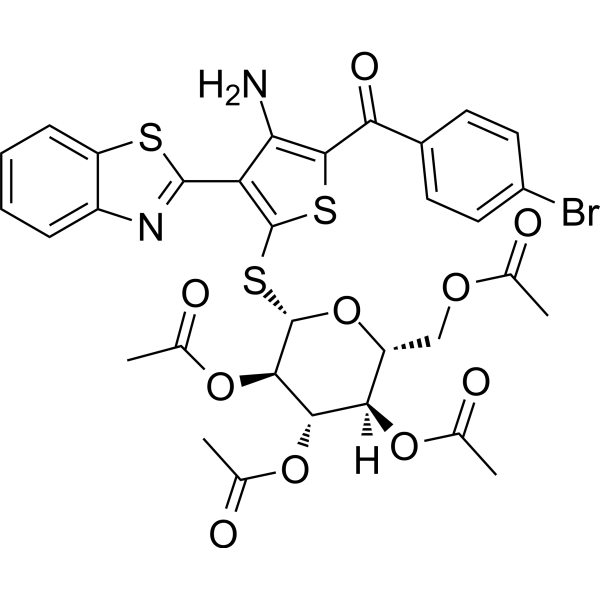
HCVcc-IN-2 is a benzothiazole-2-thiophene S-glycoside derivative with antitumor and antiviral activity. HCVcc-IN-2 has high inhibition against the three cell line from CNS cancer (SF-539 and SNB-75), colon cancer (HCT-116), and renal cancer (A498).
Nur für Forschungszwecke. Wir verkaufen nicht an Patienten.
- CAS. Nr.: 2977251-02-6
- Formel: C32H29BrN2O10S3
- Molecular Weight:777.68
-
Speicherung:
Please store the product under the recommended conditions in the Certificate of Analysis.

To place orders, for customer services and technical support, please contact: MedChemExpress USA
Tel: 609-228-6898 E-mail: [email protected] [email protected]


-
 Biologische Aktivität
-
Chemical Information
- Protokoll
- Reinheit & Dokumentation
- Verweise
-
 Help & FAQs




Biologische Aktivität
Beschreibung
In Vitro
HCVcc-IN-2 (compound 6c) (0.1, 1, 10, and 100 μg/mL; 1 h) shows antiviral activities against a variety of viruses such as coxsackievirus B4 (CBV4), hepatitis A virus HM 175 (HAV), hepatitis C genotype 4 (HCVcc), adenovirus type 7 (HAdV7), and herpes simplex virus 1 (HSV-1) with viral reduction rates of 83.3%, 63.3%, 40%, 63.3%, and 30%, respectively[1].
HCVcc-IN-2 (0.55-1.9 μg/mL; 1 h) inhibits various virus with IC50 of 0.55 μg/mL (herpes simplex virus), 0.76 μg/mL (HCVcc genotype virus), and 0.76 μg/mL (coxsackievirus B4), respectively; or with CC50 of 1.8 μg/mL (herpes simplex virus), 1.9 μg/mL (HCVcc genotype virus), and 1.9 μg/mL (coxsackievirus B4), respectively[1].
HCVcc-IN-2 (7.68-16.01 μg/mL; ) inhibits hepatitis C virus NS3/4A and HSV- USP7 protease enzyme with IC50s of 16.01 μg/mL and 7.68 μg/mL[1].
HCVcc-IN-2 (0.01 mM; 24 h) has low cytotoxicity, shows high inhibition against two cell lines, SK-MEL-5, OVCAR-4[1].
MedChemExpress (MCE) has not independently confirmed the accuracy of these methods. They are for reference only.
-
Cell Line:FRHK-4, Hep2, BGM, Vero, and Huh 7.5 cell lines
-
Concentration:100 μg/mL
-
Incubation Time:24 hours
-
Result:Showed nontoxic under the doses of 100 μg/mL against FRHK-4, Hep2, BGM, Vero, and Huh 7.5 cells, respectively.
-
Cell Line:SF-539, SNB-75, HCT-116, and A498
-
Concentration:0.01 mM
-
Incubation Time:24 hours
-
Result:Inhibited SF-539, SNB-75, HCT-116, and A498 cell viability by 15.70%, 16.66%, 75.89%, and 58.5%, respectively.


Chemical Information
-
CAS. Nr. 2977251-02-6
-
Molecular Weight 777.68
-
Formel C32H29BrN2O10S3
-
SMILES
O=C(C1=C(N)C(C2=NC3=CC=CC=C3S2)=C(S[C@H]4[C@H](OC(C)=O)[C@@H](OC(C)=O)[C@@](OC(C)=O)([H])[C@@H](COC(C)=O)O4)S1)C5=CC=C(Br)C=C5
-
Versand
Room temperature in continental US; may vary elsewhere.
-
Speicherung
Please store the product under the recommended conditions in the Certificate of Analysis.


Reinheit & Dokumentation
Verweise

Calculators
Konzentration (Stammlösung) × Volumen (Stammlösung) = Konzentration (Ziellösung) × Volumen (Ziellösung)


HCVcc-IN-2 Related Classifications
HY-151589 Related Classifications
 Powered by Bioz