



Diammonium Glycyrrhizinate

Based on 1 Customer Validation
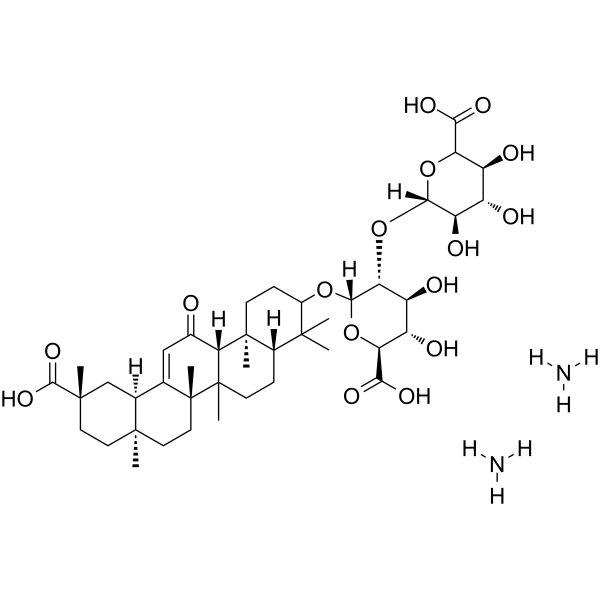
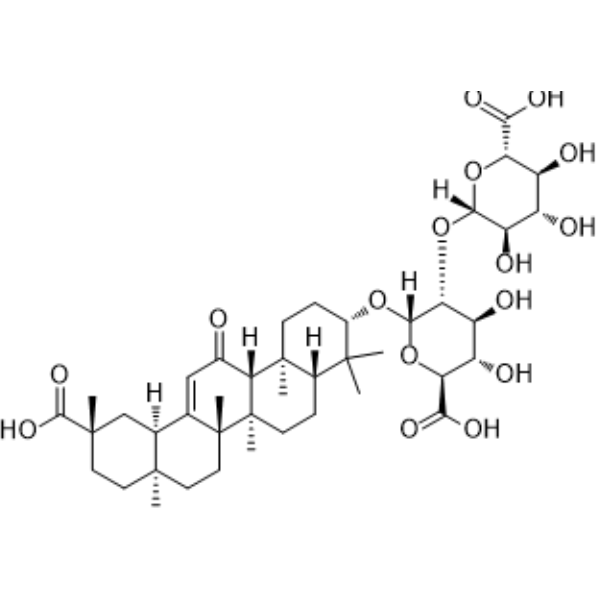
Diammonium glycyrrhizinate is a substance that can be extracted and purified from a traditional Chinese medicinal herb. Diammonium glycyrrhizinate has anti-inflammatory effect, resistance to biologic oxidation, membranous protection and a weak steroidal action. Diammonium glycyrrhizinate exerts protective effect by downregulating inflammation cytokines, suppressing the NF-κB pathway, and restoring superoxide dismutase. Diammonium glycyrrhizinate can be used as a hepatic protector and can therefore be studied in research for most liver diseases.
For research use only. We do not sell to patients.
- Purity : 99.94%
- CAS No.: 79165-06-3
- Formula: C42H68N2O16
- Molecular Weight:856.99
-
Storage:
4°C, sealed storage, away from moisture and light
* In solvent : -80°C, 6 months; -20°C, 1 month (sealed storage, away from moisture and light)

To place orders, for customer services and technical support, please contact: MedChemExpress USA
Tel: 609-228-6898 E-mail: [email protected] [email protected]


-
 Biological Activity
-
Chemical Information
-
Solvent & Solubility
- Purity & Documentation
- References
-
 Help & FAQs




Biological Activity
Description
In Vitro
Diammonium glycyrrhizinate (Compound DG) (0.001 mg/mL, 1 h before Aβ1-42) decreases the mRNA levels of TNF-α, COX-2, iNOS, and IL-1β increased by Aβ1-42 (5 μM)[4].
Diammonium glycyrrhizinate (0.001 mg/mL, 6-24 h) markedly increases the cell viability of HT22 and SH-SY5Y cell lines[4].
MedChemExpress (MCE) has not independently confirmed the accuracy of these methods. They are for reference only.
-
Cell Line:BV-2 cells
-
Concentration:0.001 mg/mL
-
Incubation Time:1 h before Aβ1-42 (5 μM for 6 h)
-
Result:Attenuated Aβ1-42-induced NF-κB nuclear translocation.
In Vivo
Diammonium glycyrrhizinate (75-200 mg/kg, i.p., 2 h before the Concanavalin A (HY-P2149) injection) inhibits the increase of both ALT and AST levels in liver-injury mice model[2].
Diammonium glycyrrhizinate (131.69-2250 mg/kg, i.p., single dose) results in LD50 values of 525.10 mg/kg and 997.26 mg/kg for male and female ICR mice[3].
Diammonium glycyrrhizinate (15-120 mg/kg, i.p., single dose) returns the difference of the serum sodium with the addition of Oxymatrine (HY-N0158) (15-60 mg/kg) in ICR mice[3].
Diammonium glycyrrhizinate (90 mg/kg, i.p., single dose) results in significantly higher serum sodium levels in ICR mice[3].
Diammonium glycyrrhizinate (10 mg/kg/day, i.p., 14 d) significantly decreases the mRNA levels of COX-2, TNF-α, iNOS, and IL-1β whilst increasing mRNA level of IL-10 in AD mice[4].
Diammonium glycyrrhizinate (150 mg/kg/day, i.p., alternate days for 14 w) remarkedly decreases the epididymal adipose tissues in HFD-fed C57BL/6J mice[5].
MedChemExpress (MCE) has not independently confirmed the accuracy of these methods. They are for reference only.
-
Animal Model:SD rats received colonic infusion of acetic acid (30 mg/kg)[1]
-
Dosage:40 mg/kg
-
Administration:Intraperitoneal injection (i.p.), every day for 1 week
-
Result:Significantly improved the inflammatory indices including disease activity index, morphologic injury, histological changes and MPO activity.
Significantly reduced the positive percentages and density of TNF-α, ICAM-1, and NF-κB p65, indicating the inhibition of their expression.
-
Animal Model:Immune-mediated liver-injury mice model induced by Concanavalin A (20 mg/kg, i.v.)[2]
-
Dosage:75, 200 mg/kg
-
Administration:Intraperitoneal injection (i.p.), 2 h before the Concanavalin A injection
-
Result:Resulted in lower ALT levels and damage score.
Resulted in a marked decrease in the expression level of cleaved-caspase 3.
Downregulated the mRNA level of TNF-α and IL-6.
Significantly decreased the apoptosis level of CD8+ T cells and showed a lower apoptosis phenomenon of CD4+ T cells.
Inhibited the proliferation of the CD8+CD69+ subset in the splenocytes.
Upregulated the percentage of CD4+CD25-CD69+ subset in liver.
Promoted CD4+CD25+Foxp3+ Tregs proliferation while inhibiting NKT cells proliferation.
-
Animal Model:HFD-fed C57BL/6J mice (4 w, 18-22 g)[5]
-
Dosage:150 mg/kg/day
-
Administration:Intraperitoneal injection (i.p.), alternate days for 14 w
-
Result:Significantly ameliorates liver steatosis.
Prominently decreased the serum level of TG.
Prevented NAFLD development.
Increased the number of OTUs.
Notably increased the species richness of the gut microbiota in mice and had a modulation of effects on the gut microbiota structure.
Restored the low SCFA production induced by NAFLD.
Reduced the intestinal low-grade inflammation in the NAFLD mice.
Increased the goblet cell number and mucin production.
Clinical Trial
| NCT Number | Sponsor | Condition | Start Date |
Phase

|
|---|---|---|---|---|
| NCT01329991 | Plexxikon| | 2011-05 | PHASE1 |


Chemical Information
-
CAS No. 79165-06-3
-
Appearance Solid
-
Molecular Weight 856.99
-
Formula C42H68N2O16
-
Color White to off-white
-
SMILES
C[C@]12[C@@](C(C=C3[C@]2(CC[C@@]4([C@@]3([H])C[C@](C)(CC4)C(O)=O)C)C)=O)([H])[C@@]5([C@@](C(C)([C@H](CC5)O[C@@H]6[C@@H]([C@H]([C@@H]([C@H](O6)C(O)=O)O)O)O[C@@H]7O[C@@H]([C@H]([C@@H]([C@H]7O)O)O)C(O)=O)C)([H])CC1)C.N.N
-
Structure Classification
-
Initial Source
-
Shipping
Room temperature in continental US; may vary elsewhere.
-
Storage
4°C, sealed storage, away from moisture and light
* In solvent : -80°C, 6 months; -20°C, 1 month (sealed storage, away from moisture and light)


Solvent & Solubility
In Vitro:
DMSO : 100 mg/mL (116.69 mM; Need ultrasonic; Hygroscopic DMSO has a significant impact on the solubility of product, please use newly opened DMSO)
H2O : ≥ 100 mg/mL (116.69 mM)
* "≥" means soluble, but saturation unknown.
Please refer to the solubility information to select the appropriate solvent. Once prepared, please aliquot and store the solution to prevent product inactivation from repeated freeze-thaw cycles.
Storage method and period of stock solution: -80°C, 6 months; -20°C, 1 month (sealed storage, away from moisture and light). When stored at -80°C, please use it within 6 months. When stored at -20°C, please use it within 1 month.
* Note: If you choose water as the stock solution, please dilute it to the working solution, then filter and sterilize it with a 0.22 μm filter before use.
Please refer to the solubility information to select the appropriate solvent. Once prepared, please aliquot and store the solution to prevent product inactivation from repeated freeze-thaw cycles.
Storage method and period of stock solution: -80°C, 6 months; -20°C, 1 month (sealed storage, away from moisture and light). When stored at -80°C, please use it within 6 months. When stored at -20°C, please use it within 1 month.
* Note: If you choose water as the stock solution, please dilute it to the working solution, then filter and sterilize it with a 0.22 μm filter before use.
Concentration (start) × Volume (start) = Concentration (final) × Volume (final)
In Vivo:
Select the appropriate dissolution method based on your experimental animal and administration route.
- For the following dissolution methods, please ensure to first prepare a clear stock solution using an In Vitro approach and then sequentially add co-solvents:
- To ensure reliable experimental results, the clarified stock solution can be appropriately stored based on storage conditions. As for the working solution for In Vivo experiments, it is recommended to prepare freshly and use it on the same day.
- The percentages shown for the solvents indicate their volumetric ratio in the final prepared solution. If precipitation or phase separation occurs during preparation, heat and/or sonication can be used to aid dissolution.
Add each solvent one by one: 10% DMSO 40% PEG300 5% Tween-80 45% Saline
Solubility: ≥ 2.5 mg/mL (2.92 mM); Clear solution
This protocol yields a clear solution of ≥ 2.5 mg/mL (saturation unknown).
Taking 1 mL working solution as an example, add 100 μL DMSO stock solution (25.0 mg/mL) to 400 μL PEG300, and mix evenly; then add 50 μL Tween-80 and mix evenly; then add 450 μL Saline to adjust the volume to 1 mL.
Preparation of Saline: Dissolve 0.9 g sodium chloride in ddH₂O and dilute to 100 mL to obtain a clear Saline solution.
Add each solvent one by one: 10% DMSO 90% (20% SBE-β-CD in Saline)
Solubility: ≥ 2.5 mg/mL (2.92 mM); Clear solution
This protocol yields a clear solution of ≥ 2.5 mg/mL (saturation unknown).
Taking 1 mL working solution as an example, add 100 μL DMSO stock solution (25.0 mg/mL) to 900 μL 20% SBE-β-CD in Saline, and mix evenly.
Preparation of 20% SBE-β-CD in Saline (4°C, storage for one week): 2 g SBE-β-CD powder is dissolved in 10 mL Saline, completely dissolve until clear.
In Vivo Dissolution Calculator
Please enter the basic information of animal experiments:
-
-
-
-
Recommended: Prepare an additional quantity of animals to account for potential losses during experiments.
Working solution concentration: 0.22 mg/mL
This product has good water solubility, please refer to the measured solubility data in water/PBS/Saline for details.


Purity & Documentation
-
Data Sheet (286 KB)
-
SDS (393 KB)
- English - EN (393 KB)
- Français - FR (393 KB)
- Deutsch - DE (393 KB)
- Norwegian - NO (393 KB)
- Español - ES (393 KB)
- Swedish - SV (393 KB)
- Italian - IT (393 KB)
- Korean - KR (393 KB)
- Portuguese - PT (393 KB)
-
Handling Instructions (2659 KB)
References
[1]. Yuan H, et al. Anti-inflammatory effect of Diammonium Glycyrrhizinate in a rat model of ulcerative colitis. World J Gastroenterol. 2006 Jul 28;12(28):4578-81. [Content Brief]
[2]. Gao, M., et al., (2019). Diammonium Glycyrrhizinate Mitigates Liver Injury Via Inhibiting Proliferation Of NKT Cells And Promoting Proliferation Of Tregs. Drug design, development and therapy, 13, 3579–3589. [Content Brief]


Complete Stock Solution Preparation Table
Please refer to the solubility information to select the appropriate solvent. Once prepared, please aliquot and store the solution to prevent product inactivation from repeated freeze-thaw cycles.
Storage method and period of stock solution: -80°C, 6 months; -20°C, 1 month (sealed storage, away from moisture and light). When stored at -80°C, please use it within 6 months. When stored at -20°C, please use it within 1 month.
| Optional Solvent | Concentration Solvent Mass | 1 mg | 5 mg | 10 mg | 25 mg |
|---|---|---|---|---|---|
| DMSO / H2O | 1 mM | 1.1669 mL | 5.8344 mL | 11.6687 mL | 29.1719 mL |
| 5 mM | 0.2334 mL | 1.1669 mL | 2.3337 mL | 5.8344 mL | |
| 10 mM | 0.1167 mL | 0.5834 mL | 1.1669 mL | 2.9172 mL | |
| 15 mM | 0.0778 mL | 0.3890 mL | 0.7779 mL | 1.9448 mL | |
| 20 mM | 0.0583 mL | 0.2917 mL | 0.5834 mL | 1.4586 mL | |
| 25 mM | 0.0467 mL | 0.2334 mL | 0.4667 mL | 1.1669 mL | |
| 30 mM | 0.0389 mL | 0.1945 mL | 0.3890 mL | 0.9724 mL | |
| 40 mM | 0.0292 mL | 0.1459 mL | 0.2917 mL | 0.7293 mL | |
| 50 mM | 0.0233 mL | 0.1167 mL | 0.2334 mL | 0.5834 mL | |
| 60 mM | 0.0194 mL | 0.0972 mL | 0.1945 mL | 0.4862 mL | |
| 80 mM | 0.0146 mL | 0.0729 mL | 0.1459 mL | 0.3646 mL | |
| 100 mM | 0.0117 mL | 0.0583 mL | 0.1167 mL | 0.2917 mL |
* Note: If you choose water as the stock solution, please dilute it to the working solution, then filter and sterilize it with a 0.22 μm filter before use.


Diammonium Glycyrrhizinate Related Classifications
HY-N6804 Related Classifications
 Powered by Bioz