



Dimethyl phthalate
Based on 1 publication(s) in Google Scholar
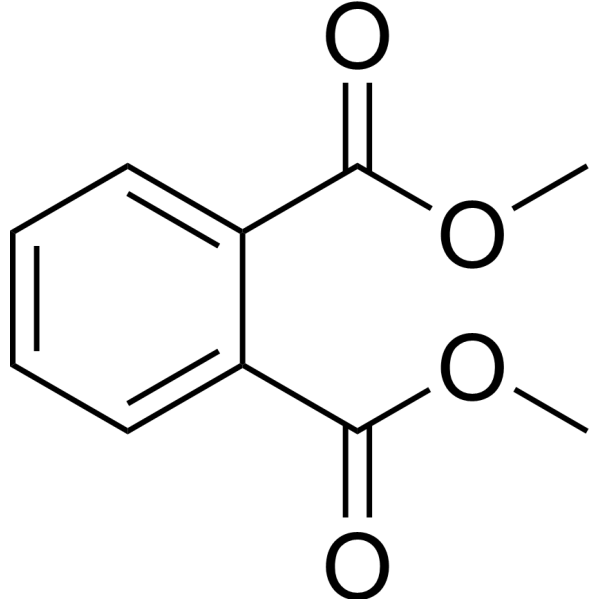
Dimethyl phthalate (DMP) can be used as a plasticizer to impart flexibility to rigid polyvinyl chloride (PVC) resin. Additionally, Dimethyl phthalate is an oral active endocrine disruptor that can cause ovarian dysfunction in mice. Dimethyl phthalate can also induce oxidative stress and apoptosis in cells, thereby affecting blood and red blood cell function in rats.
For research use only. We do not sell to patients.
- Purity : 99.87%
- CAS No.: 131-11-3
- Formula: C10H10O4
- Molecular Weight:194.19
-
Storage:
RT, protect from light.
In solvent -80°C, 1 year , -20°C, 6 months

To place orders, for customer services and technical support, please contact: MedChemExpress USA
Tel: 609-228-6898 E-mail: [email protected] [email protected]


-
 Biological Activity
-
Chemical Information
-
Solvent & Solubility
- Protocols
- Purity & Documentation
- References
-
 Help & FAQs




Publications Citing Use of MedChemExpress (MCE) Dimethyl phthalate
More

Biological Activity
Description
In Vitro
Dimethyl phthalate (0.39 or 1.5625 mM, 24 hours) promotes oxidative stress and apoptosis in SH-SY5Y cells[2]. Dimethyl phthalate (5-80 mg/L, 5.5 hours) causes membrane damage in Escherichia coli K12 cells, increasing membrane permeability, promoting cell death, and inducing oxidative stress[3].
MedChemExpress (MCE) has not independently confirmed the accuracy of these methods. They are for reference only.
-
Cell Line:SH-SY5Y neuroblastoma cells
-
Concentration:0.39 mM, 1.5625 mM
-
Incubation Time:24 h
-
Result:Significantly decreased cell viability, increased ROS levels, indicating oxidative stress, and significantly increased apoptosis levels.
In Vivo
MedChemExpress (MCE) has not independently confirmed the accuracy of these methods. They are for reference only.
-
Animal Model:Sprague-Dawley rat (4 weeks old, average weight 180 g)[4]
-
Dosage:0, 50 mg/kg, 250 mg/kg, 1000 mg/kg
-
Administration:Oral gavage (p.o.), once daily, for a total duration of 7 days
-
Result:Significantly induced oxidative stress in rats, leading to increased MDA levels in blood samples and elevated iron release levels.
-
Animal Model:Female C57BL/6J mice[5]
-
Dosage:0, 0.5, 1, 2 g/kg
-
Administration:Oral gavage (p.o.), once daily, for a total duration of 20 days and 40 days
-
Result:Significantly decreased serum FSH levels, significantly increased E2 and LH levels, and significantly increased the apoptosis rate of ovarian cells.
Clinical Trial
| NCT Number | Sponsor | Condition | Start Date |
Phase

|
|---|---|---|---|---|
| NCT01329991 | Plexxikon| | 2011-05 | PHASE1 |


Chemical Information
-
CAS No. 131-11-3
-
Appearance Liquid (Density: 1.19 g/cm3)
-
Molecular Weight 194.19
-
Formula C10H10O4
-
Color Colorless to light yellow
-
SMILES
O=C(C1=CC=CC=C1C(OC)=O)OC
-
Synonyms
DMP
-
Structure Classification
-
Initial Source
-
Shipping
Room temperature in continental US; may vary elsewhere.
-
Storage
RT, protect from light
In solvent -80°C 1 year -20°C 6 months


Publications (1)
-
Journal Impact Factor
-
Most Recent
-
Food Chem Toxicol
Integrated network toxicology, molecular docking and transcriptomics reveal the mechanistic role of phthalate esters in metabolic disease pathogenesis. [Abstract]2026 Jan:207:115855. PMID: 41275904


Solvent & Solubility
In Vitro:
DMSO : 100 mg/mL (514.96 mM; Need ultrasonic; Hygroscopic DMSO has a significant impact on the solubility of product, please use newly opened DMSO)
Please refer to the solubility information to select the appropriate solvent. Once prepared, please aliquot and store the solution to prevent product inactivation from repeated freeze-thaw cycles.
Storage method and period of stock solution: -80°C, 1 year; -20°C, 6 months. When stored at -80°C, please use it within 1 year. When stored at -20°C, please use it within 6 months.
Please refer to the solubility information to select the appropriate solvent. Once prepared, please aliquot and store the solution to prevent product inactivation from repeated freeze-thaw cycles.
Storage method and period of stock solution: -80°C, 1 year; -20°C, 6 months. When stored at -80°C, please use it within 1 year. When stored at -20°C, please use it within 6 months.
Concentration (start) × Volume (start) = Concentration (final) × Volume (final)
In Vivo:
Select the appropriate dissolution method based on your experimental animal and administration route.
- For the following dissolution methods, please ensure to first prepare a clear stock solution using an In Vitro approach and then sequentially add co-solvents:
- To ensure reliable experimental results, the clarified stock solution can be appropriately stored based on storage conditions. As for the working solution for In Vivo experiments, it is recommended to prepare freshly and use it on the same day.
- The percentages shown for the solvents indicate their volumetric ratio in the final prepared solution. If precipitation or phase separation occurs during preparation, heat and/or sonication can be used to aid dissolution.
Add each solvent one by one: 10% DMSO 40% PEG300 5% Tween-80 45% Saline
Solubility: ≥ 2.5 mg/mL (12.87 mM); Clear solution
This protocol yields a clear solution of ≥ 2.5 mg/mL (saturation unknown).
Taking 1 mL working solution as an example, add 100 μL DMSO stock solution (25.0 mg/mL) to 400 μL PEG300, and mix evenly; then add 50 μL Tween-80 and mix evenly; then add 450 μL Saline to adjust the volume to 1 mL.
Preparation of Saline: Dissolve 0.9 g sodium chloride in ddH₂O and dilute to 100 mL to obtain a clear Saline solution.
Add each solvent one by one: 10% DMSO 90% (20% SBE-β-CD in Saline)
Solubility: ≥ 2.5 mg/mL (12.87 mM); Clear solution
This protocol yields a clear solution of ≥ 2.5 mg/mL (saturation unknown).
Taking 1 mL working solution as an example, add 100 μL DMSO stock solution (25.0 mg/mL) to 900 μL 20% SBE-β-CD in Saline, and mix evenly.
Preparation of 20% SBE-β-CD in Saline (4°C, storage for one week): 2 g SBE-β-CD powder is dissolved in 10 mL Saline, completely dissolve until clear.
In Vivo Dissolution Calculator
Please enter the basic information of animal experiments:
-
-
-
-
Recommended: Prepare an additional quantity of animals to account for potential losses during experiments.
Please enter your animal formula composition:
-
%DMSO +
Recommended: Keep the proportion of DMSO in working solution below 2% if your animal is weak.
-
%+
-
+%Tween-80 + +
-
%Saline +
The co-solvents required include: DMSO, . All of co-solvents are available by MedChemExpress (MCE). , Tween 80. All of co-solvents are available by MedChemExpress (MCE).
Working solution concentration: 0.22 mg/mL
Method for preparing stock solution: mg drug dissolved in μL DMSO. Stock solution concentration: mg/mL.
1. Take μL DMSO stock solution;
2. Add μL .
μL , mix evenly;
3. Then add μL Tween 80, mix evenly;
4. Then add μL
Please ensure that the stock solution in the first step is dissolved to a clear state, and add co-solvents in sequence. You can use ultrasonic heating (ultrasonic cleaner, recommended frequency 20-40 kHz), vortexing, etc. to assist dissolution.


Purity & Documentation
-
Data Sheet (283 KB)
-
SDS (393 KB)
- English - EN (393 KB)
- Français - FR (393 KB)
- Deutsch - DE (393 KB)
- Norwegian - NO (393 KB)
- Español - ES (393 KB)
- Swedish - SV (393 KB)
- Italian - IT (393 KB)
- Korean - KR (393 KB)
- Portuguese - PT (393 KB)
-
Handling Instructions (2659 KB)
References
[1]. Wang ZG, et al. Impacts of dimethyl phthalate on the bacterial community and functions in black soils. Front Microbiol. 2015 May 5;6:405. [Content Brief]
[3]. Wang Z, et al. Dimethyl phthalate damaged the cell membrane of Escherichia coli K12. Ecotoxicol Environ Saf. 2019 Sep 30;180:208-214. [Content Brief]
[4]. Chi Z, et al. Revealing the toxicity of dimethyl phthalate (DMP) to the oxygen-carrying function of red blood cells (RBCs): The iron release mechanism. Chemosphere. 2021 Jan;263:128017. [Content Brief]
[5]. Mei Y, et al. Effects of Dimethyl Phthalate (DMP) on Serum Sex Hormone Levels and Apoptosis in C57 Female Mice. Int J Endocrinol Metab. 2019 Apr 22;17(2):e82882. [Content Brief]
[6]. Yin H, et al. Dimethyl phthalate exposure induces cognitive impairment via COX2-mediated neuroinflammation. Ecotoxicol Environ Saf. 2024 Oct 1;284:117039. [Content Brief]


Complete Stock Solution Preparation Table
Please refer to the solubility information to select the appropriate solvent. Once prepared, please aliquot and store the solution to prevent product inactivation from repeated freeze-thaw cycles.
Storage method and period of stock solution: -80°C, 1 year; -20°C, 6 months. When stored at -80°C, please use it within 1 year. When stored at -20°C, please use it within 6 months.
| Optional Solvent | Concentration Solvent Mass | 1 mg | 5 mg | 10 mg | 25 mg |
|---|---|---|---|---|---|
| DMSO | 1 mM | 5.1496 mL | 25.7480 mL | 51.4960 mL | 128.7399 mL |
| 5 mM | 1.0299 mL | 5.1496 mL | 10.2992 mL | 25.7480 mL | |
| 10 mM | 0.5150 mL | 2.5748 mL | 5.1496 mL | 12.8740 mL | |
| 15 mM | 0.3433 mL | 1.7165 mL | 3.4331 mL | 8.5827 mL | |
| 20 mM | 0.2575 mL | 1.2874 mL | 2.5748 mL | 6.4370 mL | |
| 25 mM | 0.2060 mL | 1.0299 mL | 2.0598 mL | 5.1496 mL | |
| 30 mM | 0.1717 mL | 0.8583 mL | 1.7165 mL | 4.2913 mL | |
| 40 mM | 0.1287 mL | 0.6437 mL | 1.2874 mL | 3.2185 mL | |
| 50 mM | 0.1030 mL | 0.5150 mL | 1.0299 mL | 2.5748 mL | |
| 60 mM | 0.0858 mL | 0.4291 mL | 0.8583 mL | 2.1457 mL | |
| 80 mM | 0.0644 mL | 0.3218 mL | 0.6437 mL | 1.6092 mL | |
| 100 mM | 0.0515 mL | 0.2575 mL | 0.5150 mL | 1.2874 mL |


Dimethyl phthalate Related Classifications
HY-N7106 Related Classifications
 Powered by Bioz