



Direct Red 80
Based on 3 publication(s) in Google Scholar
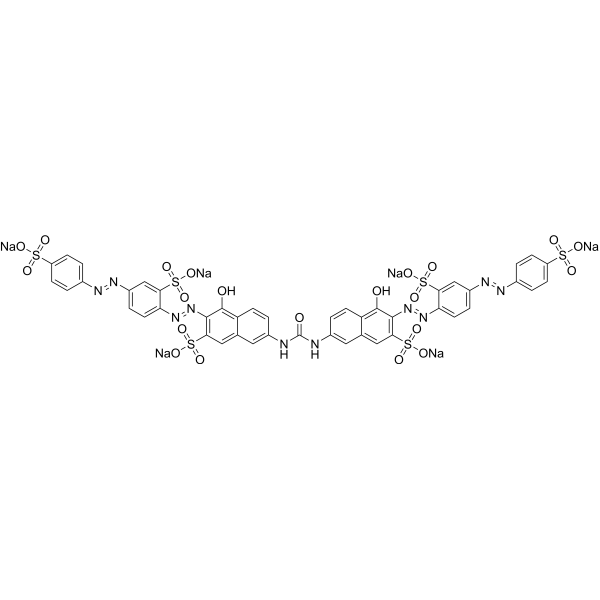
Direct Red 80 (Sirius Red) is a polyazo dye used principally in staining methods for collagen and amyloid. Direct Red 80 does not release benzidine upon degradation and is safer than many traditional direct dyes.
For research use only. We do not sell to patients.
- Purity : 95.0%
- CAS No.: 2610-10-8
- Formula: C45H26N10Na6O21S6
- Molecular Weight:1373.07
-
Storage:
4°C, sealed storage, away from moisture and light
* In solvent : -80°C, 6 months; -20°C, 1 month (sealed storage, away from moisture and light)

To place orders, for customer services and technical support, please contact: MedChemExpress USA
Tel: 609-228-6898 E-mail: [email protected] [email protected]


-
 Biological Activity
-
Chemical Information
-
Solvent & Solubility
- Protocols
- Purity & Documentation
- References
-
 Help & FAQs


-
HY-100523
ML385Nrf2 Inhibitor -
HY-D0940
H2DCFDAROS-Sensitive Probe -
HY-17567A
Heparin sodium saltAnticoagulant -

HY-P9926
DupilumabIL-4Rα Inhibitor -

HY-D1056A1
Lipopolysaccharides, from E. coli O111:B4Endotoxin -
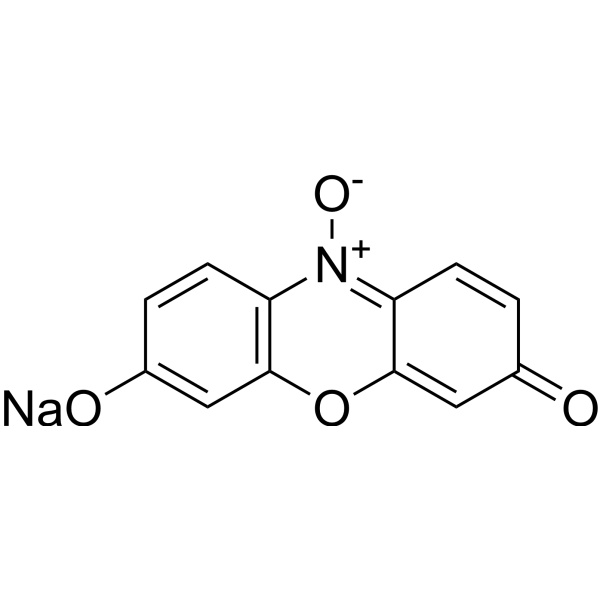
HY-111391
Resazurin sodiumBacterial Inhibitor -
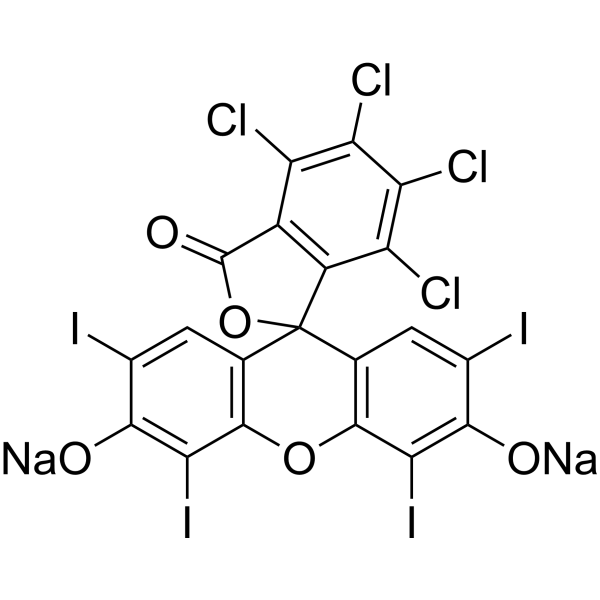
HY-D0214
Acid Red 94 sodiumPhotosensitizer -

HY-D0214R
Acid Red 94 sodium (Standard)Biological Dye -
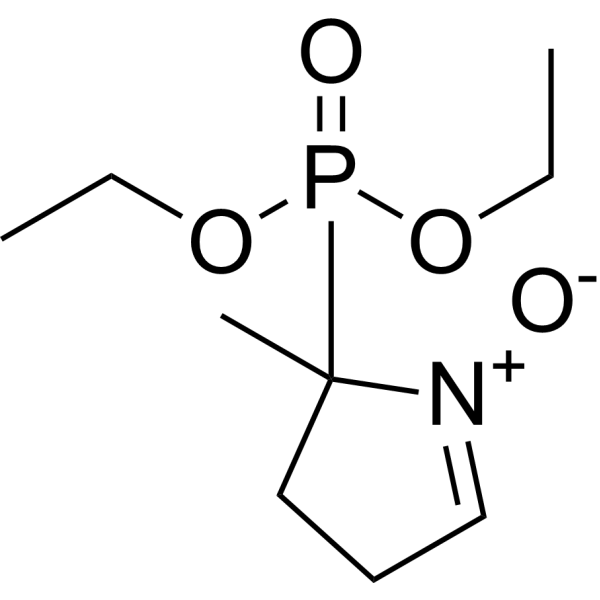
HY-120976
DEPMPOSpin-trapping Probe -
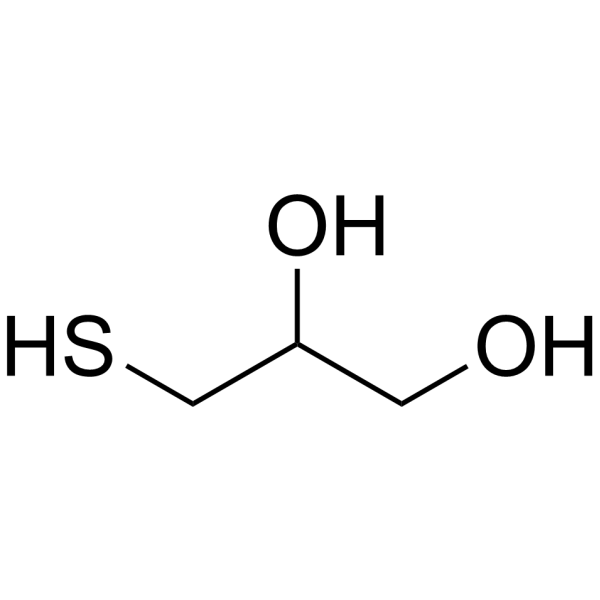
HY-W010572
1-ThioglycerolBiochemical Assay Reagent -

HY-D0842A
BSA Protein (Low Endotoxin,Fatty acid free)Oligonucleotide-binding Protein -

HY-D0842
BSA ProteinGlobular Protein
Publications Citing Use of MedChemExpress (MCE) Direct Red 80
More

Biological Activity
Description
In Vitro
Direct Red 80 (Sirius Red) has two important uses in histopathology: staining collagen from solution in saturated aqueous picric acid and staining amyloid from an alkaline solution. Stained structures are red[1].
Confocal laser microscopy (CLM) is also used to evaluate collagen production and distribution after Direct Red 80 staining. Direct Red 80 is not specific for the different types of collagen. Samples are washed in dH2O, pretreats for 40 min with a solution of 0.2% phosphomolybdic acid (PMA) and incubates for 30 min in a solution consisting of 0.1% Direct red 80 diluted in saturated aqueous picric acid. Finally each sample is washed in 0.01 M HCl for 2 min. PMA is used to make colourless cytoplasm and HCl is used to remove non-specific staining[1].
MedChemExpress (MCE) has not independently confirmed the accuracy of these methods. They are for reference only. Further protocols information, click here.


Chemical Information
-
CAS No. 2610-10-8
-
Appearance Solid
-
Molecular Weight 1373.07
-
Formula C45H26N10Na6O21S6
-
Color Brown to reddish brown
-
SMILES
O=C(NC1=CC2=CC(S(=O)(O[Na])=O)=C(/N=N/C3=CC=C(/N=N/C4=CC=C(S(=O)(O[Na])=O)C=C4)C=C3S(=O)(O[Na])=O)C(O)=C2C=C1)NC5=CC6=CC(S(=O)(O[Na])=O)=C(/N=N/C7=CC=C(/N=N/C8=CC=C(S(=O)(O[Na])=O)C=C8)C=C7S(=O)(O[Na])=O)C(O)=C6C=C5
-
Synonyms
Sirius Red
-
Shipping
Room temperature in continental US; may vary elsewhere.
-
Storage
4°C, sealed storage, away from moisture and light
* In solvent : -80°C, 6 months; -20°C, 1 month (sealed storage, away from moisture and light)


Publications (3)
-
Journal Impact Factor
-
Most Recent
-
J Extracell Vesicles
Umbilical Cord-Mesenchymal Stromal Cell-Derived Extracellular Vesicles Target the Liver to Improve Neurovascular Health in Type 2 Diabetes With Non-Alcoholic Fatty Liver Disease. [Abstract]2025 Jul;14(7):e70125. PMID: 40620065 -
Autophagy
Byakangelicin alleviates metabolic dysfunction-associated steatohepatitis by selective inhibition of a non-canonical MTORC1 signaling pathway. [Abstract]2026 May 25:1-21. PMID: 42152469 -


Solvent & Solubility
In Vitro:
DMSO : 5 mg/mL (3.64 mM; ultrasonic and warming and heat to 60°C; Hygroscopic DMSO has a significant impact on the solubility of product, please use newly opened DMSO)
H2O : < 0.1 mg/mL (insoluble)
Please refer to the solubility information to select the appropriate solvent. Once prepared, please aliquot and store the solution to prevent product inactivation from repeated freeze-thaw cycles.
Storage method and period of stock solution: -80°C, 6 months; -20°C, 1 month (sealed storage, away from moisture and light). When stored at -80°C, please use it within 6 months. When stored at -20°C, please use it within 1 month.
Please refer to the solubility information to select the appropriate solvent. Once prepared, please aliquot and store the solution to prevent product inactivation from repeated freeze-thaw cycles.
Storage method and period of stock solution: -80°C, 6 months; -20°C, 1 month (sealed storage, away from moisture and light). When stored at -80°C, please use it within 6 months. When stored at -20°C, please use it within 1 month.
Concentration (start) × Volume (start) = Concentration (final) × Volume (final)

Protocols
-
Collagen: Sirius Red Staining
Sirius Red or picrosirius red staining is a histochemical method for visualizing collagen-rich extracellular matrix in tissue sections, and collagen fibers are detected as red-stained structures under bright-field microscopy with enhanced birefringence under polarized light. Picrosirius red is useful for assessing total collagen organization, distribution, and fibrosis burden, but polarized color should not be interpreted as a definitive collagen type I versus type III readout because color is affected by fiber orientation, thickness, and packing.
-
Amyloid: Congo Red Amyloid Staining
Congo red amyloid staining is a histochemical method used to detect extracellular amyloid deposits in tissue sections based on the affinity of Congo red dye for β-pleated sheet-rich protein aggregates. When bound to amyloid, Congo red produces characteristic apple-green birefringence under polarized light microscopy, which is widely regarded as a diagnostic feature of amyloid deposition in histopathology. The diagnostic principle relies on the combination of dye binding (congophilia) and optical anisotropy under polarized illumination, which distinguishes amyloid from most non-amyloid eosinophilic extracellular deposits in routine histological evaluation. Amyloid identification by Congo red staining remains a cornerstone in diagnostic pathology despite the availability of adjunct methods such as immunohistochemistry and mass spectrometry, particularly because of its ability to localize deposits directly within tissue architecture. The specificity of Congo red-positive deposits is incre


Purity & Documentation
-
Data Sheet (271 KB)
-
SDS (537 KB)
- English - EN (537 KB)
- Français - FR (537 KB)
- Deutsch - DE (537 KB)
- Norwegian - NO (537 KB)
- Español - ES (537 KB)
- Swedish - SV (537 KB)
- Italian - IT (537 KB)
- Korean - KR (537 KB)
- Portuguese - PT (537 KB)
-
Handling Instructions (2659 KB)
References


Complete Stock Solution Preparation Table
Please refer to the solubility information to select the appropriate solvent. Once prepared, please aliquot and store the solution to prevent product inactivation from repeated freeze-thaw cycles.
Storage method and period of stock solution: -80°C, 6 months; -20°C, 1 month (sealed storage, away from moisture and light). When stored at -80°C, please use it within 6 months. When stored at -20°C, please use it within 1 month.
| Optional Solvent | Concentration Solvent Mass | 1 mg | 5 mg | 10 mg | 25 mg |
|---|---|---|---|---|---|
| DMSO | 1 mM | 0.7283 mL | 3.6415 mL | 7.2830 mL | 18.2074 mL |


Direct Red 80 Related Classifications
HY-D0333 Related Classifications
 Powered by Bioz