



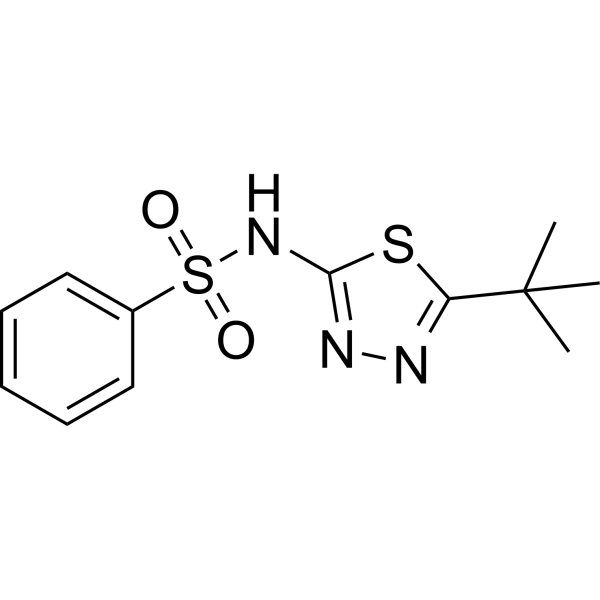
Glybuzole
Glybuzole (Desaglybuzole) is an orally effective hypoglycemic agent. Glybuzole promotes insulin secretion by pancreatic β cells and inhibits glucagon secretion by pancreatic α cells. Glybuzole reduces blood glucose levels as well as arginine-stimulated plasma glucagon levels. Glybuzole can be used in diabetes-related research.
For research use only. We do not sell to patients.
- CAS No.: 1492-02-0
- Formula: C12H15N3O2S2
- Molecular Weight:297.40
-
Storage:
Please store the product under the recommended conditions in the Certificate of Analysis.

To place orders, for customer services and technical support, please contact: MedChemExpress USA
Tel: 609-228-6898 E-mail: [email protected] [email protected]


-
 Biological Activity
-
Chemical Information
- Protocols
- Purity & Documentation
- References
-
 Help & FAQs




Biological Activity
Description
In Vitro
Glybuzole (4-40 μg/mL; 24 h) binds to human serum albumin (HSA) with a binding constant of 15.6 μM[2].
MedChemExpress (MCE) has not independently confirmed the accuracy of these methods. They are for reference only.
In Vivo
Glybuzole (50-100 mg/kg; p.o.; single dose, 29 consecutive days) reduces blood glucose in normal male Wistar rats, with a plasma half-life of 7 hours after a single 50 mg/kg dose, and is primarily excreted in feces and bile[2].
Glybuzole (50 mg/kg; p.o.; single dose) has reduced blood glucose-lowering efficacy in male Wistar rats pretreated with phenobarbital, and its plasma half-life is shortened to 4.5 hours after a single 50 mg/kg dose[2].
Glybuzole (50 mg/kg; p.o.; single dose) has its plasma half-life prolonged to 28 hours after a single 50 mg/kg dose and results in sustained blood glucose reduction in male Wistar rats pretreated with SKF 525A[2].
Glybuzole (50 mg/kg; p.o.; single dose) has its plasma half-life prolonged to 34 hours after a single 50 mg/kg dose, increases urinary excretion 2.5-fold compared to normal rats, and results in sustained blood glucose reduction in male Wistar rats pretreated with Carbon tetrachloride (HY-Y0298)[2].
Glybuzole (20-100 mg/kg; p.o., i.v.; single dose) reduces blood glucose levels in normal male rabbits[2].
MedChemExpress (MCE) has not independently confirmed the accuracy of these methods. They are for reference only.
-
Animal Model:mongrel (adult, 18-28 kg, anesthetized)[1]
-
Dosage:100 mg
-
Administration:intra-arterial; over 10 minutes
-
Result:Decreased femoral artery blood glucose to 72.0 mg/100ml at 40 minutes post-infusion.
Increased pancreatic vein plasma insulin to 164.0 μU/mL at 1 minute and 352.3 μU/mL at 3 minutes post-infusion, then declined toward baseline by 40 minutes.
Decreased pancreatic vein plasma glucagon from baseline to a nadir of 0.92 mμg/mL at 6 minutes post-infusion, then returned to baseline.
-
Animal Model:Wistar (male, body weight 190-210 g)[2]
-
Dosage:50 mg/kg (single dose); 100 mg/kg (29 consecutive daily doses followed by a single 100 mg/kg dose)
-
Administration:p.o.; single dose; 29 consecutive days
-
Result:Reached peak blood concentration of ≈100 μg/mL at 1 hour, with a plasma half-life of 7 hours after a single 50 mg/kg oral dose.
Excreted 20.6% of administered radioactivity in urine and 74.2% in feces over 96 hours; excreted 91.1% of administered radioactivity in bile within 48 hours after a single 50 mg/kg oral dose.
Accounted for 88.6-94.4% of plasma radioactivity as unchanged drug over 1-24 hours, with metabolites I and II making up 1.5-3.6% and 2.3-8.5% respectively after a single 50 mg/kg oral dose.
Accounted for 97.5-97.8% of plasma radioactivity as unchanged drug over 1-24 hours, with metabolites I and II making up 0.3-1.4% and 1.1-1.9% respectively after 30 days of continuous 100 mg/kg dosing.
Reduced blood glucose levels in normal rats, with the lowest levels observed at 1-3 hours post-administration after a single 50 mg/kg oral dose.
-
Animal Model:Wistar (male, body weight 190-210 g, pretreated with phenobarbital)[2]
-
Dosage:50 mg/kg
-
Administration:p.o.; single dose
-
Result:Reached peak blood concentration at 1 hour, with a plasma half-life of 4.5 hours after a single 50 mg/kg oral dose.
Excreted 27.8% of administered radioactivity in urine over 96 hours after a single 50 mg/kg oral dose.
Accounted for 73.0-92.7% of plasma radioactivity as unchanged drug over 1-12 hours, with metabolite II increasing to 22.1% at 12 hours after a single 50 mg/kg oral dose.
Showed reduced blood glucose-lowering activity compared to normal rats after a single 50 mg/kg oral dose.
-
Animal Model:Wistar (male, body weight 190-210 g, pretreated with SKF 525A)[2]
-
Dosage:50 mg/kg
-
Administration:p.o.; single dose
-
Result:Reached peak blood concentration at 3 hours, with a plasma half-life of 28 hours after a single 50 mg/kg oral dose.
Excreted 27.8% of administered radioactivity in urine and 71.6% in feces over 96 hours after a single 50 mg/kg oral dose.
Accounted for 93.9-99.9% of plasma radioactivity as unchanged drug over 1-24 hours, with minimal metabolites detected before 24 hours after a single 50 mg/kg oral dose.
Produced a sustained blood glucose-lowering effect in pretreated rats after a single 50 mg/kg oral dose.
-
Animal Model:Wistar (male, body weight 190-210 g, pretreated with carbon tetrachloride)[2]
-
Dosage:50 mg/kg
-
Administration:p.o.; single dose
-
Result:Reached peak blood concentration at 3 hours, with a plasma half-life of 34 hours after a single 50 mg/kg oral dose.
Excreted 50% of administered radioactivity in urine and 36% in feces over 96 hours; excreted 66.3% of administered radioactivity in bile within 48 hours after a single 50 mg/kg oral dose.
Produced a sustained blood glucose-lowering effect in pretreated rats after a single 50 mg/kg oral dose.
-
Animal Model:(male, body weight 2.5 kg)[2]
-
Dosage:20-100 mg/kg (20 mg/kg i.v.; 100 mg/kg p.o.)
-
Administration:p.o.; i.v.; single dose
-
Result:Reduced blood glucose levels in normal rabbits, with the lowest levels observed at 3 hours post-administration after a single 100 mg/kg oral dose.
Reduced blood glucose levels in normal rabbits, with the lowest levels observed at 2 hours post-administration after a single 20 mg/kg intravenous dose.


Chemical Information
-
CAS No. 1492-02-0
-
Molecular Weight 297.40
-
Formula C12H15N3O2S2
-
SMILES
O=S(C1=CC=CC=C1)(NC2=NN=C(C(C)(C)C)S2)=O
-
Synonyms
Desaglybuzole
-
Shipping
Room temperature in continental US; may vary elsewhere.
-
Storage
Please store the product under the recommended conditions in the Certificate of Analysis.


Purity & Documentation
References

Calculators
Concentration (start) × Volume (start) = Concentration (final) × Volume (final)


Glybuzole Related Classifications
HY-120401 Related Classifications
 Powered by Bioz