



Tofersen
Based on 2 publication(s) in Google Scholar
Tofersen (BIIB067) is an antisense oligonucleotide and SOD1 mRNA inhibitor with an IC50 of 320 pM. Tofersen mediates RNase H-dependent degradation of SOD1 mRNA to reduce SOD1 protein levels in cerebrospinal fluid and serum. Tofersen downregulates cerebrospinal fluid neurofilament light chain, neurofilament heavy chain, amyloid-beta 1-40, amyloid-beta 1-42, neuropeptide Y, ubiquitin C-terminal hydrolase L1, neuropentraxins 1, 2, R, corticotropin-releasing hormone, IL-15, and serum neurofilament light chain, neurofilament heavy chain. Tofersen can be used for the research of superoxide dismutase 1-associated amyotrophic lateral sclerosis.
For research use only. We do not sell to patients.
- Purity : 96.53%
- CAS No.: 2088232-70-4
- Molecular Weight:7128.00
-
Storage:
-20°C, stored under nitrogen, away from moisture
* In solvent : -80°C, 6 months; -20°C, 1 month (stored under nitrogen, away from moisture)


To place orders, for customer services and technical support, please contact: MedChemExpress USA
Tel: 609-228-6898 E-mail: [email protected] [email protected]


-
 Biological Activity
-
Chemical Information
-
Solvent & Solubility
- Protocols
- Purity & Documentation
- References
-
 Help & FAQs


-

HY-108753
EteplirsenAntisense Oligonucleotide -

HY-145727
VolanesorsenAntisense Oligonucleotide -

HY-112958
FomivirsenCMV Inhibitor -

HY-132611
GolodirsenAntisense Oligonucleotide -

HY-112980
NusinersenSMN Inducer -
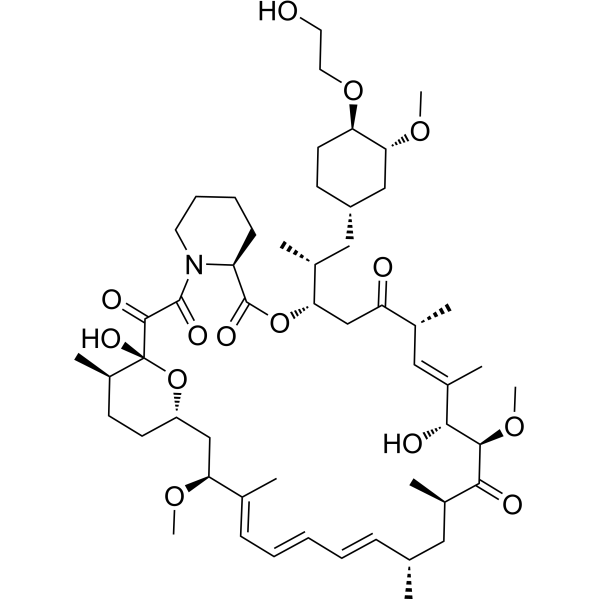
HY-10218
EverolimusmTORC Inhibitor -
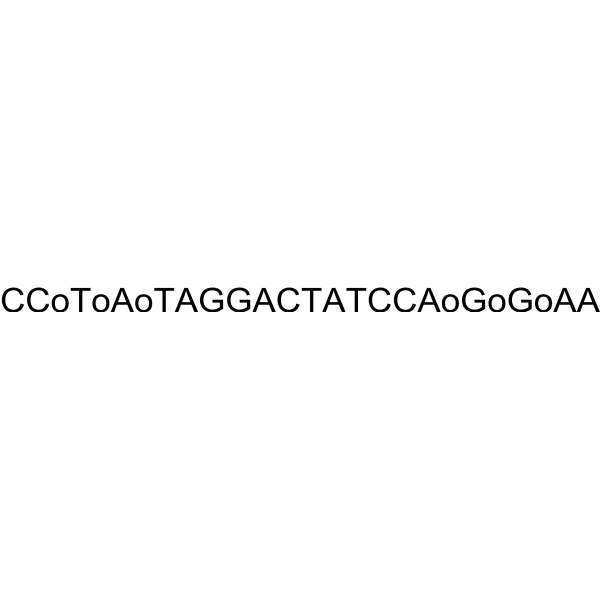
HY-109528
Fomivirsen sodiumCMV Inhibitor -
HY-153734
Inactive ASO (in vivo) sodiumNegative Control
Publications Citing Use of MedChemExpress (MCE) Tofersen
More

Biological Activity
Description
IC50 & Target
[2]|
SOD1 mRNA 0.32 nM (IC50) |
In Vitro
Tofersen (72 h) potently silences SOD1 mRNA in human HeLa cells with an IC50 of ~0.32 nM[2].
Tofersen-loaded Ca2+P lipid nanoparticles (72 h) reduce SOD1 protein levels by >3.3-fold in HEK293T cells after 72 h of incubation[5].
Tofersen-loaded Ca2+P lipid nanoparticles (0.78-50 nM; 1-48 h) exhibit dose- and time-dependent uptake into NSC-34 mouse motor neuron-like cells, are non-cytotoxic at concentrations up to 25 nM after 48 h, and undergo pH-dependent release of Tofersen within the cytoplasm[5].
MedChemExpress (MCE) has not independently confirmed the accuracy of these methods. They are for reference only.
In Vivo
Tofersen (0.25 mg/kg; i.v.; single dose) combined with optimized FUS and microbubbles delivers 5-10% of the administered dose to mouse brain tissue, achieving >3.5-fold higher brain uptake than without FUS[5].
Tofersen (0.5 mg/kg; i.v.; once weekly; 9 weeks) combined with FUS reduces SOD1 expression in targeted mouse brain cortex regions and preserves spinal cord motor neuron count without inducing neuroinflammation in G93A-SOD1 ALS mice[5].
Delivery of Tofersen (ISIS 333611) to the CSF of SOD1G93A rats distributes to the brain and spinal cord, reduces spinal cord SOD1 mRNA and protein levels, and prolongs survival in this ALS model[6].
Tofersen (Intrathecal) extends survival and improves muscle response function in transgenic rodent models of SOD1-mediated ALS[8].
Tofersen (Intrathecal) lowers SOD1 protein concentrations in non-human primates[8].
MedChemExpress (MCE) has not independently confirmed the accuracy of these methods. They are for reference only.
-
Animal Model:B6SJL-Tg(SOD1*G93A)1Gur/J (equal numbers of male and female, pre-symptomatic 6 weeks old or symptomatic 12 weeks old)[2]
-
Dosage:42 nmol (~300 μg)
-
Administration:intracerebroventricular injection; single dose
-
Result:Extended median survival to 143 days (pre-symptomatic cohort) and 139 days (symptomatic cohort).
Reduced SOD1 mRNA by 40%-60% in the cortex and cerebellum in both treatment cohorts.
-
Animal Model:B6.Cg Sod1G93A (G93A-SOD1) transgenic (9-week-old, male and female, ALS model)[6]
-
Dosage:0.5 mg/kg
-
Administration:i.v.; once weekly; 9 weeks
-
Result:Significantly reduced SOD1 fluorescence intensity in the FUS-exposed cerebral cortex compared to FUS-only or Tofersen-only control groups.
Showed no significant difference in SOD1 levels in non-FUS-exposed cerebellar regions.
Increased spinal cord motor neuron count significantly compared to both control groups.
Detected no significant increases in microglial (IBA1+ cell count) or astrocytic (GFAP fold change) activity in FUS-exposed brain regions, indicating no treatment-related neuroinflammation.
Clinical Trial
| NCT Number | Sponsor | Condition | Start Date |
Phase

|
|---|---|---|---|---|
| NCT01329991 | 2011-05 | PHASE1 |


Chemical Information
-
CAS No. 2088232-70-4
-
Appearance Solid
-
Molecular Weight 7128.00
-
Color Off-white to light yellow
-
SMILES
[Tofersen]
-
Synonyms
BIIB067; ISIS-SOD1Rx; ISIS 333611
-
Sequence
DNA, d([2'-O-(2-methoxyethyl)]m5rC-sp-[2'-O-(2-methoxyethyl)]rA-[2'-O-(2- methoxyethyl)]rG-sp-[2'-O-(2-methoxyethyl)]rG-[2'-O-(2-methoxyethyl)]rA-sp-Tsp-A-sp-m5C-sp-A-sp-T-sp-T-sp-T-sp-m5C-sp-T-sp-A-sp-[2'-O-(2-methoxyethyl)]m5rC-[2'-O-(2-methoxyethyl)]rA-sp-[2'-O-(2-methoxyethyl)]rG-[2'-O-(2-methoxyethyl)]m5rC-sp-[2'-O-(2-methoxyethyl)]m5rU)
-
Shipping
Room temperature in continental US; may vary elsewhere.
-
Storage
-20°C, stored under nitrogen, away from moisture
* In solvent : -80°C, 6 months; -20°C, 1 month (stored under nitrogen, away from moisture)


Publications (2)
-
Journal Impact Factor
-
Most Recent
-
J Mass Spectrom
Characterisation of Antisense Oligonucleotides by Ion-Pair Reversed-Phase UHPLC-HRMS: Method development using Design of Experiments. [Abstract]2026 Apr;61(4):e70049. PMID: 41856548 -
Rapid Commun Mass Spectrom
Optimisation of Heated Electrospray Ionisation Parameters to Minimise In-Source Generated Impurities in the Analysis of Oligonucleotide Therapeutics. [Abstract]2025 Jul 15;39(13):e10033. PMID: 40181565


Solvent & Solubility
In Vitro:
H2O : 100 mg/mL (14.03 mM; Need ultrasonic)
Please refer to the solubility information to select the appropriate solvent. Once prepared, please aliquot and store the solution to prevent product inactivation from repeated freeze-thaw cycles.
Storage method and period of stock solution: -80°C, 6 months; -20°C, 1 month (stored under nitrogen, away from moisture). When stored at -80°C, please use it within 6 months. When stored at -20°C, please use it within 1 month.
* Note: If you choose water as the stock solution, please dilute it to the working solution, then filter and sterilize it with a 0.22 μm filter before use.
Please refer to the solubility information to select the appropriate solvent. Once prepared, please aliquot and store the solution to prevent product inactivation from repeated freeze-thaw cycles.
Storage method and period of stock solution: -80°C, 6 months; -20°C, 1 month (stored under nitrogen, away from moisture). When stored at -80°C, please use it within 6 months. When stored at -20°C, please use it within 1 month.
* Note: If you choose water as the stock solution, please dilute it to the working solution, then filter and sterilize it with a 0.22 μm filter before use.
Concentration (start) × Volume (start) = Concentration (final) × Volume (final)
In Vivo:
For the following dissolution methods, please prepare the working solution directly:
It is recommended to prepare fresh solutions and use them promptly within a short period of time.
The percentages shown for the solvents indicate their volumetric ratio in the final prepared solution. If precipitation or phase separation occurs during preparation, heat and/or sonication can be used to aid dissolution.
Add each solvent one by one: PBS
Solubility: 100 mg/mL (14.03 mM); Clear solution; Need ultrasonic


Purity & Documentation
-
Data Sheet (292 KB)
-
SDS (254 KB)
- English - EN (254 KB)
- Français - FR (254 KB)
- Deutsch - DE (254 KB)
- Norwegian - NO (254 KB)
- Español - ES (254 KB)
- Swedish - SV (254 KB)
- Italian - IT (254 KB)
- Korean - KR (254 KB)
- Portuguese - PT (254 KB)
-
Handling Instructions (2242 KB)
References
[1]. Steffke C, et al. Targeted Proteomics upon Treatment with Tofersen Identifies Novel Response Markers for Superoxide Dismutase 1-Linked Amyotrophic Lateral Sclerosis. Ann Neurol. 2025;98(6):1318-1334. [Content Brief]
[2]. Weiss A, et al. RNAi-mediated silencing of SOD1 profoundly extends survival and functional outcomes in ALS mice. Mol Ther. 2025;33(8):3917-3938. [Content Brief]
[3]. Miller TM, et al. Trial of Antisense Oligonucleotide Tofersen for SOD1 ALS. N Engl J Med. 2022;387(12):1099-1110. [Content Brief]
[4]. Miller TM, et al. Long-Term Tofersen in SOD1 Amyotrophic Lateral Sclerosis. JAMA Neurol. 2026 Feb 1;83(2):115-125. [Content Brief]
[5]. Ediriweera GR, et al. Lipid nanoparticles and transcranial focused ultrasound enhance the delivery of SOD1 antisense oligonucleotides to the murine brain for ALS therapy. J Control Release. 2025;378:221-235. [Content Brief]
[6]. Miller TM, et al. An antisense oligonucleotide against SOD1 delivered intrathecally for patients with SOD1 familial amyotrophic lateral sclerosis: a phase 1, randomised, first-in-man study. Lancet Neurol. 2013 May;12(5):435-42. [Content Brief]
[7]. Duan C, et al. Intrathecal administration of a novel siRNA modality extends survival and improves motor function in the SOD1G93A ALS mouse model. Mol Ther Nucleic Acids. 2024;35(1):102147. Published 2024 Feb 15. [Content Brief]
[8]. Miller T, et al. Phase 1-2 Trial of Antisense Oligonucleotide Tofersen for SOD1 ALS. N Engl J Med. 2020 Jul 9;383(2):109-119. [Content Brief]
[9]. Wiesenfarth M, et al. Effects of tofersen treatment in patients with SOD1-ALS in a "real-world" setting - a 12-month multicenter cohort study from the German early access program. EClinicalMedicine. 2024;69:102495. Published 2024 Feb 15. [Content Brief]


Complete Stock Solution Preparation Table
Please refer to the solubility information to select the appropriate solvent. Once prepared, please aliquot and store the solution to prevent product inactivation from repeated freeze-thaw cycles.
Storage method and period of stock solution: -80°C, 6 months; -20°C, 1 month (stored under nitrogen, away from moisture). When stored at -80°C, please use it within 6 months. When stored at -20°C, please use it within 1 month.
| Optional Solvent | Concentration Solvent Mass | 1 mg | 5 mg | 10 mg | 25 mg |
|---|---|---|---|---|---|
| H2O | 1 mM | 0.1403 mL | 0.7015 mL | 1.4029 mL | 3.5073 mL |
| 5 mM | 0.0281 mL | 0.1403 mL | 0.2806 mL | 0.7015 mL | |
| 10 mM | 0.0140 mL | 0.0701 mL | 0.1403 mL | 0.3507 mL |
* Note: If you choose water as the stock solution, please dilute it to the working solution, then filter and sterilize it with a 0.22 μm filter before use.


Tofersen Related Classifications
HY-132580 Related Classifications
 Powered by Bioz