



Neuroscience Analysis dyes
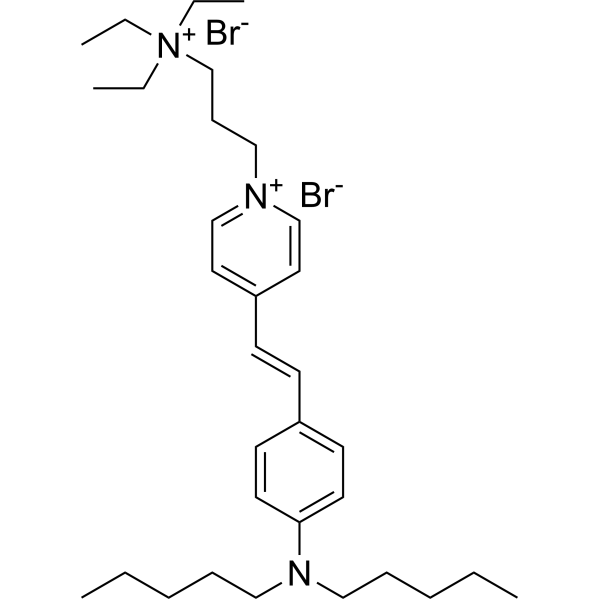
- Formel: C32H53Br2N3
- Molecular Weight: 639.59
FM1-84 (Neurodye GH1-84) is a fluorescent dye. FM1-84 has lipophilic and facilitates association with membranes, resulting in an increase in fluorescence intensity (λex=510 nm, λem=625 nm). FM1-84 can be used for synaptic vesicle recycling in neurons research.

- Formel: C32H22N3O2P
- Molecular Weight: 511.51
DCM-ONOO is a near-infrared two-photon fluorescence probe specifically designed for real-time monitoring of the dynamic fluctuations of peroxynitrite (ONOO⁻) in epilepsy models. DCM-ONOO exhibits excellent optical properties, with a single photon excitation (Ex) of 520 nm; a single photon emission (Em) of 685 nm; a two-photon excitation of 820 nm; and a Stokes shift of 165 nm. When DCM-ONOO is combined with ONOO⁻, it shifts from 460 nm to 512 nm, and only generates a significant fluorescence response to ONOO⁻. DCM-ONOO has been successfully applied to rat epilepsy models.
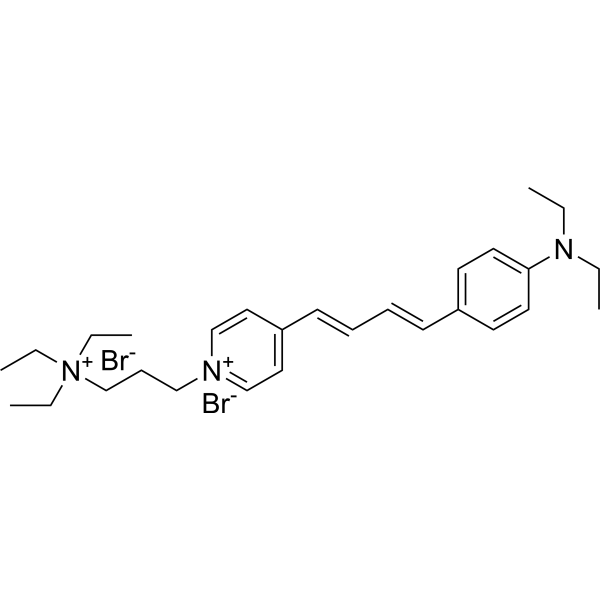
- Formel: C28H43Br2N3
- Molecular Weight: 581.47
RH 414 is the styryl pyridinium dye. RH 414 can be used for optical monitoring of synaptic vesicle membrane trafficking.
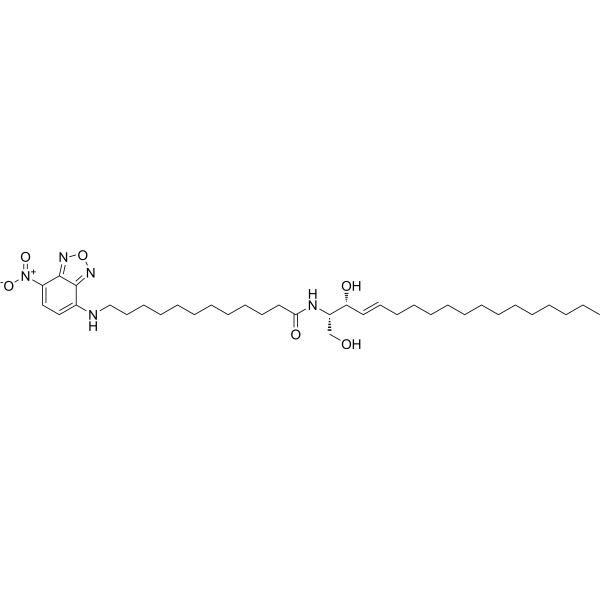
- Formel: C36H61N5O6
- Molecular Weight: 659.90
C12-NBD-ceramide is a fluorescent analogue of ceramide, it can be used as a substrate in ceramidase assays.
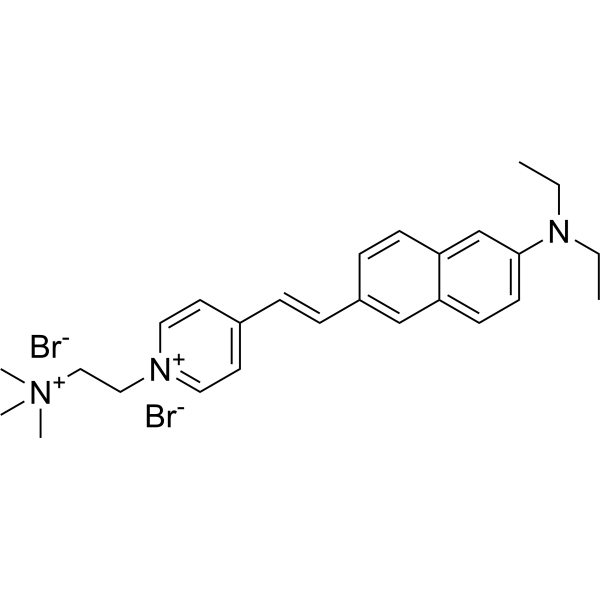
- Formel: C26H35Br2N3
- Molecular Weight: 549.38
Di-2-ANEPEQ is a voltage sensitive membrane potential fluorescence dye. Di-2-ANEPEQ can be used for the evaluation of voltage-sensitive fluorescence dyes for monitoring neuronal activity in the embryonic central nervous system.
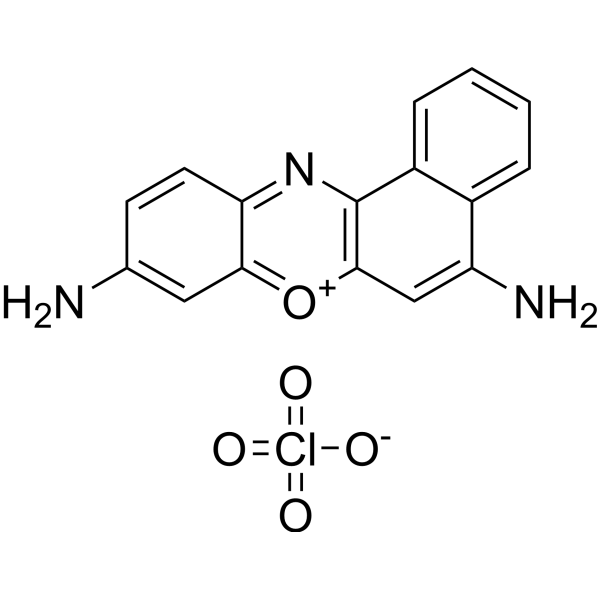
- Formel: C16H12ClN3O5
- Molecular Weight: 361.74
Cresyl Violet perchlorate is a red fluorescent stain, which can be used to stain neurons.
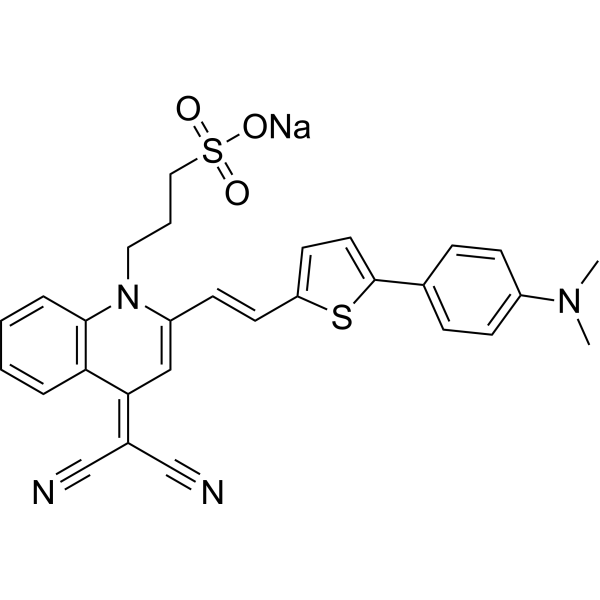
- Formel: C29H25N4NaO3S2
- Molecular Weight: 564.65
QM-FN-SO3 is a BBB-penetrable near-infrared (NIR) aggregation-induced emission (AIE)-active probe for Aβ plaques. QM-FN-SO3 can be used for in vivo detection of Aβ plaques. QM-FN-SO3 has ultra-high S/N ratio, binding affinity, and high-performance NIR emission.
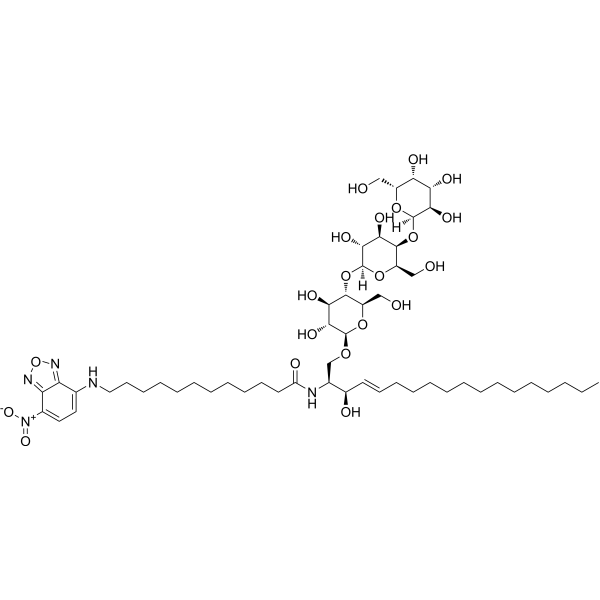
- Formel: C54H91N5O21
- Molecular Weight: 1146.32
C12 NBD galactosylceramide is a biologically active derivative of galactosylceramide that is tagged with a fluorescent C12 nitrobenzoxadiazole (C12 NBD) group. C12 NBD galactosylceramide has been used to detect ceramide trihexoside.

- Formel: C64H59BF2N14O4
- Molecular Weight: 1137.05
BOD-Tz-TMR is a fluorescent probe used for nitric oxide (NO) detection and atherosclerotic plaque imaging.BOD-Tz-TMR has a detection limit of 31 nM for NO. BOD-Tz-TMR functions via Förster resonance energy transfer (FRET) and bioorthogonal reactions, in which the tetrazine linker quenches fluorescence through the energy transfer to dark state (ETDS) mechanism. The interaction of BOD-Tz-TMR with NO triggers a ratiometric shift in fluorescence from BODIPY (Ex/Em: 488 nm/512 nm, green channel) to TMR (Em: 592 nm, red channel). BOD-Tz-TMR labels macrophages through a bioorthogonal reaction with BCN, enabling its targeted accumulation at atherosclerotic plaque sites to detect endogenous NO associated with lesion progression. BOD-Tz-TMR can be used in studies related to atherosclerosis.

- Formel: C25H25BrN2OS
- Molecular Weight: 481.45
DNTPH is a near-infrared (NIR) aggregation-induced emission (AIE) fluorescent probe used for imaging β-amyloid (Aβ) aggregates. Designed by balancing hydrophobic and hydrophilic groups, DNTPH achieves selective binding to Aβ42 fibrils and generates a near-infrared fluorescent signal with high signal-to-noise ratio. Upon binding to Aβ42 fibrils, DNTPH exhibits enhanced fluorescence, while also inhibiting Aβ42 fibril formation, promoting fibril depolymerization, attenuating Aβ-induced neurotoxicity, and improving cognitive function in Alzheimer's disease (AD) mice. DNTPH can be used in Alzheimer's disease research.


- Formel: C57H105Cl3N4
- Molecular Weight: 952.83
AM3-25 is a lipophilic styrene fluorescent dye commonly used as a fixable probe for nerve endings and cell membranes. AM3‑25 bears an amino group at its hydrophilic end, enabling it to cross‑link with proteins during formaldehyde or glutaraldehyde fixation and thereby immobilizing the stained label.

- Formel: C41H57F9N4O6
- Molecular Weight: 872.90
AM4-66 is a fluorescent dye used for cell membrane surface labeling. AM4-66 serves as a cell membrane surface marker and can label intact plasma membranes; when used sequentially with fluid-phase endocytosis markers such as fluorescent dextran, it does not stain dextran-positive intracellular structures that have detached from the cell surface, thus confirming that these internalized membranes no longer belong to the intact cell membrane surface (Ex/Em = 510/750 nm).

- Formel: C29H45Cl3N4
- Molecular Weight: 556.05
AM4-64 is a fixable cationic styryl fluorescent dye for nerve terminals, which can be used for vesicle cycle evaluation, endocytic pathway tracing and endocytosis detection. AM4-64 inserts into the plasma membrane, is internalized via activity- or energy-dependent endocytosis, and accumulates in vesicles, endosomal compartments, vacuolar membranes, mitochondria and endolysosomal structures. The fluorescence of AM4-64 is enhanced in the membrane-bound state. AM4-64 is applicable to relevant studies on neurons, plant and fungal cells and tissues (Ex/Em = 510/750 nm).

- Formel: C44H47N3O4SSi
- Molecular Weight: 742.01
BeRST voltage sensitive dye is a silicon-rhodamine-based voltage-sensitive dye that serves as a membrane potential indicator, featuring fast response kinetics, high sensitivity, photostability, and excellent signal-to-noise ratio. BeRST voltage sensitive dye relies on the photoinduced electron transfer (PeT) mechanism to report changes in neuronal membrane potential via fluorescent signals. BeRST voltage sensitive dye localizes to the extracellular surface of neuronal plasma membranes, including cell bodies and neurites. BeRST voltage sensitive dye can be used in studies related to Alzheimer's disease (Ex/Em = 658/683 nm).

- Formel: C67H105ClN2O5S
- Molecular Weight: 1086.08
Neuro-DiO 4-chlorobenzenesulfonate is a hydrophobic C18 alkyl chain carbocyanine dye with green fluorescence, commonly used as a vascular marker, cell internalizer and deposition agent. Neuro-DiO 4-chlorobenzenesulfonate inserts its alkyl chain into the endothelial plasma membrane via liposome-mediated perfusion to achieve vascular labeling. Neuro-DiO chlorobenzenesulfonate can also stain the cell membrane and cytoplasm of cancer cells to assist in confocal microscopy observations. Neuro-DiO chlorobenzenesulfonate can be released from nanosponges and accumulate on the surface of mouse retina, then internalize into retinal ganglion cells, which is applicable to researches related to glaucoma and other diseases. It should be noted that during liposome-mediated vascular staining in mice, Neuro-DiO 4-chlorobenzenesulfonate may cause leakage of airway lavage fluid.


- Formel: C38H27N5
- Molecular Weight: 553.65
PTPA-QM is a low-cytotoxicity Aβ protein probe that can be used for live-cell imaging and tissue section staining (Lys. Ex/Em = 385/615 nm). PTPA-QM can intercalate into the β-sheet layered structure of β-amyloid fibrils, form intermolecular interactions with amino acid residues, restrict intramolecular rotation and trigger fluorescence activation for imaging purposes. PTPA-QM is applicable to Alzheimer's disease-related research. Maximum excitation/emission wavelength: 448/605 nm.



