



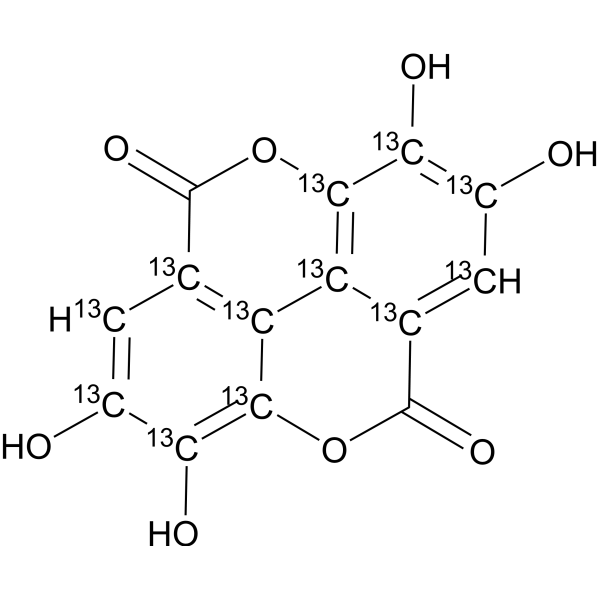
Ellagic acid-13C12
Ellagic acid-13C12 is 13 C-labeled Ellagic acid (HY-B0183). Ellagic acid is a natural antioxidant and acts as a potent and ATP-competitive inhibitor of CK2 and SHP2, with an IC50 of 40 nM and a Ki of 20 nM.
For research use only. We do not sell to patients.
- Formula: C213C12H6O8
- Molecular Weight:314.10
-
Storage:Powder -20°C, 3 years ; In solvent -80°C, 6 months , -20°C, 1 month

To place orders, for customer services and technical support, please contact: MedChemExpress USA
Tel: 609-228-6898 E-mail: [email protected] [email protected]


-
 Biological Activity
-
Chemical Information
- Protocols
- Purity & Documentation
- References
-
 Help & FAQs




Biological Activity
Description
Application
1. This compound can be used as a tracer
2. This compound can be used as an internal standard for quantitative analysis by NMR, GC-MS, or LC-MS.


Chemical Information
-
Unlabeled CAS 476-66-4
-
Appearance Solid
-
Molecular Weight 314.10
-
Formula C213C12H6O8
-
Color White to off-white
-
SMILES
O=C1[13C]2=[13CH][13C](O)=[13C](O)[13C](O3)=[13C]2[13C]4=[13C](C3=O)[13CH]=[13C](O)[13C](O)=[13C]4O1
-
Shipping
Room temperature in continental US; may vary elsewhere.
-
Storage
Powder -20°C 3 years In solvent -80°C 6 months -20°C 1 month

Protocols
-
Cell Cytotoxicity Assay
Cytotoxicity assays are usually based on the assessment of cell membrane damage, which can also be indirectly detected by measuring cell viability. Detection methods include MTT assay, CKK-8 assay, LDH assay and ATP assay, etc.


Purity & Documentation
-
Data Sheet (276 KB)
-
SDS (251 KB)
- English - EN (251 KB)
- Français - FR (251 KB)
- Deutsch - DE (251 KB)
- Norwegian - NO (251 KB)
- Español - ES (251 KB)
- Swedish - SV (251 KB)
- Italian - IT (251 KB)
- Korean - KR (251 KB)
- Portuguese - PT (251 KB)
-
Handling Instructions (2659 KB)
References
[1]. [1] Cozza G, et al. Identification of ellagic acid as potent inhibitor of protein kinase CK2: a successful example of a virtual screening application. J Med Chem. 2006 Apr 20;49(8):2363-6. [Content Brief]
[2]. Ma CH, et al. Discovery of ellagic acid as a competitive inhibitor of Src homology phosphotyrosyl phosphatase 2 (SHP2) for cancer treatment: In vitro and in silico study. Int J Biol Macromol. 2024 Jan;254(Pt 2):127845. [Content Brief]

Calculators
Concentration (start) × Volume (start) = Concentration (final) × Volume (final)


Ellagic acid-13C12 Related Classifications
HY-B0183S Related Classifications
 Powered by Bioz