



Lactimidomycin
Based on 1 publication(s) in Google Scholar
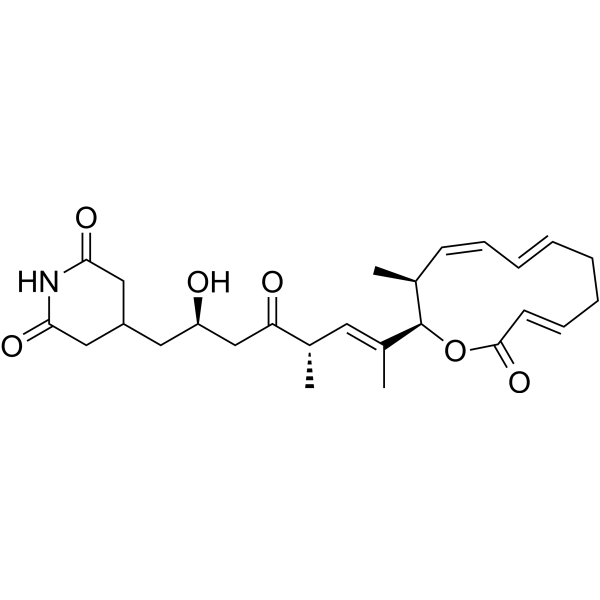
Lactimidomycin is a glutarimide-containing compound isolated from Streptomyces. Lactimidomycin is a potent inhibitor of eukaryotic translation elongation. Lactimidomycin has a potent antiproliferative effect on tumor cell lines and selectively inhibit protein translation. Lactimidomycin inhibits protein synthesis with an IC50 value of 37.82 nM. Lactimidomycin is also a potent and non-toxic inhibitor of dengue virus 2 and other RNA viruses. Anticancer and antiviral activities.
Para uso exclusivo en investigación. No vendemos a pacientes.
- Pureza : 99.90%
- No. CAS: 134869-15-1
- Fòrmula: C26H35NO6
- Peso molecular:457.56
-
Almacenamiento:Powder -20°C, 3 years ; In solvent -80°C, 6 months , -20°C, 1 month

To place orders, for customer services and technical support, please contact: MedChemExpress USA
Tel: 609-228-6898 E-mail: [email protected] [email protected]


-
 Actividad biológica
-
Chemical Information
-
Solvente y solubilidad
- Protocolo
- Pureza y Documentación
- Referencias
-
 Help & FAQs


Publications Citing Use of MedChemExpress (MCE) Lactimidomycin
More

Actividad biológica
Descripciòn
IC50 & Target
Eukaryotic translation elongation[1]
Dengue virus 2 and other RNA viruses[2]
Cellular Effect
|
Cell Line

|
Type | Value | Description | References |
|---|---|---|---|---|
| HeLa | IC50 |
37.82 nM
Compound: 4, LTM
|
Inhibition of protein synthesis in human HeLa cells assessed as [35S]cysteine/methionine utilization after 2 hrs by scintillation spectroscopy
Inhibition of protein synthesis in human HeLa cells assessed as [35S]cysteine/methionine utilization after 2 hrs by scintillation spectroscopy
|
[PMID: 20118940] |
| HeLa | IC50 |
>10000 nM
Compound: 4, LTM
|
Inhibition of transcriptional activity in human HeLa cells assessed as [3H]uridine utilization after 2 hrs by scintillation counting
Inhibition of transcriptional activity in human HeLa cells assessed as [3H]uridine utilization after 2 hrs by scintillation counting
|
[PMID: 20118940] |
In Vitro
Lactimidomycin (0.01-100 nM; 24 hours; Hs 579T, HCC 1937, HCC 1395, HCC 2218, BT 474, MCF 7, MDA MB231 cells and MCF 10A) treatment inhibits cell growth with IC50 concentrations in the low nanomolar range, but higher doses are necessary to inhibit growth of the non-tumorigenic breast cell line MCF10A[1].
Lactimidomycin induces a clear dose-responsive inhibition of DENV2 infectious particle production with an EC90 value of 0.4 μM. No measurable decrease in cell viability was detected at concentrations up to 12.5 µM[2].
Lactimidomycin is a potent inhibitor of DENV2 and Lactimidomycin's inhibition of DENV2 translation leads to reduced production of newly infectious particles. Lactimidomycin may protect cells from viral cytopathic effects including apoptosis, likely through inhibition of virus protein production and replication[2].
MedChemExpress (MCE) has not independently confirmed the accuracy of these methods. They are for reference only. Further protocols information, click here.
-
Cell Line:Hs 579T, HCC 1937, HCC 1395, HCC 2218, BT 474, MCF 7, MDA MB231 cells and MCF 10A
-
Concentration:0.01-100 nM
-
Incubation Time:24 hours
-
Result:Inhibited cell growth with IC50 concentrations in the low nanomolar range.
In Vivo
MedChemExpress (MCE) has not independently confirmed the accuracy of these methods. They are for reference only.
-
Animal Model:Female nude mice (6-8 week old) with MDA MB 231 cells[1]
-
Dosage:0.6 mg/kg
-
Administration:Intraperitoneal injection; daily; for one month
-
Result:Had an appreciable effect on tumor growth in vivo.


Chemical Information
-
No. CAS 134869-15-1
-
Appearance Solid
-
Peso molecular 457.56
-
Fòrmula C26H35NO6
-
Color White to off-white
-
SMILES
O=C(CC(C[C@@H](O)CC([C@@H](C)/C=C([C@@H]([C@@H](C)/C=C\C=C\CC/C=C/1)OC1=O)\C)=O)C2)NC2=O
-
Structure Classification
-
Initial Source
S. amphibiosporus ATCC 53964
-
Envío
Room temperature in continental US; may vary elsewhere.
-
Almacenamiento
Powder -20°C 3 years In solvent -80°C 6 months -20°C 1 month


Publications (1)
-
Journal Impact Factor
-
Most Recent
-
J Biol Chem
A cell-based chemical-genetic screen for amino acid stress response inhibitors reveals torins reverse stress kinase GCN2 signaling. [Abstract]2022 Dec;298(12):102629. PMID: 36273589


Solvente y solubilidad
In Vitro:
DMSO : 5.72 mg/mL (12.50 mM; Need ultrasonic and warming; Hygroscopic DMSO has a significant impact on the solubility of product, please use newly opened DMSO)
Please refer to the solubility information to select the appropriate solvent. Once prepared, please aliquot and store the solution to prevent product inactivation from repeated freeze-thaw cycles.
Storage method and period of stock solution: -80°C, 6 months; -20°C, 1 month. When stored at -80°C, please use it within 6 months. When stored at -20°C, please use it within 1 month.
Please refer to the solubility information to select the appropriate solvent. Once prepared, please aliquot and store the solution to prevent product inactivation from repeated freeze-thaw cycles.
Storage method and period of stock solution: -80°C, 6 months; -20°C, 1 month. When stored at -80°C, please use it within 6 months. When stored at -20°C, please use it within 1 month.
Concentration (start) × Volume (start) = Concentration (final) × Volume (final)

Protocolo
-
Research Protocol for Infectious Diseases
Infectious-disease experiments test how pathogens interact with host barriers, innate immune receptors, inflammatory signaling, pathogen replication, and tissue injury; pattern-recognition receptors such as TLRs, RIG-I-like receptors, NOD-like receptors, and inflammasomes detect microbial molecules and activate NF-κB, interferon, and cytokine responses. The central hypothesis is that infection severity reflects the balance between pathogen burden and host response: protective inflammation restricts pathogen growth, whereas excessive or mislocalized inflammation contributes to tissue damage and disease phenotype. Unresolved questions include which host pathways are protective versus pathogenic, why some infection models fail to translate to human disease, and which combined readouts best predict clinically relevant infection outcomes.
-
Cell Cytotoxicity Assay
Cytotoxicity assays are usually based on the assessment of cell membrane damage, which can also be indirectly detected by measuring cell viability. Detection methods include MTT assay, CKK-8 assay, LDH assay and ATP assay, etc.
-
Cell Viability Determination by MTT Colorimetric Assay
The following protocol uses the MTT colorimetric assay as a classic literature-established method for assessing cell viability/metabolic activity in cultured mammalian cells. MTT[3-(4,5-dimethylthiazol-2-yl)-2,5-diphenyltetrazolium bromide] is reduced by metabolically active cells to a colored formazan product; the amount of formazan is quantified spectrophotometrically and provides an indirect measure of metabolically active viable cells. Importantly, MTT reduction reflects cellular oxidoreductase/metabolic activity rather than an absolute direct count of living cells, so changes in cellular metabolism can alter the signal independently of cell number.


Pureza y Documentación
-
Ficha de datos (274 KB)
-
SDS (251 KB)
- English - EN (251 KB)
- Français - FR (251 KB)
- Deutsch - DE (251 KB)
- Norwegian - NO (251 KB)
- Español - ES (251 KB)
- Swedish - SV (251 KB)
- Italian - IT (251 KB)
- Korean - KR (251 KB)
- Portuguese - PT (251 KB)
-
Instrucciones de manejo (2659 KB)
Referencias
[1]. Schneider-Poetsch T, et al. Inhibition of eukaryotic translation elongation by cycloheximide and lactimidomycin. Nat Chem Biol. 2010 Mar;6(3):209-217. [Content Brief]
[2]. Carocci M, et al. Lactimidomycin is a broad-spectrum inhibitor of dengue and other RNA viruses. Antiviral Res. 2016 Apr;128:57-62. [Content Brief]


Complete Stock Solution Preparation Table
Please refer to the solubility information to select the appropriate solvent. Once prepared, please aliquot and store the solution to prevent product inactivation from repeated freeze-thaw cycles.
Storage method and period of stock solution: -80°C, 6 months; -20°C, 1 month. When stored at -80°C, please use it within 6 months. When stored at -20°C, please use it within 1 month.
| Optional Solvent | Concentration Solvent Mass | 1 mg | 5 mg | 10 mg | 25 mg |
|---|---|---|---|---|---|
| DMSO | 1 mM | 2.1855 mL | 10.9275 mL | 21.8551 mL | 54.6376 mL |
| 5 mM | 0.4371 mL | 2.1855 mL | 4.3710 mL | 10.9275 mL | |
| 10 mM | 0.2186 mL | 1.0928 mL | 2.1855 mL | 5.4638 mL |


Lactimidomycin Related Classifications
HY-18979 Related Classifications
 Powered by Bioz