7 Results for "

H complexing agent

" in MedChemExpress (MCE) Product Catalog:
Products (7)

7 Results for "H complexing agent" in MCE Product Catalog:

Referencia número: HY-133513
No. CAS: 1919794-40-3
Pureza:  98.15%
Synonyms: (±)-H3L28
Target:  

Drug Derivative

Áreas de investigación:  

Cancer

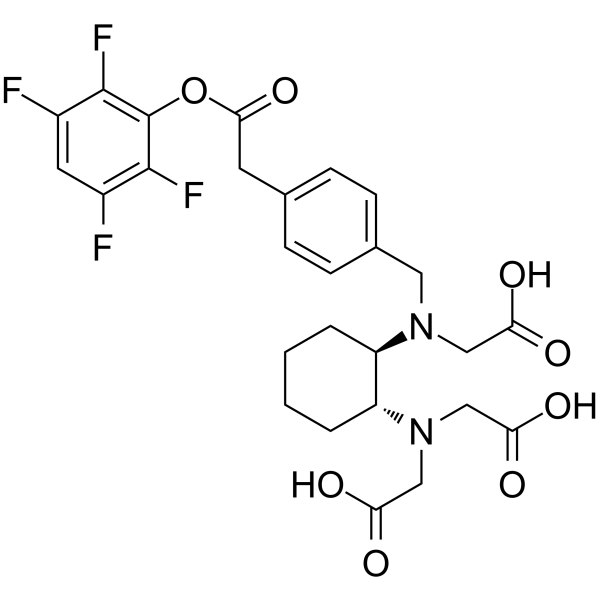
(±)-H3RESCA-TFP ((±)-H3L28) is a tetrafluorophenyl ester derivative of restrained complexing agent (RESCA). (±)-H3RESCA-TFP can be used to conjugate the chelator with a biomolecule via amine coupling (e.g., N terminus and/or the ε-amino groups of lysine) .
loading...
    loading...
Referencia número: HY-20559
No. CAS: 96-99-1
4-Chloro-3-nitrobenzoic acid is a benzoic acid derivative and an important intermediate for the synthesis of anticancer agents. 4-Chloro-3-nitrobenzoic acid shows low cytotoxicity against HepG2, A549 and HeLa cancer cells in vitro (>10,000 μM). 4-Chloro-3-nitrobenzoic acid can block thymidine uptake and inhibit lymphocyte growth. 4-Chloro-3-nitrobenzoic acid serves as a ligand for Cu (II) complexes and is used in the preparation of 10H-pyrazino[2,3-b][1,4]benzothiazine derivatives .
loading...
    loading...
Referencia número: HY-P5227
No. CAS: 1969409-70-8
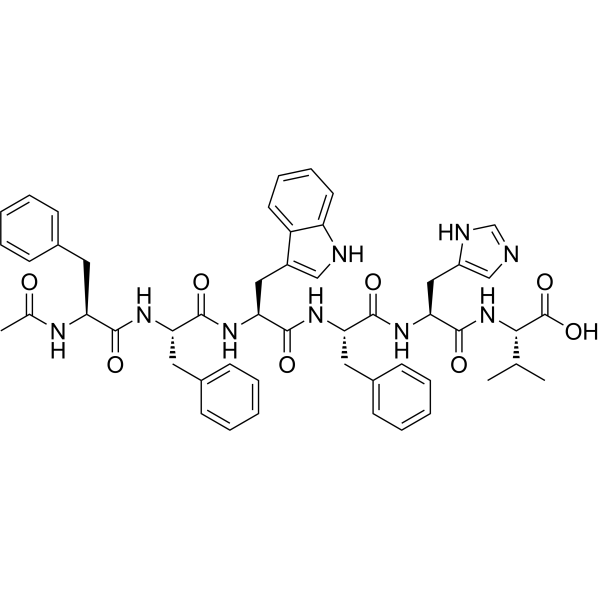
Acetyl hexapeptide-49 is an antiviral agent and barrier repair agent. Acetyl hexapeptide-49 regulates the PAR-2-mediated neurogenic inflammatory axis, reducing the release of related inflammatory factors and CGRP. Acetyl hexapeptide-49 promotes wound healing and barrier recovery. Acetyl hexapeptide-49 blocks bHLH-like motif-mediated binding, disrupts TLE1-IAV NP and SARS-CoV-2 nucleocapsid-TLE1 interactions, reduces TLE1-KLF4 complex formation, and relieves interferon suppression. Acetyl hexapeptide-49 inhibits IAV polymerase activity and enhances innate antiviral signaling, protecting mice against H1N1 and SARS-CoV-2 challenge in vivo. Acetyl hexapeptide-49 can be used in research related to sensitive skin, influenza A virus infection, and SARS-CoV-2 infection .
loading...
    loading...
Referencia número: HY-155718
Target:  

Apoptosis

Áreas de investigación:  

Cancer

fac-[Re(CO)3(L6)(H2O)][NO3] (compound 6), the rhenium(I) tricarbonyl aqua complex, is an anticancer agent associated with mitochondrial dysfunction. fac-[Re(CO)3(L6)(H2O)][NO3] is cytotoxic to prostate cancer cells, IC50=50 nM (PC-3 cells). fac-[Re(CO)3(L6)(H2O)][NO3] mainly accumulates in the nucleus, down-regulates ATP production in PC3 cells, and promotes apoptosis. However, fac-[Re(CO)3(L6)(H2O)][NO3] did not induce necrosis, pyrodeath and autophagy .
loading...
    loading...
Referencia número: HY-155719
Target:  

Paraptosis

Áreas de investigación:  

Cancer

fac-[Re(CO)3(L3)(H2O)][NO3] (compound 3), the rhenium(I) tricarbonyl aqua complex, is an anticancer agent associated with mitochondrial dysfunction. fac-[Re(CO)3(L3)(H2O)][NO3] is cytotoxic to prostate cancer cells with IC50=0.32 μM (PC-3 cells). fac-[Re(CO)3(L3)(H2O)][NO3] mainly accumulates in mitochondria, down-regulates ATP production in PC3 cells, and promotes paraptosis. However, fac-[Re(CO)3(L3)(H2O)][NO3] did not induce necrosis, apoptosis and autophagy .
loading...
    loading...
Referencia número: HY-17516R
No. CAS: 129558-76-5
Áreas de investigación:  

Infection

Tolfenpyrad (Standard) is the analytical standard of Tolfenpyrad (HY-17516). This product is intended for research and analytical applications. Tolfenpyrad is an orally active insecticide, acaricide and antibacterial agent. Tolfenpyrad inhibits Complex I in the mitochondrial respiratory electron transport chain, interfering with the cell respiration process. Tolfenpyrad has significant insecticidal activity against a variety of insect pests such as H. contortus, Coccinella septempunctata. Tolfenpyrad has antibacterial activity against Francisella novicida, with an IC50 of 1.2 µM or 1.5 µM .
loading...
    loading...
Referencia número: HY-180269
Áreas de investigación:  

Infection

Anti-Influenza agent 10 (Compound 41) is an influenza A virus RNA-dependent RNA polymerase (RdRp) inhibitor. Anti-Influenza agent 10 exhibits potent antiviral activity against A/PR/8/34(H1N1) with an IC50 of 0.29μM and a KD of 4.11 μM. Anti-Influenza agent 10 can inhibit the assembly of the viral RdRp complex by disrupting the protein interaction between PA and PB1 subunits, thereby blocking the transcription and replication of the viral genome. Anti-Influenza agent 10 shows significant broad-spectrum effects on multiple influenza virus strains, such as H3N2, H3N8 and H9N2 with IC50 values of 3.96, 1.91 and 1.45 μM. Anti-Influenza agent 10 can be used for the research of influenza A Virus Infection .
loading...
    loading...

