



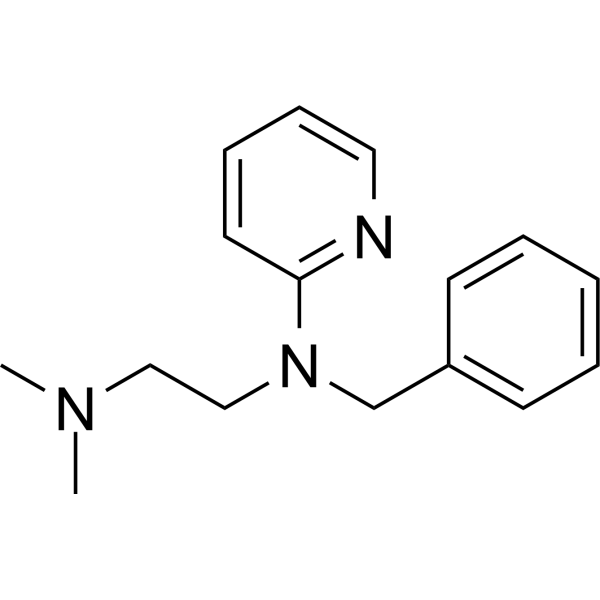
Tripelennamine
Tripelennamine is a histamine H1-receptor antagonist. Tripelennamine effectively reverses histamine-induced bronchoconstriction, increased transpulmonary pressure, elevated pulmonary vascular resistance and reduced dynamic compliance. Tripelennamine does not significantly affect arterial hypoxemia, hemoglobin desaturation and hypercapnia in horses undergoing short-term high-intensity exercise. Tripelennamine exhibits local and central analgesic activity. Tripelennamine can be used in studies related to emphysema, urticaria and acute laminitis.
Para uso exclusivo en investigación. No vendemos a pacientes.
- No. CAS: 91-81-6
- Fòrmula: C16H21N3
- Peso molecular:255.36
-
Almacenamiento:
Please store the product under the recommended conditions in the Certificate of Analysis.

To place orders, for customer services and technical support, please contact: MedChemExpress USA
Tel: 609-228-6898 E-mail: [email protected] [email protected]


-
 Actividad biológica
-
Chemical Information
- Pureza y Documentación
- Referencias
-
 Help & FAQs


Ver todos los productos específicos de isoformas Histamine Receptor
More

Actividad biológica
Descripciòn
IC50 & Target
|
H1 Receptor |
In Vitro
Tripelennamine (1.0 μg/mL) exhibits 83.4% protein binding in healthy Arabian camel serum and 73.6% protein binding in healthy horse serum, with no significant difference between the two species[2].
MedChemExpress (MCE) has not independently confirmed the accuracy of these methods. They are for reference only. .
In Vivo
MedChemExpress (MCE) has not independently confirmed the accuracy of these methods. They are for reference only.
-
Animal Model:Thoroughbred (3 fillies, 4 geldings, 3-6 yr old, 460 kg)[1]
-
Dosage:1.10 mg/kg
-
Administration:i.v.; single dose 15 minutes preexercise
-
Result:Caused central nervous system excitement, significant tachycardia, systemic and pulmonary hypertension, and raised hemoglobin concentration from 12.7 g/dl to 17.7 g/dl.
Increased mixed venous blood O2 tension and hemoglobin-O2 saturation, and increased arterial and mixed venous blood O2 content with no change in arterial-to-mixed venous O2 content gradient.
Increased core temperature during exercise to 41.2°C at 120 seconds of galloping (vs.
40.7°C in controls).
Showed no statistically significant differences from controls in exercise-induced arterial hypoxemia (arterial O2 tension at 120 seconds of galloping: 71.3 Torr vs.
71.3 Torr), arterial hemoglobin-O2 saturation (80.6% vs.
83.8%), arterial CO2 tension (60.1 Torr vs.
56.2 Torr), arterial pH (7.040 vs.
7.090), arterial and mixed venous blood O2 content, arterial-to-mixed venous O2 content gradient (22.8 mL O2/dl blood vs.
23.2 mL O2/dl blood), or O2 extraction (92.2% vs.
91.5%).
Resulted in exercise-induced pulmonary hemorrhage in all treated horses, matching control rates.


Chemical Information
-
No. CAS 91-81-6
-
Peso molecular 255.36
-
Fòrmula C16H21N3
-
SMILES
CN(C)CCN(CC1=CC=CC=C1)C2=NC=CC=C2
-
Structure Classification
-
Initial Source
-
Envío
Room temperature in continental US; may vary elsewhere.
-
Almacenamiento
Please store the product under the recommended conditions in the Certificate of Analysis.


Pureza y Documentación
Referencias
[1]. Manohar M, et al. H1-receptor antagonist, tripelennamine, does not affect arterial hypoxemia in exercising Thoroughbreds. J Appl Physiol. 2002 Apr;92(4):1515-23. [Content Brief]
[2]. Wasfi IA, et al. Comparative disposition of tripelennamine in horses and camels after intravenous administration. J Vet Pharmacol Ther. 2000 Jun;23(3):145-52. [Content Brief]
[3]. Yeh SY, et al. The pharmacokinetics of pentazocine and tripelennamine. Clin Pharmacol Ther. 1986 Jun;39(6):669-76. [Content Brief]

Calculators
Concentration (start) × Volume (start) = Concentration (final) × Volume (final)


Tripelennamine Related Classifications
HY-17428A Related Classifications
 Powered by Bioz