



HEPES-d18
Based on 1 publication(s) in Google Scholar
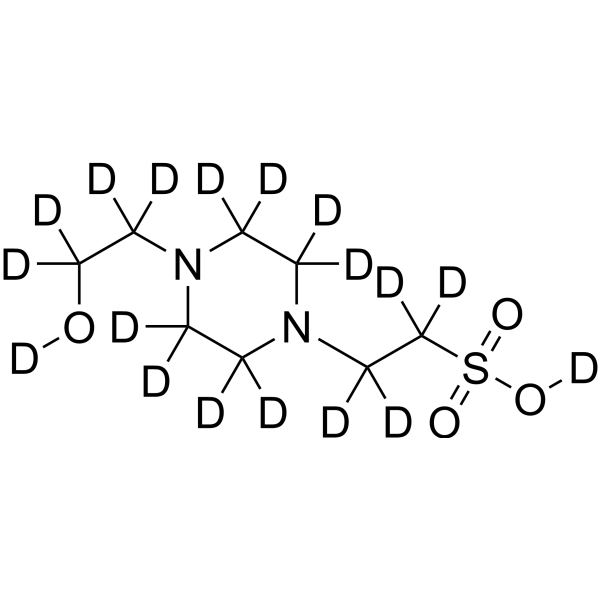
HEPES-d18 is the deuterium labeled HEPES. HEPES, a nonvolatile zwitterionic chemical buffering agent, is broadly applied in cell culture. HEPES is effective at pH 6.8 to 8.2. HEPES is also a potent inducer of lysosome biogenesis.
For research use only. We do not sell to patients.
- Purity : 99.89%
- CAS No.: 203805-87-2
- Formula: C8D18N2O4S
- Molecular Weight:256.42
-
Storage:Powder -20°C, 3 years , 4°C, 2 years ; In solvent -80°C, 6 months , -20°C, 1 month

To place orders, for customer services and technical support, please contact: MedChemExpress USA
Tel: 609-228-6898 E-mail: [email protected] [email protected]


-
 Biological Activity
-
Chemical Information
-
Solvent & Solubility
- Protocols
- Purity & Documentation
- References
-
 Help & FAQs


Publications Citing Use of MedChemExpress (MCE) HEPES-d18
More

Biological Activity
Description
In Vitro
Stable heavy isotopes of hydrogen, carbon, and other elements have been incorporated into drug molecules, largely as tracers for quantitation during the drug development process. Deuteration has gained attention because of its potential to affect the pharmacokinetic and metabolic profiles of drugs[1].
MedChemExpress (MCE) has not independently confirmed the accuracy of these methods. They are for reference only. Further protocols information, click here.
Application
1. This compound can be used as a tracer
2. This compound can be used as an internal standard for quantitative analysis by NMR, GC-MS, or LC-MS.


Chemical Information
-
CAS No. 203805-87-2
-
Unlabeled CAS 7365-45-9
-
Appearance Solid
-
Molecular Weight 256.42
-
Formula C8D18N2O4S
-
Color White to off-white
-
SMILES
O=S(C([2H])([2H])C([2H])([2H])N1C([2H])([2H])C([2H])([2H])N(C([2H])([2H])C1([2H])[2H])C([2H])([2H])C([2H])([2H])O[2H])(O[2H])=O
-
Shipping
Room temperature in continental US; may vary elsewhere.
-
Storage
Powder -20°C 3 years 4°C 2 years In solvent -80°C 6 months -20°C 1 month


Publications (1)
-
Journal Impact Factor
-
Most Recent
-
J Pharm Biomed Anal
Development of pH-adjusted NMR methodology for quantitation of caffeoylquinic acid derivatives and evaluation of their antimalignant pleural mesothelioma potential. [Abstract]2025 Jul 15:259:116776. PMID: 40024029


Solvent & Solubility
In Vitro:
H2O : 100 mg/mL (389.99 mM; Need ultrasonic)
Please refer to the solubility information to select the appropriate solvent. Once prepared, please aliquot and store the solution to prevent product inactivation from repeated freeze-thaw cycles.
Storage method and period of stock solution: -80°C, 6 months; -20°C, 1 month. When stored at -80°C, please use it within 6 months. When stored at -20°C, please use it within 1 month.
* Note: If you choose water as the stock solution, please dilute it to the working solution, then filter and sterilize it with a 0.22 μm filter before use.
Please refer to the solubility information to select the appropriate solvent. Once prepared, please aliquot and store the solution to prevent product inactivation from repeated freeze-thaw cycles.
Storage method and period of stock solution: -80°C, 6 months; -20°C, 1 month. When stored at -80°C, please use it within 6 months. When stored at -20°C, please use it within 1 month.
* Note: If you choose water as the stock solution, please dilute it to the working solution, then filter and sterilize it with a 0.22 μm filter before use.
Concentration (start) × Volume (start) = Concentration (final) × Volume (final)

Protocols
-
Lysosome and acidic-vesicle live-cell staining
Lysosome and acidic-vesicle live-cell staining detects acidic intracellular compartments by using membrane-permeant acidotropic probes that accumulate in low-pH vesicles, including lysosomes, late endosomes, autolysosomes, and acidic phagosomes. LysoTracker staining is commonly used as an intensity-based readout of acidic lysosomal compartment abundance or enlargement, while acridine orange produces green fluorescence in less concentrated compartments and red fluorescence after concentration-dependent accumulation in acidic vesicular organelles. Loss or reduction of acridine-orange red signal can be used as a readout of lysosomal membrane permeabilization or reduced acidic-vesicle integrity. This protocol is designed for live cultured cells and can be adapted for fluorescence microscopy, high-content imaging, plate-reader readout, or flow cytometry when the selected literature supports the readout. Because these dyes report acidotropic accumulation rather than lysosome identity alone,
-
Directly Induced Neuron Culture
Directly induced neuron culture converts somatic cells, most commonly fibroblasts, into induced neurons without passing through a pluripotent or neural progenitor stage; classic evidence shows that mouse fibroblasts can be converted by Ascl1, Brn2/Pou3f2, and Myt1l, human fibroblasts can be converted by defined neuronal transcription factors, and human fibroblasts can also be converted by miR-9/9-124 with neurogenic or subtype-specifying transcription factors. The readout is acquisition of neuronal identity and function, assessed by neuronal morphology, neuronal markers such as Tuj1/βIII-tubulin, MAP2, synapsin, and subtype markers when relevant, together with functional assays such as action-potential firing, synaptic activity, and electrophysiology.


Purity & Documentation
-
Data Sheet (279 KB)
-
SDS (396 KB)
- English - EN (396 KB)
- Français - FR (396 KB)
- Deutsch - DE (396 KB)
- Norwegian - NO (396 KB)
- Español - ES (396 KB)
- Swedish - SV (396 KB)
- Italian - IT (396 KB)
- Korean - KR (396 KB)
- Portuguese - PT (396 KB)
-
Handling Instructions (2659 KB)
References
[1]. Russak EM, et al. Impact of Deuterium Substitution on the Pharmacokinetics of Pharmaceuticals. Ann Pharmacother. 2019 Feb;53(2):211-216. [Content Brief]
[2]. Suzuki T, et al. Nonvolatile buffer coating of titanium to prevent its biological aging and for drug delivery. Biomaterials. 2010;31(18):4818-4828. [Content Brief]
[3]. Sledź P, et al. An experimental charge density of HEPES. Acta Crystallogr B. 201066(Pt 4):482-492. [Content Brief]
[4]. Tol MJ, et al. HEPES activates a MiT/TFE-dependent lysosomal-autophagic gene network in cultured cells: A call for caution. Autophagy. 201814(3):437-449. [Content Brief]


Complete Stock Solution Preparation Table
Please refer to the solubility information to select the appropriate solvent. Once prepared, please aliquot and store the solution to prevent product inactivation from repeated freeze-thaw cycles.
Storage method and period of stock solution: -80°C, 6 months; -20°C, 1 month. When stored at -80°C, please use it within 6 months. When stored at -20°C, please use it within 1 month.
| Optional Solvent | Concentration Solvent Mass | 1 mg | 5 mg | 10 mg | 25 mg |
|---|---|---|---|---|---|
| H2O | 1 mM | 3.8999 mL | 19.4993 mL | 38.9985 mL | 97.4963 mL |
| 5 mM | 0.7800 mL | 3.8999 mL | 7.7997 mL | 19.4993 mL | |
| 10 mM | 0.3900 mL | 1.9499 mL | 3.8999 mL | 9.7496 mL | |
| 15 mM | 0.2600 mL | 1.3000 mL | 2.5999 mL | 6.4998 mL | |
| 20 mM | 0.1950 mL | 0.9750 mL | 1.9499 mL | 4.8748 mL | |
| 25 mM | 0.1560 mL | 0.7800 mL | 1.5599 mL | 3.8999 mL | |
| 30 mM | 0.1300 mL | 0.6500 mL | 1.3000 mL | 3.2499 mL | |
| 40 mM | 0.0975 mL | 0.4875 mL | 0.9750 mL | 2.4374 mL | |
| 50 mM | 0.0780 mL | 0.3900 mL | 0.7800 mL | 1.9499 mL | |
| 60 mM | 0.0650 mL | 0.3250 mL | 0.6500 mL | 1.6249 mL | |
| 80 mM | 0.0487 mL | 0.2437 mL | 0.4875 mL | 1.2187 mL | |
| 100 mM | 0.0390 mL | 0.1950 mL | 0.3900 mL | 0.9750 mL |
* Note: If you choose water as the stock solution, please dilute it to the working solution, then filter and sterilize it with a 0.22 μm filter before use.


HEPES-d18 Related Classifications
HY-D0857S Related Classifications
 Powered by Bioz