



HIV-1 inhibitor-49
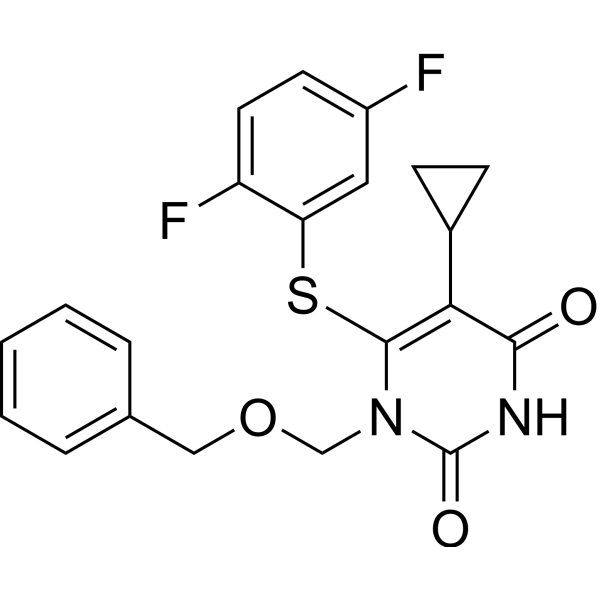
HIV-1 inhibitor-49 is an orally active HIV-1 inhibitor, is a HEPT analog. HIV-1 inhibitor-49 possesses great pharmacokinetics profiles and potent non-nucleoside reverse transcriptase inhibitory activity (IC50=30 nM). HIV-1 inhibitor-49 exerts potential safety without acute toxicity in mouse model.
Para uso exclusivo en investigación. No vendemos a pacientes.
- No. CAS: 3038135-11-1
- Fòrmula: C21H18F2N2O3S
- Peso molecular:416.44
-
Almacenamiento:
Please store the product under the recommended conditions in the Certificate of Analysis.

To place orders, for customer services and technical support, please contact: MedChemExpress USA
Tel: 609-228-6898 E-mail: [email protected] [email protected]


-
 Actividad biológica
-
Chemical Information
- Protocolo
- Pureza y Documentación
- Referencias
-
 Help & FAQs




Actividad biológica
Descripciòn
IC50 & Target
[1]|
HIV-1 (WT) 17 nM (EC50) |
HIV-1 (L100I) 0.38 μM (EC50) |
HIV-1 (K103N) 2.64 μM (EC50) |
HIV-1 (Y181C) 1.85 μM (EC50) |
HIV-1 (E138K) 0.09 μM (EC50) |
Cellular Effect
|
Cell Line

|
Type | Value | Description | References |
|---|---|---|---|---|
| MT4 | CC50 |
39.21 μM
Compound: 9h
|
Cytotoxicity against human MT4 cells assessed as reduction in cell viability
Cytotoxicity against human MT4 cells assessed as reduction in cell viability
|
[PMID: 36442370] |
In Vitro
HIV-1 inhibitor-49 (compound 9h) (EC50=17 nM-39.21 μM) inhibits WT HIV-1 with much higher selectivity index over other HIV-1 mutant (L100I, K103N, Y181C, and E138K)[1].
HIV-1 inhibitor-49 (0-50 μM) shows little CYP enzyme, hERG inhibition in CHO-hERG cells, with IC50s of 27.6 μM (CYP2C9), 30.3 μM (CYP2C19), and >50 μM (others)[1].
MedChemExpress (MCE) has not independently confirmed the accuracy of these methods. They are for reference only. Further protocols information, click here.
In Vivo
HIV-1 inhibitor-49 (10 mg/kg; p.o.; single dose) shows excellent oral bioavailability in rats[1].
Rat PK profile[1]
| Route | Dose (mg/kg) | AUC0-t (ng·h/mL) | AUC0-∞ (ng·h/mL) | T1/2 (h) | Tmax (h) | Vz (mL/kg) | Cl (mL/h/kg) | Cmax (ng/mL) | F (%) |
| i.v. | 1.0 | 1102 | 1100 | 0.514 | 0.083 | 698 | 936 | 2033 | |
| p.o. | 10 | 9557 | 8663 | 2.51 | 0.583 | 3523 | 86.72% |
MedChemExpress (MCE) has not independently confirmed the accuracy of these methods. They are for reference only.


Chemical Information
-
No. CAS 3038135-11-1
-
Peso molecular 416.44
-
Fòrmula C21H18F2N2O3S
-
SMILES
O=C1NC(N(C(SC2=CC(F)=CC=C2F)=C1C3CC3)COCC4=CC=CC=C4)=O
-
Envío
Room temperature in continental US; may vary elsewhere.
-
Almacenamiento
Please store the product under the recommended conditions in the Certificate of Analysis.

Protocolo
-
Cell Cytotoxicity Assay
Cytotoxicity assays are usually based on the assessment of cell membrane damage, which can also be indirectly detected by measuring cell viability. Detection methods include MTT assay, CKK-8 assay, LDH assay and ATP assay, etc.
-
Protocol for Pharmacokinetic Study
Pharmacokinetic studies quantify how an organism handles a drug over time through absorption, distribution, metabolism, and excretion, and the core experimental readout is the concentration-time profile of parent drug and, when relevant, metabolites in biological matrices such as plasma, whole blood, urine, bile, or tissue. Pharmacokinetic analysis links dose, route, exposure, clearance, half-life, distribution, bioavailability, and systemic exposure to drug efficacy and toxicity hypotheses rather than measuring a signaling pathway directly. The literature links pharmacokinetics to drug-development phenotypes by showing that drug metabolism and pharmacokinetics influence compound progression, exposure-response interpretation, safety margins, dosing strategy, and failure risk during discovery and development. DMPK science contributes to compound optimization by integrating physicochemical properties, in vitro metabolism, transporter behavior, in vivo exposure, and pharmacodynamic contex
-
Acute Systemic Toxicity Study
Acute systemic toxicity studies evaluate adverse effects occurring after a single exposure, or repeated exposure within a short acute window, and the main in vivo readouts are mortality, moribund condition, clinical signs, body-weight change, and gross pathological findings; acute oral toxicity methods were developed to replace classical LD50 testing with reduced-animal designs such as fixed-dose procedure, acute toxic class method, and up-and-down procedure. The fixed-dose procedure classifies acute toxicity by administering predefined dose levels and observing evident toxicity rather than using death as the primary endpoint, whereas the acute toxic class method uses sequential groups of three animals per step and the up-and-down procedure doses animals sequentially to estimate an LD50 with fewer animals than conventional LD50 testing.
-
How to Choose the Right Model Animal
Choosing the right model animal is a validity-driven decision in which the species, strain, sex, age, genetic background, disease-induction method, outcome measures, and welfare burden must match the scientific question rather than laboratory tradition or convenience. A model should be selected by judging face validity, construct validity, and predictive validity: whether it resembles the human phenotype, whether it reproduces relevant mechanisms, and whether results are likely to predict human biology or treatment response. Animal studies often fail to translate because of species differences, weak disease resemblance, poor experimental design, inadequate reporting, publication bias, and underuse of randomization, blinding, and sample-size justification. Unresolved questions include how to rank competing models objectively, how much human-disease complexity must be reproduced for a given objective, and when non-animal systems such as organoids, ex vivo tissue, or computational models


Pureza y Documentación
Referencias

Calculators
Concentration (start) × Volume (start) = Concentration (final) × Volume (final)


HIV-1 inhibitor-49 Related Classifications
HY-151933 Related Classifications
 Powered by Bioz