



306-N16B

Based on 1 Customer Validation
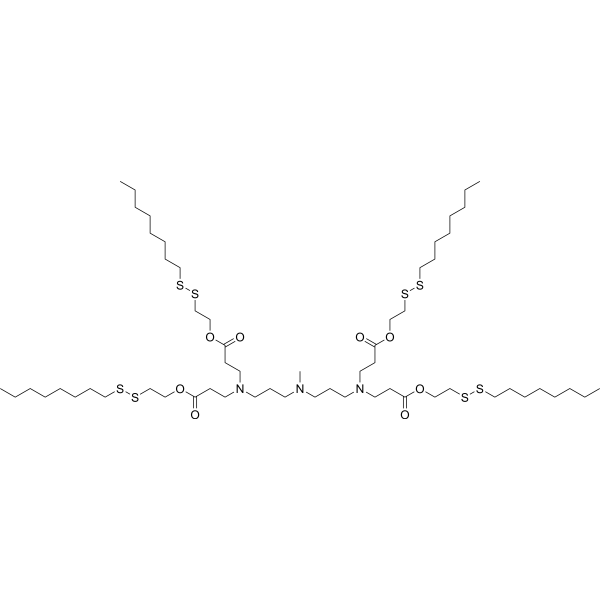
306-N16B is a selective lung-targeted lipid nanoparticle that reversibly targets lung endothelial cells and specific immune cells through selective adsorption of a protein corona mediated by differences in tail structure (such as fibrinogen β/γ chain). 306-N16B binds to specific plasma proteins in the blood to form a protein corona, which guides the particles to be enriched in the lungs, releases mRNA and promotes target cell gene expression, exerts efficient lung cell transfection activity, and can precisely regulate gene delivery of different cell types in the lungs (such as endothelial cells and macrophages). 306-N16B can be used in gene therapy technologies for hereditary lung diseases including pulmonary lymphangioleiomyomatosis (LAM), restoring tumor suppressor function by delivering Tsc2 mRNA, and can also be used for lung-specific mRNA vaccines and gene editing therapies.
For research use only. We do not sell to patients.
- Purity : 98.84%
- CAS No.: 2803699-70-7
- Formula: C75H151N7O4S8
- Molecular Weight:1471.57
-
Storage:Pure form -20°C, 3 years , 4°C, 2 years ; In solvent -80°C, 6 months , -20°C, 1 month


To place orders, for customer services and technical support, please contact: MedChemExpress USA
Tel: 609-228-6898 E-mail: [email protected] [email protected]


-
 Biological Activity
-
Chemical Information
-
Solvent & Solubility
- Protocols
- Purity & Documentation
- References
-
 Help & FAQs


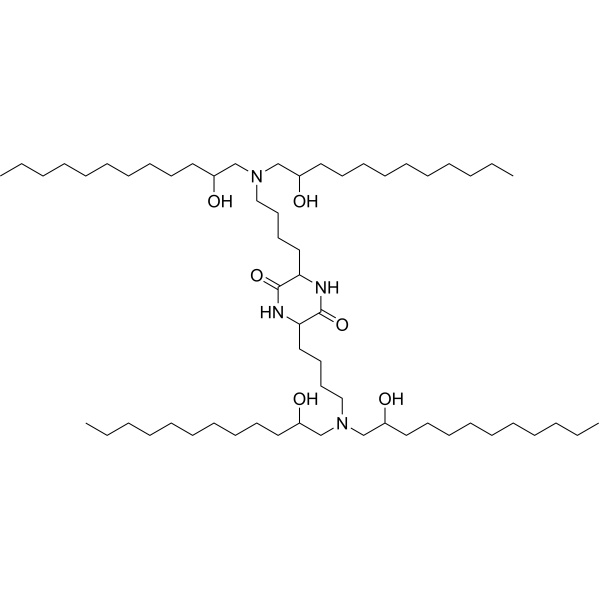
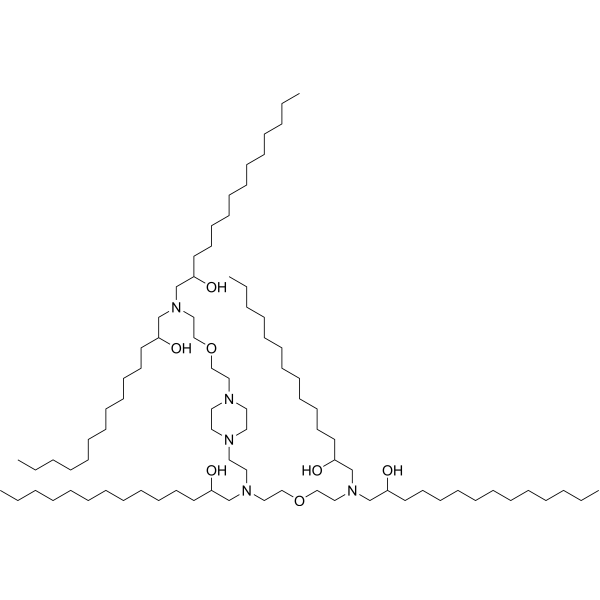


Biological Activity
Description
In Vivo
In the Cre/LoxP gene editing experiment, 306-N16B (0.75 mg mRNA equiv./kg; 7 d) induces Ai14 mouse lung endothelial cell-specific tdTomato expression, and flow cytometry shows that the endothelial cell transfection rate reached 33.6%, which is significantly higher than that of epithelial cells (1.5%) and macrophages (1.9%)[1].
MedChemExpress (MCE) has not independently confirmed the accuracy of these methods. They are for reference only.


Chemical Information
-
CAS No. 2803699-70-7
-
Appearance Oil
-
Molecular Weight 1471.57
-
Formula C75H151N7O4S8
-
Color Colorless to off-white
-
SMILES
O=C(CCN(CCCN(CCCN(CCC(NCCSSCCCCCCCCCCCC)=O)CCC(NCCSSCCCCCCCCCCCC)=O)C)CCC(NCCSSCCCCCCCCCCCC)=O)NCCSSCCCCCCCCCCCC
-
Shipping
Room temperature in continental US; may vary elsewhere.
-
Storage
Pure form -20°C 3 years 4°C 2 years In solvent -80°C 6 months -20°C 1 month


Solvent & Solubility
In Vitro:
DMSO : 100 mg/mL (67.95 mM; Need ultrasonic; Hygroscopic DMSO has a significant impact on the solubility of product, please use newly opened DMSO)
Ethanol : 25 mg/mL (16.99 mM; Need ultrasonic)
Please refer to the solubility information to select the appropriate solvent. Once prepared, please aliquot and store the solution to prevent product inactivation from repeated freeze-thaw cycles.
Storage method and period of stock solution: -80°C, 6 months; -20°C, 1 month. When stored at -80°C, please use it within 6 months. When stored at -20°C, please use it within 1 month.
Please refer to the solubility information to select the appropriate solvent. Once prepared, please aliquot and store the solution to prevent product inactivation from repeated freeze-thaw cycles.
Storage method and period of stock solution: -80°C, 6 months; -20°C, 1 month. When stored at -80°C, please use it within 6 months. When stored at -20°C, please use it within 1 month.
Concentration (start) × Volume (start) = Concentration (final) × Volume (final)


Purity & Documentation
-
Data Sheet (272 KB)
-
SDS (252 KB)
- English - EN (252 KB)
- Français - FR (252 KB)
- Deutsch - DE (252 KB)
- Norwegian - NO (252 KB)
- Español - ES (252 KB)
- Swedish - SV (252 KB)
- Italian - IT (252 KB)
- Korean - KR (252 KB)
- Portuguese - PT (252 KB)
-
Handling Instructions (2659 KB)
References
[1]. Qiu M, et al. Lung-selective mRNA delivery of synthetic lipid nanoparticles for the treatment of pulmonary lymphangioleiomyomatosis. Proc Natl Acad Sci U S A. 2022 Feb 22;119(8):e2116271119. [Content Brief]
[2]. Yuan Z, et al. Impact of physicochemical properties on biological effects of lipid nanoparticles: Are they completely safe. Sci Total Environ. 2024 Jun 1;927:172240. [Content Brief]


Complete Stock Solution Preparation Table
Please refer to the solubility information to select the appropriate solvent. Once prepared, please aliquot and store the solution to prevent product inactivation from repeated freeze-thaw cycles.
Storage method and period of stock solution: -80°C, 6 months; -20°C, 1 month. When stored at -80°C, please use it within 6 months. When stored at -20°C, please use it within 1 month.
| Optional Solvent | Concentration Solvent Mass | 1 mg | 5 mg | 10 mg | 25 mg |
|---|---|---|---|---|---|
| Ethanol / DMSO | 1 mM | 0.6795 mL | 3.3977 mL | 6.7955 mL | 16.9887 mL |
| 5 mM | 0.1359 mL | 0.6795 mL | 1.3591 mL | 3.3977 mL | |
| 10 mM | 0.0680 mL | 0.3398 mL | 0.6795 mL | 1.6989 mL | |
| 15 mM | 0.0453 mL | 0.2265 mL | 0.4530 mL | 1.1326 mL | |
| DMSO | 20 mM | 0.0340 mL | 0.1699 mL | 0.3398 mL | 0.8494 mL |
| 25 mM | 0.0272 mL | 0.1359 mL | 0.2718 mL | 0.6795 mL | |
| 30 mM | 0.0227 mL | 0.1133 mL | 0.2265 mL | 0.5663 mL | |
| 40 mM | 0.0170 mL | 0.0849 mL | 0.1699 mL | 0.4247 mL | |
| 50 mM | 0.0136 mL | 0.0680 mL | 0.1359 mL | 0.3398 mL | |
| 60 mM | 0.0113 mL | 0.0566 mL | 0.1133 mL | 0.2831 mL |


306-N16B Related Classifications
HY-150229 Related Classifications
 Powered by Bioz