



ML162-yne

Based on 1 Customer Validation
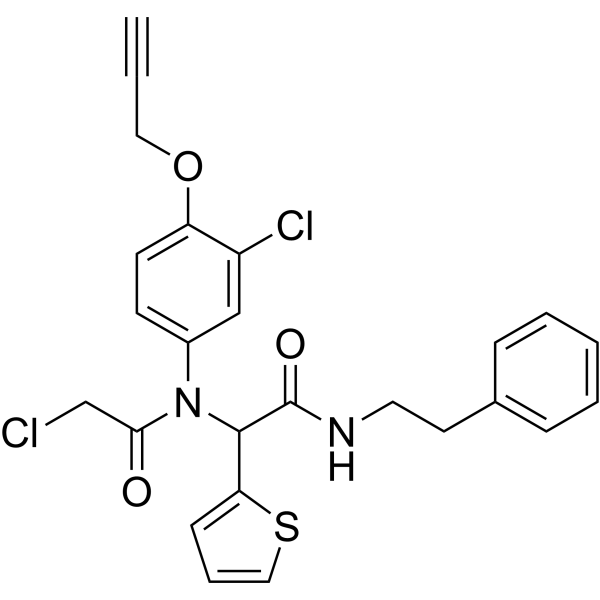
ML162-yne is a potent GPX4-inhibitor affinity probe. ML162-yne is a click chemistry reagent, it contains an Alkyne group and can undergo copper-catalyzed azide-alkyne cycloaddition (CuAAc) with molecules containing Azide groups.
For research use only. We do not sell to patients.
- Purity : 99.06%
- CAS No.: 2883115-46-4
- Formula: C25H22Cl2N2O3S
- Molecular Weight:501.42
-
Storage:Powder -20°C, 3 years , 4°C, 2 years ; In solvent -80°C, 6 months , -20°C, 1 month

To place orders, for customer services and technical support, please contact: MedChemExpress USA
Tel: 609-228-6898 E-mail: [email protected] [email protected]


-
 Biological Activity
-
Chemical Information
-
Solvent & Solubility
- Protocols
- Purity & Documentation
- References
-
 Help & FAQs




Biological Activity
Description
IC50 & Target
|
GPX4 |


Chemical Information
-
CAS No. 2883115-46-4
-
Appearance Solid
-
Molecular Weight 501.42
-
Formula C25H22Cl2N2O3S
-
Color White to off-white
-
SMILES
O=C(C(N(C1=CC=C(C(Cl)=C1)OCC#C)C(CCl)=O)C2=CC=CS2)NCCC3=CC=CC=C3
-
Shipping
Room temperature in continental US; may vary elsewhere.
-
Storage
Powder -20°C 3 years 4°C 2 years In solvent -80°C 6 months -20°C 1 month


Solvent & Solubility
In Vitro:
DMSO : 100 mg/mL (199.43 mM; Need ultrasonic; Hygroscopic DMSO has a significant impact on the solubility of product, please use newly opened DMSO)
Please refer to the solubility information to select the appropriate solvent. Once prepared, please aliquot and store the solution to prevent product inactivation from repeated freeze-thaw cycles.
Storage method and period of stock solution: -80°C, 6 months; -20°C, 1 month. When stored at -80°C, please use it within 6 months. When stored at -20°C, please use it within 1 month.
Please refer to the solubility information to select the appropriate solvent. Once prepared, please aliquot and store the solution to prevent product inactivation from repeated freeze-thaw cycles.
Storage method and period of stock solution: -80°C, 6 months; -20°C, 1 month. When stored at -80°C, please use it within 6 months. When stored at -20°C, please use it within 1 month.
Concentration (start) × Volume (start) = Concentration (final) × Volume (final)
In Vivo:
Select the appropriate dissolution method based on your experimental animal and administration route.
- For the following dissolution methods, please ensure to first prepare a clear stock solution using an In Vitro approach and then sequentially add co-solvents:
- To ensure reliable experimental results, the clarified stock solution can be appropriately stored based on storage conditions. As for the working solution for In Vivo experiments, it is recommended to prepare freshly and use it on the same day.
- The percentages shown for the solvents indicate their volumetric ratio in the final prepared solution. If precipitation or phase separation occurs during preparation, heat and/or sonication can be used to aid dissolution.
In Vivo Dissolution Calculator
Please enter the basic information of animal experiments:
-
-
-
-
Recommended: Prepare an additional quantity of animals to account for potential losses during experiments.
Please enter your animal formula composition:
-
%DMSO +
Recommended: Keep the proportion of DMSO in working solution below 2% if your animal is weak.
-
%+
-
+%Tween-80 + +
-
%Saline +
The co-solvents required include: DMSO, . All of co-solvents are available by MedChemExpress (MCE). , Tween 80. All of co-solvents are available by MedChemExpress (MCE).
Working solution concentration: 0.22 mg/mL
Method for preparing stock solution: mg drug dissolved in μL DMSO. Stock solution concentration: mg/mL.
1. Take μL DMSO stock solution;
2. Add μL .
μL , mix evenly;
3. Then add μL Tween 80, mix evenly;
4. Then add μL
Please ensure that the stock solution in the first step is dissolved to a clear state, and add co-solvents in sequence. You can use ultrasonic heating (ultrasonic cleaner, recommended frequency 20-40 kHz), vortexing, etc. to assist dissolution.


Purity & Documentation
-
Data Sheet (274 KB)
-
SDS (614 KB)
- English - EN (614 KB)
- Français - FR (614 KB)
- Deutsch - DE (614 KB)
- Norwegian - NO (614 KB)
- Español - ES (614 KB)
- Swedish - SV (614 KB)
- Italian - IT (614 KB)
- Korean - KR (614 KB)
- Portuguese - PT (614 KB)
-
Handling Instructions (2659 KB)
References


Complete Stock Solution Preparation Table
Please refer to the solubility information to select the appropriate solvent. Once prepared, please aliquot and store the solution to prevent product inactivation from repeated freeze-thaw cycles.
Storage method and period of stock solution: -80°C, 6 months; -20°C, 1 month. When stored at -80°C, please use it within 6 months. When stored at -20°C, please use it within 1 month.
| Optional Solvent | Concentration Solvent Mass | 1 mg | 5 mg | 10 mg | 25 mg |
|---|---|---|---|---|---|
| DMSO | 1 mM | 1.9943 mL | 9.9717 mL | 19.9434 mL | 49.8584 mL |
| 5 mM | 0.3989 mL | 1.9943 mL | 3.9887 mL | 9.9717 mL | |
| 10 mM | 0.1994 mL | 0.9972 mL | 1.9943 mL | 4.9858 mL | |
| 15 mM | 0.1330 mL | 0.6648 mL | 1.3296 mL | 3.3239 mL | |
| 20 mM | 0.0997 mL | 0.4986 mL | 0.9972 mL | 2.4929 mL | |
| 25 mM | 0.0798 mL | 0.3989 mL | 0.7977 mL | 1.9943 mL | |
| 30 mM | 0.0665 mL | 0.3324 mL | 0.6648 mL | 1.6619 mL | |
| 40 mM | 0.0499 mL | 0.2493 mL | 0.4986 mL | 1.2465 mL | |
| 50 mM | 0.0399 mL | 0.1994 mL | 0.3989 mL | 0.9972 mL | |
| 60 mM | 0.0332 mL | 0.1662 mL | 0.3324 mL | 0.8310 mL | |
| 80 mM | 0.0249 mL | 0.1246 mL | 0.2493 mL | 0.6232 mL | |
| 100 mM | 0.0199 mL | 0.0997 mL | 0.1994 mL | 0.4986 mL |


ML162-yne Related Classifications
HY-153748 Related Classifications
 Powered by Bioz