



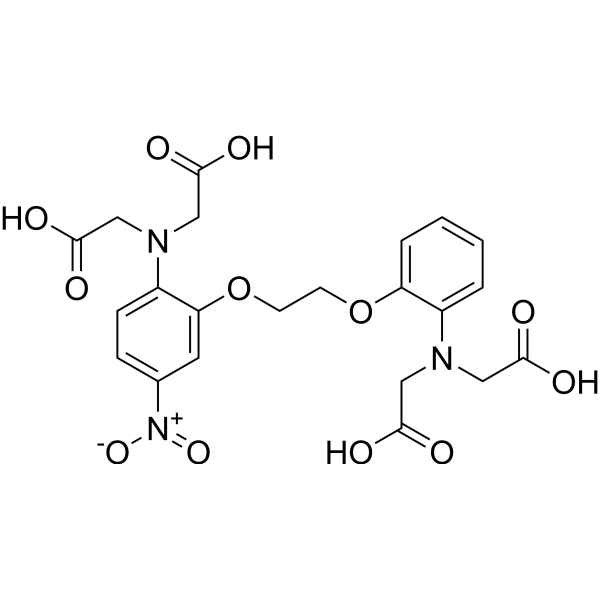
5-Nitro BAPTA
5-Nitro BAPTA is a calcium chelator, combinded with 2-Me-substituted TM ( as a fluorescent moiety), can be used to form a red fluorescent probe (CaTM-2 AM), for imaging of cytoplasmic Ca2+ in cultured living cells. 5-Nitro BAPTA is a building block used in the synthesis of Ca2+ specific chelators, Ca2+ buffers, and fluorescent Ca2+ indicators.
商品は「研究用試薬」です。人や動物の医療用・臨床診断用・食品用の製品ではありません。
研究用途以外に使用した場合、当社は一切の責任を負いかねます。
- CAS 番号: 124251-83-8
- 分子式: C22H23N3O12
- 分子量:521.43
-
保管条件:
Please store the product under the recommended conditions in the Certificate of Analysis.

To place orders, for customer services and technical support, please contact: MedChemExpress USA
Tel: 609-228-6898 E-mail: [email protected] [email protected]


-
 生物活性
生物活性
-
化学情報
- プロトコル
- 純度とドキュメンテーション
- 参考文献
-
 Help & FAQs




生物活性
製品説明
体外実験
Guide (The following is our recommended protocol. This protocol is only a guide and should be modified according to your specific needs).
5-Nitro BAPTA, designed to a red fluorescent probe for cytoplasmic Ca2+ with strong emission in the long-wavelength region[1].
General procedure for fluorescence imaging of cultured Hela cells[1]:
1.Plate cells onto a 35-mm poly-L-lysinecoated glass-bottomed dish (Matsunami) in DMEM supplemented with 10% (v/v) fetal bovine serum, 1% penicillin and 1% streptomycin.
2. Remove DMEM, wash the dish with HBSS 3 times, and then add CaTM-2 AM (3 μM) in Hanks’ Balanced Salt Solution (HBSS) containing 0.3% DMSO as a cosolvent.
3. Incubate at 37°C for 30 min, remove medium and wash dishes with HBSS 3 times. The cells can be observed in HBSS.
4. Capture fluorescence images with excitation and emission wavelength of 590/610-680 nm.
General procedure for fluorescence imaging of slices[1]:
1. Incubate slide cultures with 2 mL dye solution at 37 oC for 40 min. The dye solution is artificial cerebrospinal fluid (aCSF) containing 10 μM CaTM-2 AM, 0.01% Pluronic F-127, and 0.005% Cremophor EL. aCSF consisted of : 126 mM NaCl, 26 mM NaHCO3, 3.5 mM KCl, 1.24 mM NaH2PO4, 1.3 mM MgSO4, 1.2 mM CaCl2, and 10 glucose.
2. Wash slieds with aCSF three times and recover in 2 mL aCSF at 37 oC for 45 min, during which 2 μL of 1 mM Acridine orange was added to the aCSF at time 40 min.
3. Transferre slice cultures into a recording chamber heated at 35 oC and continuously perfused with aCSF at 2 mL/min.
4. Acqure images at 10 frames/s with a Nipkowdisk confocal unit (CSUX-1, Yokogawa Electric, Tokyo, Japan), cooled CCD camera (iXon DU897, Andor, Belfast, UK), a water-immersion objective lens (16×, 0. NA, Nikon, Tokyo, Japan), and image acquisition software (Solis, Andor Technology, Belfast, UK).
5. Set the excitation wavelength to 488 nm (7 mW) and 568 nm (15 mW) for Acridine orange and CaTM-2 with an argon-krypton laser (641-YB-A01; Melles Griot, Carlsbad, CA, USA) and set the emission wavelength to 520-535 nm and 617-673 nm band-pass emission filters, respectively.
6. Analysis data with custom-made software written in Microsoft Visual Basic.
7. Calculate fluorescence change ΔF/F as (Ft-F0)/F0, where Ft is the fluorescence intensity at frame time t, and F0 is the average baseline.
MedChemExpress (MCE) has not independently confirmed the accuracy of these methods. They are for reference only.


化学情報
-
CAS 番号 124251-83-8
-
分子量 521.43
-
分子式 C22H23N3O12
-
SMILES
O=C(O)CN(C1=CC=CC=C1OCCOC2=CC([N+]([O-])=O)=CC=C2N(CC(O)=O)CC(O)=O)CC(O)=O
-
輸送条件
Room temperature in continental US; may vary elsewhere.
-
保管条件
Please store the product under the recommended conditions in the Certificate of Analysis.


純度とドキュメンテーション
参考文献

Calculators
濃度 (開始) × 体積 (開始) = 濃度 (終了) × 体積 (終了)


5-Nitro BAPTA 関連分類
HY-D1636 関連分類
 Powered by Bioz