
Antituberculosis agent-2
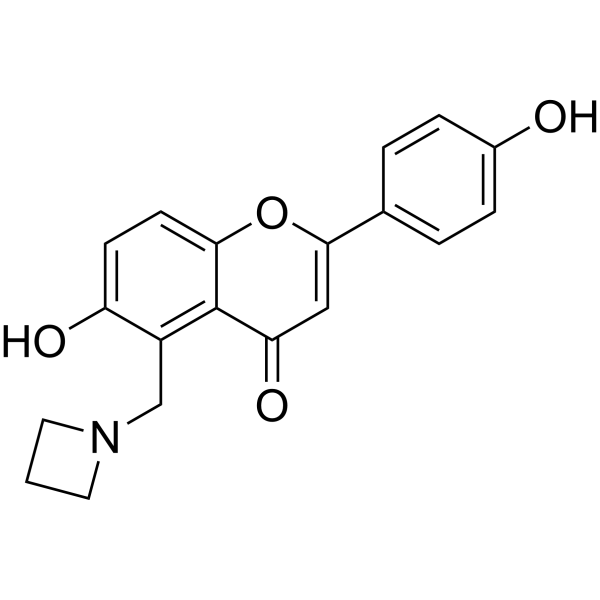
Antituberculosis agent-2 (Compound 8d) is an antituberculosis agent against agent-sensitive and multidrug-resistant tuberculosis. Antituberculosis agent-2 shows anti-tuberculosis activity with MIC values of 0.454, 1.757 and 1.644 μg/mL against M. tuberculosis H37Rv, 13946 and 14862, respectively. Antituberculosis agent-2 displays favorable mouse and human microsomal stability, low cytotoxicity, and acceptable oral bioavailability.
商品は「研究用試薬」です。人や動物の医療用・臨床診断用・食品用の製品ではありません。
研究用途以外に使用した場合、当社は一切の責任を負いかねます。
- CAS 番号: 2411741-01-8
- 分子式: C19H17NO4
- 分子量:323.34
-
保管条件:
Please store the product under the recommended conditions in the Certificate of Analysis.
生物活性
製品説明
Cellular Effect
|
Cell Line
|
Type | Value | Description | References |
|---|---|---|---|---|
| Vero | IC50 |
53.1 μg/mL
Compound: 8d
|
Cytotoxicity against African green monkey Vero cells assessed as reduction in cell viability
|
[PMID: 31986405] |
化学情報
-
CAS 番号 2411741-01-8
-
分子量 323.34
-
分子式 C19H17NO4
-
SMILES
O=C1C=C(C2=CC=C(O)C=C2)OC3=CC=C(O)C(CN4CCC4)=C13
-
輸送条件
Room temperature in continental US; may vary elsewhere.
-
保管条件
Please store the product under the recommended conditions in the Certificate of Analysis.
プロトコル
-
Cell Cytotoxicity Assay
Cytotoxicity assays are usually based on the assessment of cell membrane damage, which can also be indirectly detected by measuring cell viability. Detection methods include MTT assay, CKK-8 assay, LDH assay and ATP assay, etc.
-
Mammalian live/dead viability and cytotoxicity staining
Live/dead viability and cytotoxicity staining assays are based on the simultaneous detection of intracellular esterase activity in metabolically active (viable) cells and membrane integrity loss in non-viable cells. In commonly used dual-staining approaches, membrane-permeant fluorogenic substrates are converted by intracellular esterases into fluorescent products in live cells, while impermeant DNA-binding dyes selectively enter cells with compromised plasma membranes and label nucleic acids in dead or dying cells, enabling discrimination between viable and non-viable populations by fluorescence microscopy or flow cytometry.
-
Protocol for Pharmacokinetic Study
Pharmacokinetic studies quantify how an organism handles a drug over time through absorption, distribution, metabolism, and excretion, and the core experimental readout is the concentration-time profile of parent drug and, when relevant, metabolites in biological matrices such as plasma, whole blood, urine, bile, or tissue. Pharmacokinetic analysis links dose, route, exposure, clearance, half-life, distribution, bioavailability, and systemic exposure to drug efficacy and toxicity hypotheses rather than measuring a signaling pathway directly. The literature links pharmacokinetics to drug-development phenotypes by showing that drug metabolism and pharmacokinetics influence compound progression, exposure-response interpretation, safety margins, dosing strategy, and failure risk during discovery and development. DMPK science contributes to compound optimization by integrating physicochemical properties, in vitro metabolism, transporter behavior, in vivo exposure, and pharmacodynamic contex
-
Cell Viability Determination by MTT Colorimetric Assay
The following protocol uses the MTT colorimetric assay as a classic literature-established method for assessing cell viability/metabolic activity in cultured mammalian cells. MTT[3-(4,5-dimethylthiazol-2-yl)-2,5-diphenyltetrazolium bromide] is reduced by metabolically active cells to a colored formazan product; the amount of formazan is quantified spectrophotometrically and provides an indirect measure of metabolically active viable cells. Importantly, MTT reduction reflects cellular oxidoreductase/metabolic activity rather than an absolute direct count of living cells, so changes in cellular metabolism can alter the signal independently of cell number.
純度とドキュメンテーション
参考文献
Calculators
濃度 (開始) × 体積 (開始) = 濃度 (終了) × 体積 (終了)

