



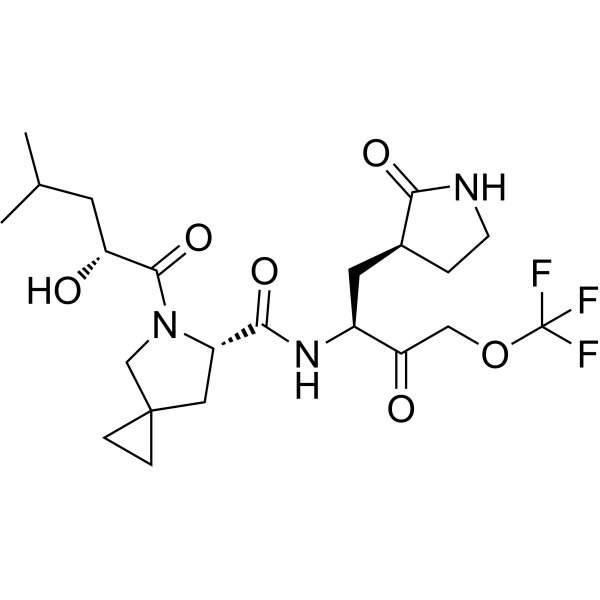
CMX990

Based on 1 Customer Validation
CMX990 is a SARS-CoV-2 3CL protease inhibitor. The EC90s for inhibiting SARS-CoV-2 were 9.6 nM and 101 nM in human bronchial epithelial cells (HBECs) and HeLa-ACE2 cells, respectively. CMX990 has good ADME and pharmacokinetic properties.
商品は「研究用試薬」です。人や動物の医療用・臨床診断用・食品用の製品ではありません。
研究用途以外に使用した場合、当社は一切の責任を負いかねます。
- 純度 : 96.63%
- CAS 番号: 2882934-64-5
- 分子式: C22H32F3N3O6
- 分子量:491.50
-
保管条件:Powder -20°C, 3 years , 4°C, 2 years ; In solvent -80°C, 6 months , -20°C, 1 month

To place orders, for customer services and technical support, please contact: MedChemExpress USA
Tel: 609-228-6898 E-mail: [email protected] [email protected]


-
 生物活性
生物活性
-
化学情報
- プロトコル
- 純度とドキュメンテーション
- 参考文献
-
 Help & FAQs




生物活性
製品説明
IC50 & Target
SARS-CoV-2[1]
Cellular Effect
|
Cell Line

|
Type | Value | Description | References |
|---|---|---|---|---|
| Epithelial cell | EC50 |
5.3 nM
Compound: CMX990
|
Antiviral activity against SARS-CoV-2 infected in human Primary bronchial epithelial cell assessed as inhibition of viral growth
Antiviral activity against SARS-CoV-2 infected in human Primary bronchial epithelial cell assessed as inhibition of viral growth
|
[PMID: 38335279] |
| HCT-8 | CC50 |
>30 μM
Compound: CMX990
|
Cytotoxicity against human HCT-8 cells incubated for 120 hrs by Cell-Titer Glo assay
Cytotoxicity against human HCT-8 cells incubated for 120 hrs by Cell-Titer Glo assay
|
[PMID: 38335279] |
| HeLa | CC50 |
>40 μM
Compound: CMX990
|
Cytotoxicity against human HeLa cells expressing ACE2 incubated for 120 hrs by Cell-Titer Glo assay
Cytotoxicity against human HeLa cells expressing ACE2 incubated for 120 hrs by Cell-Titer Glo assay
|
[PMID: 38335279] |
| MRC5 | CC50 |
>30 μM
Compound: CMX990
|
Cytotoxicity against human MRC5 cells incubated for 120 hrs by Cell-Titer Glo assay
Cytotoxicity against human MRC5 cells incubated for 120 hrs by Cell-Titer Glo assay
|
[PMID: 38335279] |


化学情報
-
CAS 番号 2882934-64-5
-
性状 Solid
-
分子量 491.50
-
分子式 C22H32F3N3O6
-
Color White to off-white
-
SMILES
O=C(N[C@H](C(COC(F)(F)F)=O)C[C@@H]1CCNC1=O)[C@@H]2CC3(CC3)CN2C([C@H](O)CC(C)C)=O
-
輸送条件
Room temperature in continental US; may vary elsewhere.
-
保管条件
Powder -20°C 3 years 4°C 2 years In solvent -80°C 6 months -20°C 1 month

プロトコル
-
Protocol for Pharmacokinetic Study
Pharmacokinetic studies quantify how an organism handles a drug over time through absorption, distribution, metabolism, and excretion, and the core experimental readout is the concentration-time profile of parent drug and, when relevant, metabolites in biological matrices such as plasma, whole blood, urine, bile, or tissue. Pharmacokinetic analysis links dose, route, exposure, clearance, half-life, distribution, bioavailability, and systemic exposure to drug efficacy and toxicity hypotheses rather than measuring a signaling pathway directly. The literature links pharmacokinetics to drug-development phenotypes by showing that drug metabolism and pharmacokinetics influence compound progression, exposure-response interpretation, safety margins, dosing strategy, and failure risk during discovery and development. DMPK science contributes to compound optimization by integrating physicochemical properties, in vitro metabolism, transporter behavior, in vivo exposure, and pharmacodynamic contex


純度とドキュメンテーション
-
データシート (270 KB)
-
SDS (252 KB)
- English - EN (252 KB)
- Français - FR (252 KB)
- Deutsch - DE (252 KB)
- Norwegian - NO (252 KB)
- Español - ES (252 KB)
- Swedish - SV (252 KB)
- Italian - IT (252 KB)
- Korean - KR (252 KB)
- Portuguese - PT (252 KB)
-
取扱説明書 (2659 KB)
参考文献

Calculators
濃度 (開始) × 体積 (開始) = 濃度 (終了) × 体積 (終了)


CMX990 関連分類
HY-149767 関連分類
 Powered by Bioz