



コハク酸ジエチル
Based on 5 publication(s) in Google Scholar
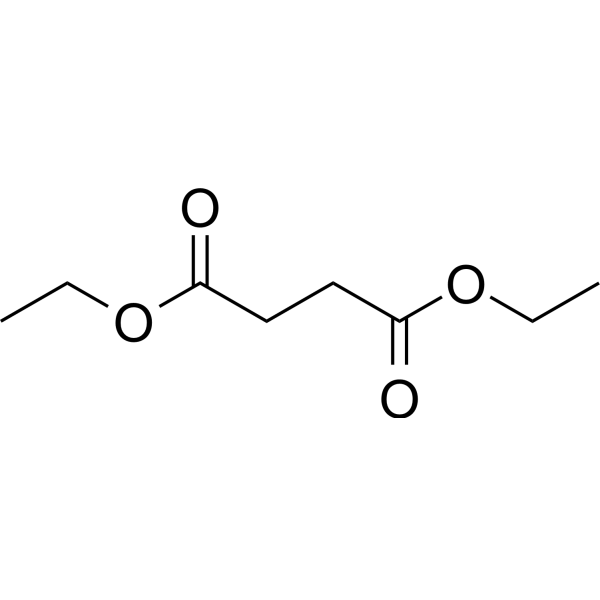
Diethyl succinate (Diethyl Butanedioate) can be utilized at physiological pH, allowing it to penetrate biological membranes and integrate into the cells of tissue cultures, where it is metabolized via the tricarboxylic acid cycle. Diethyl succinate modulates the polarization and activation of microglial cells by reducing mitochondrial fission and the levels of reactive oxygen species (ROS), thereby exerting an inflammatory protective effect in primary microglial cells. Furthermore, Diethyl succinate is non-toxic and can be used in flavorings and seasonings.
商品は「研究用試薬」です。人や動物の医療用・臨床診断用・食品用の製品ではありません。
研究用途以外に使用した場合、当社は一切の責任を負いかねます。
- 純度: 98.0%
- CAS 番号: 123-25-1
- 分子式: C8H14O4
- 分子量:174.19
-
保管条件:Pure form -20°C, 3 years , 4°C, 2 years ; In solvent -80°C, 6 months , -20°C, 1 month

To place orders, for customer services and technical support, please contact: MedChemExpress USA
Tel: 609-228-6898 E-mail: [email protected] [email protected]


-
 生物活性
生物活性
-
化学情報
-
溶剤 & 溶解度
- 純度とドキュメンテーション
- 参考文献
-
 Help & FAQs




MedChemExpress(MCE)の使用を引用している文献 Diethyl succinate
More Customer Validation & Images

-
Cell Proliferation/Viability Assay
-
Bio/Physico-chemical Assay
-
Bio/Physico-chemical Assay


生物活性
Diethyl succinate (5 mM; 3 h) reduces ROS production in primary microglia[2]. Diethyl succinate (0-10 mM; 0.25-3 h) induces decreased mitochondrial fission in primary microglia[2].
MedChemExpress (MCE) has not independently confirmed the accuracy of these methods. They are for reference only.
-
Cell Line:Primary microglia
-
Concentration:0, 0.2, 0.5, 1, 5 and 10 mM
-
Incubation Time:0.25, 1 and 3 h
-
Result:Increased phosphorylation of DRP1 at S637.


化学情報
-
CAS 番号 123-25-1
-
性状 Liquid (Density: 1.047 g/cm3)
-
分子量 174.19
-
分子式 C8H14O4
-
Color Colorless to light yellow
-
SMILES
O=C(OCC)CCC(OCC)=O
-
別名
Diethyl succinate; Diethyl Butanedioate
-
Structure Classification
-
Initial Source
-
輸送条件
Room temperature in continental US; may vary elsewhere.
-
保管条件
Pure form -20°C 3 years 4°C 2 years In solvent -80°C 6 months -20°C 1 month


Publications (5)
-
Journal Impact Factor
-
Most Recent
-
Mol Cell
Accumulation of succinate suppresses de novo purine synthesis through succinylation-mediated control of the mitochondrial folate cycle. [Abstract]2025 Oct 28:S1097-2765(25)00819-6. PMID: 41161310
Diethyl succinate purchased from MedChemExpress. Usage Cited in: Mol Cell. 2025 Oct 28:S1097-2765(25)00819-6. [Abstract]
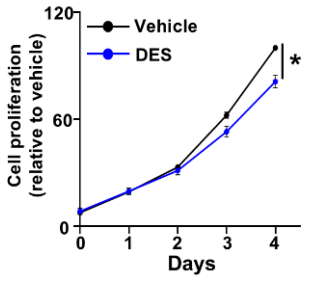
HeLa cells treated with either vehicle (ethanol) or Diethyl succinate (DES, 3 mM) were monitored for proliferation over 4 days. Prolonged exposure to DES significantly impaired proliferation, highlighting that chronic succinate accumulation negatively impacts cell growth.
Diethyl succinate purchased from MedChemExpress. Usage Cited in: Mol Cell. 2025 Oct 28:S1097-2765(25)00819-6. [Abstract]
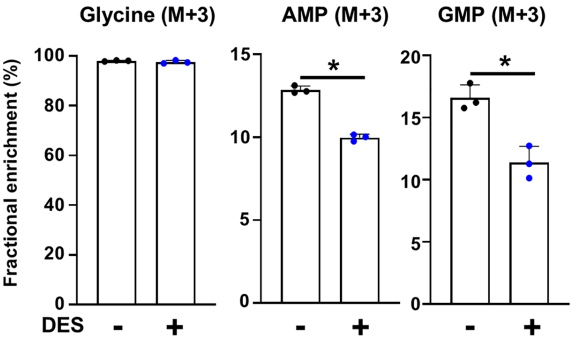
Fractional enrichment (%) of the indicated isotopologues from HeLa cells labeled with [15N-13C2]-glycine for 4 h in the presence or absence of exogenous cell-permeable succinate (Diethyl succinate [DES]). Stable isotope tracing using [[15N-13C2]-glycine revealed a marked decrease in labeled purine nucleotides, including AMP (M+3) and GMP (M+3), following DES treatment.
Diethyl succinate purchased from MedChemExpress. Usage Cited in: Mol Cell. 2025 Oct 28:S1097-2765(25)00819-6. [Abstract]
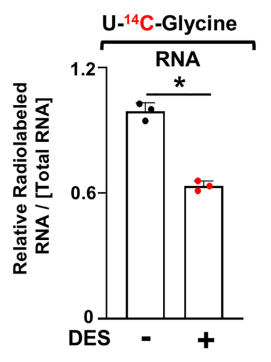
The relative levels of incorporation of [14C] into RNA are shown. HeLa cells were treated with either vehicle or Diethyl succinate (DES, 5 mM) for 8 h. DES treatment decreased the incorporation of [14C] from glycine into RNA.
-
-
Cell Death Differ
2024 Aug;31(8):983-998. PMID: 38719928 -
Aging Cell
Aging Impairs Macrophage Phagocytosis Through Mitochondrial ROS-Induced Collagen Production. [Abstract]2026 Jun;25(6):e70594. PMID: 42298889 -
Commun Biol
SIRT5-mediated desuccinylation of MTHFD2 enhances chemoresistance in breast cancer cells by reducing therapy-induced senescence. [Abstract]2025 Oct 20;8(1):1485. PMID: 41116031


溶剤 & 溶解度
DMSO : ≥ 250 mg/mL (1435.21 mM; Hygroscopic DMSO has a significant impact on the solubility of product, please use newly opened DMSO)
* "≥" means soluble, but saturation unknown.
Please refer to the solubility information to select the appropriate solvent. Once prepared, please aliquot and store the solution to prevent product inactivation from repeated freeze-thaw cycles.
Storage method and period of stock solution: -80°C, 6 months; -20°C, 1 month. When stored at -80°C, please use it within 6 months. When stored at -20°C, please use it within 1 month.
Please refer to the solubility information to select the appropriate solvent. Once prepared, please aliquot and store the solution to prevent product inactivation from repeated freeze-thaw cycles.
Storage method and period of stock solution: -80°C, 6 months; -20°C, 1 month. When stored at -80°C, please use it within 6 months. When stored at -20°C, please use it within 1 month.
濃度 (開始) × 体積 (開始) = 濃度 (終了) × 体積 (終了)
Select the appropriate dissolution method based on your experimental animal and administration route.
- For the following dissolution methods, please ensure to first prepare a clear stock solution using an In Vitro approach and then sequentially add co-solvents:
- To ensure reliable experimental results, the clarified stock solution can be appropriately stored based on storage conditions. As for the working solution for In Vivo experiments, it is recommended to prepare freshly and use it on the same day.
- The percentages shown for the solvents indicate their volumetric ratio in the final prepared solution. If precipitation or phase separation occurs during preparation, heat and/or sonication can be used to aid dissolution.
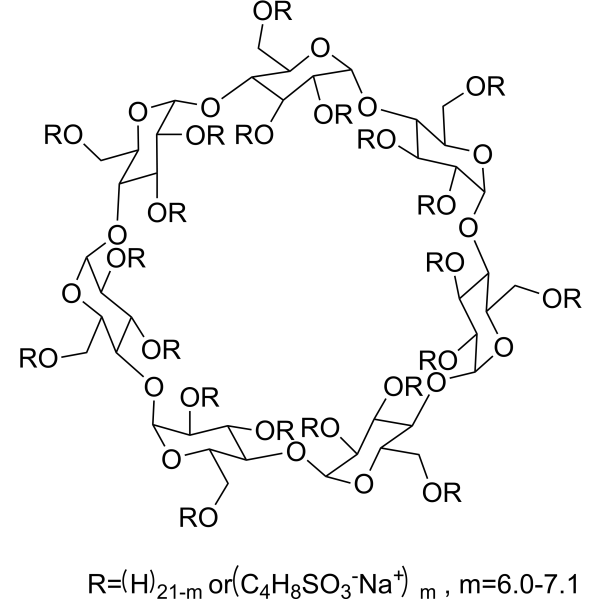
Add each solvent one by one: 10% DMSO 90% (20% SBE-β-CD in Saline)
Solubility: ≥ 2.08 mg/mL (11.94 mM); Clear solution
This protocol yields a clear solution of ≥ 2.08 mg/mL (saturation unknown).
Taking 1 mL working solution as an example, add 100 μL DMSO stock solution (20.8 mg/mL) to 900 μL 20% SBE-β-CD in Saline, and mix evenly.
Preparation of 20% SBE-β-CD in Saline (4°C, storage for one week): 2 g SBE-β-CD powder is dissolved in 10 mL Saline, completely dissolve until clear.
Please enter the basic information of animal experiments:
-
-
-
-
Recommended: Prepare an additional quantity of animals to account for potential losses during experiments.
Please enter your animal formula composition:
-
%DMSO +
Recommended: Keep the proportion of DMSO in working solution below 2% if your animal is weak.
-
%+
-
+%Tween-80 + +
-
%Saline +
The co-solvents required include: DMSO, . All of co-solvents are available by MedChemExpress (MCE). , Tween 80. All of co-solvents are available by MedChemExpress (MCE).
Working solution concentration: 0.22 mg/mL
Method for preparing stock solution: mg drug dissolved in μL DMSO. Stock solution concentration: mg/mL.
1. Take μL DMSO stock solution;
2. Add μL .
μL , mix evenly;
3. Then add μL Tween 80, mix evenly;
4. Then add μL
Please ensure that the stock solution in the first step is dissolved to a clear state, and add co-solvents in sequence. You can use ultrasonic heating (ultrasonic cleaner, recommended frequency 20-40 kHz), vortexing, etc. to assist dissolution.


純度とドキュメンテーション
-
データシート (276 KB)
-
SDS (393 KB)
- English - EN (393 KB)
- Français - FR (393 KB)
- Deutsch - DE (393 KB)
- Norwegian - NO (393 KB)
- Español - ES (393 KB)
- Swedish - SV (393 KB)
- Italian - IT (393 KB)
- Korean - KR (393 KB)
- Portuguese - PT (393 KB)
-
取扱説明書 (2659 KB)
参考文献
[1]. Zacharias NM, et al. Real-time molecular imaging of tricarboxylic acid cycle metabolism in vivo by hyperpolarized 1-(13)C diethyl succinate. J Am Chem Soc. 2012 Jan 18;134(2):934-43. [Content Brief]
[2]. Lixiang Wang, et al. "Diethyl succinate modulates microglial polarization and activation by reducing mitochondrial fission and cellular ROS." Metabolites 11.12 (2021): 854. [Content Brief]


Complete Stock Solution Preparation Table
Please refer to the solubility information to select the appropriate solvent. Once prepared, please aliquot and store the solution to prevent product inactivation from repeated freeze-thaw cycles.
Storage method and period of stock solution: -80°C, 6 months; -20°C, 1 month. When stored at -80°C, please use it within 6 months. When stored at -20°C, please use it within 1 month.
| Optional Solvent | Concentration Solvent Mass | 1 mg | 5 mg | 10 mg | 25 mg |
|---|---|---|---|---|---|
| DMSO | 1 mM | 5.7409 mL | 28.7043 mL | 57.4086 mL | 143.5214 mL |
| 5 mM | 1.1482 mL | 5.7409 mL | 11.4817 mL | 28.7043 mL | |
| 10 mM | 0.5741 mL | 2.8704 mL | 5.7409 mL | 14.3521 mL | |
| 15 mM | 0.3827 mL | 1.9136 mL | 3.8272 mL | 9.5681 mL | |
| 20 mM | 0.2870 mL | 1.4352 mL | 2.8704 mL | 7.1761 mL | |
| 25 mM | 0.2296 mL | 1.1482 mL | 2.2963 mL | 5.7409 mL | |
| 30 mM | 0.1914 mL | 0.9568 mL | 1.9136 mL | 4.7840 mL | |
| 40 mM | 0.1435 mL | 0.7176 mL | 1.4352 mL | 3.5880 mL | |
| 50 mM | 0.1148 mL | 0.5741 mL | 1.1482 mL | 2.8704 mL | |
| 60 mM | 0.0957 mL | 0.4784 mL | 0.9568 mL | 2.3920 mL | |
| 80 mM | 0.0718 mL | 0.3588 mL | 0.7176 mL | 1.7940 mL | |
| 100 mM | 0.0574 mL | 0.2870 mL | 0.5741 mL | 1.4352 mL |


Diethyl succinate 関連分類
HY-Y0836 関連分類
 Powered by Bioz