



Ferric oxide, red
Ferric oxide, red can be used as an excipient, such as colorant. Pharmaceutical excipients, or pharmaceutical auxiliaries, refer to other chemical substances used in the pharmaceutical process other than pharmaceutical ingredients. Pharmaceutical excipients generally refer to inactive ingredients in pharmaceutical preparations, which can improve the stability, solubility and processability of pharmaceutical preparations. Pharmaceutical excipients also affect the absorption, distribution, metabolism, and elimination (ADME) processes of co-administered drugs.
商品は「研究用試薬」です。人や動物の医療用・臨床診断用・食品用の製品ではありません。
研究用途以外に使用した場合、当社は一切の責任を負いかねます。
- CAS 番号: 1309-37-1
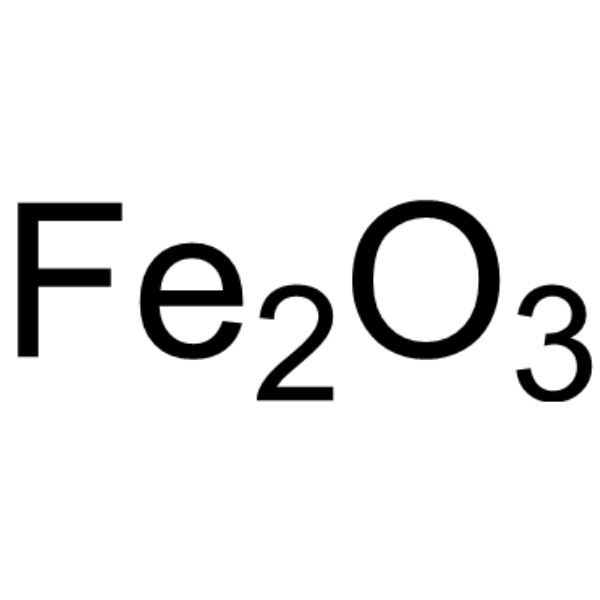
- 分子式: Fe2O3
- 分子量:159.69
-
保管条件:
Please store the product under the recommended conditions in the Certificate of Analysis.

To place orders, for customer services and technical support, please contact: MedChemExpress USA
Tel: 609-228-6898 E-mail: [email protected] [email protected]


-
 生物活性
生物活性
-
化学情報
- プロトコル
- 純度とドキュメンテーション
- 参考文献
-
 Help & FAQs


-
HY-W051271
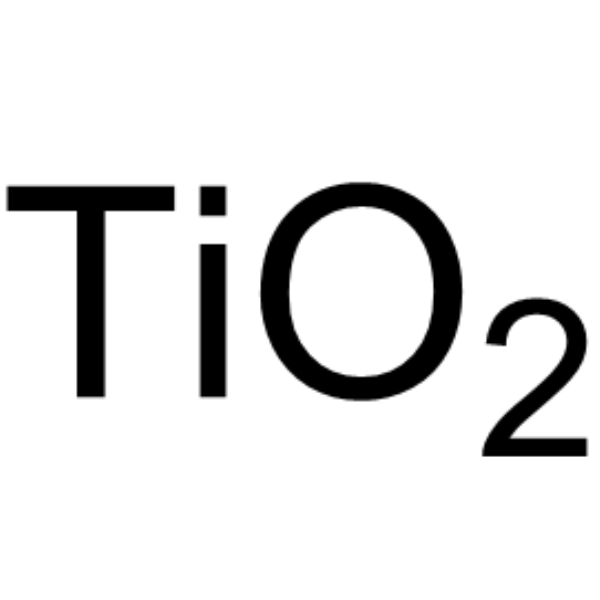
Titanium(IV) oxidePhotocatalyst -

HY-W116336B
Zinc oxide, 99.99% metals basisBiochemical Assay Reagents -

HY-W116336D
Zinc oxide, <100 nm particle sizeNitrate Reductase Activator -

HY-Y0498
Aluminum oxideAdjuvant -

HY-W075770
Nickel(II) oxideAntibacterial Agent -

HY-W111403
Calcium oxideHeterogeneous Base Catalyst -

HY-Y1213
CarbonPharmaceutical Excipient -

HY-Y0481A
Tin(II) chloride dihydrateBiochemical Assay Reagents


生物活性
製品説明
体外実験
Ferric oxide, red can be isolated from hematite ore and rust[2][3].
Ferric oxide, red is a coloring agent for tablets and capsules and is used in the pharmaceutical industry[2][3].
MedChemExpress (MCE) has not independently confirmed the accuracy of these methods. They are for reference only. Further protocols information, click here.


化学情報
-
CAS 番号 1309-37-1
-
分子量 159.69
-
分子式 Fe2O3
-
SMILES
[Fe][Fe](=O)(=O)=O
-
輸送条件
Room temperature in continental US; may vary elsewhere.
-
保管条件
Please store the product under the recommended conditions in the Certificate of Analysis.

プロトコル
-
Protocol for Pharmacokinetic Study
Pharmacokinetic studies quantify how an organism handles a drug over time through absorption, distribution, metabolism, and excretion, and the core experimental readout is the concentration-time profile of parent drug and, when relevant, metabolites in biological matrices such as plasma, whole blood, urine, bile, or tissue. Pharmacokinetic analysis links dose, route, exposure, clearance, half-life, distribution, bioavailability, and systemic exposure to drug efficacy and toxicity hypotheses rather than measuring a signaling pathway directly. The literature links pharmacokinetics to drug-development phenotypes by showing that drug metabolism and pharmacokinetics influence compound progression, exposure-response interpretation, safety margins, dosing strategy, and failure risk during discovery and development. DMPK science contributes to compound optimization by integrating physicochemical properties, in vitro metabolism, transporter behavior, in vivo exposure, and pharmacodynamic contex


純度とドキュメンテーション
参考文献
[1]. Elder DP, et al. Pharmaceutical excipients - quality, regulatory and biopharmaceutical considerations. Eur J Pharm Sci. 2016 May 25;87:88-99. [Content Brief]
[2]. Color Additives: FDA's Regulatory Process and Historical Perspectives. FoodSafety. October 1, 2003.
[3]. Overview of pharmaceutical excipients used in tablets and capsules. Drug Topics. October 24, 2008.

Calculators
濃度 (開始) × 体積 (開始) = 濃度 (終了) × 体積 (終了)


Ferric oxide, red 関連分類
HY-154696A 関連分類
 Powered by Bioz